
How hard is San Antonio water? SAWS states it typically runs 15 to 20 grains per gallon, which converts to roughly 257 to 342 ppm as calcium carbonate. The U.S. Geological Survey already calls anything above 180 mg/L “very hard,” so we sit about 1.4 to 1.9 times past that threshold — among the hardest municipal water in the country.
- SAWS reports San Antonio water at 15 to 20 grains per gallon — roughly 257 to 342 ppm as calcium carbonate.
- The U.S. Geological Survey calls anything above 180 mg/L “very hard.” San Antonio sits about 1.4 to 1.9 times past that threshold.
- That puts the city among the hardest municipal water in the country. Here, hardness is the baseline condition every appliance lives with, not an occasional complaint.
Every plumber, water treatment salesperson and neighbour with an opinion will tell you the water here is hard. Few of them give you a number, and the ones who do usually have a system to sell you five minutes later.
So this post answers how hard is San Antonio water with a published figure, names the public document it comes from, and shows you how to check it without taking anyone’s word for it — including ours.
It also settles two things national articles get wrong here. The figure you want is absent from the annual water quality report people are told to consult, and San Antonio disinfects with free chlorine rather than chloramine, which changes what equipment belongs on your incoming line.
How Hard Is San Antonio Water? The Number SAWS Publishes
The utility answers how hard is San Antonio water on its own water quality page: what it delivers typically runs 15 to 20 grains per gallon. That is SAWS describing its own product, not a contractor estimating, and it is the figure worth anchoring to.
Hardness is the dissolved calcium and magnesium in water, expressed as calcium carbonate. Two units get used interchangeably, which causes confusion when you compare quotes. Softener technicians and equipment dials use grains per gallon. Laboratories and agencies use milligrams per litre, written as ppm. One grain per gallon equals 17.1 mg/L — the conversion you need when one quote answers how hard is San Antonio water in grains and the next answers in ppm.
The answer to how hard is San Antonio water is geology, not treatment. SAWS draws mainly from the Edwards and Trinity aquifers, which move water through limestone, and limestone is calcium carbonate. Water picks up calcium and magnesium the whole way, and nothing at the utility removes it, because hardness is not a health contaminant.
| Measure | SAWS typical range | “Very hard” begins at | Where the figure comes from |
|---|---|---|---|
| Grains per gallon (gpg) | 15 – 20 | 10.5 | SAWS water quality FAQ; USGS band converted to grains. |
| Milligrams per litre (ppm as CaCO3) | 257 – 342 | 180 | Converted at 17.1 mg/L per grain; USGS classification. |
| Multiple of the very-hard threshold | 1.4× – 1.9× | 1.0× | Calculated from the two rows above. |
| Disinfectant in the distribution system | Free chlorine | — | SAWS annual water quality reports, all systems. |
Hardness range is SAWS’s own published figure; the ppm column is arithmetic on it, not a separate measurement. Bands are the USGS classification.
Where 15 to 20 Grains Sits on the National Scale
Ask how hard is San Antonio water against the national picture and the USGS scale answers it, though the top band is open-ended. Soft is below 60 mg/L, moderately hard to 120, hard to 180, very hard above that. Nothing sits above “very hard,” so a city at 190 mg/L and one at 340 mg/L get the same two words for very different problems.
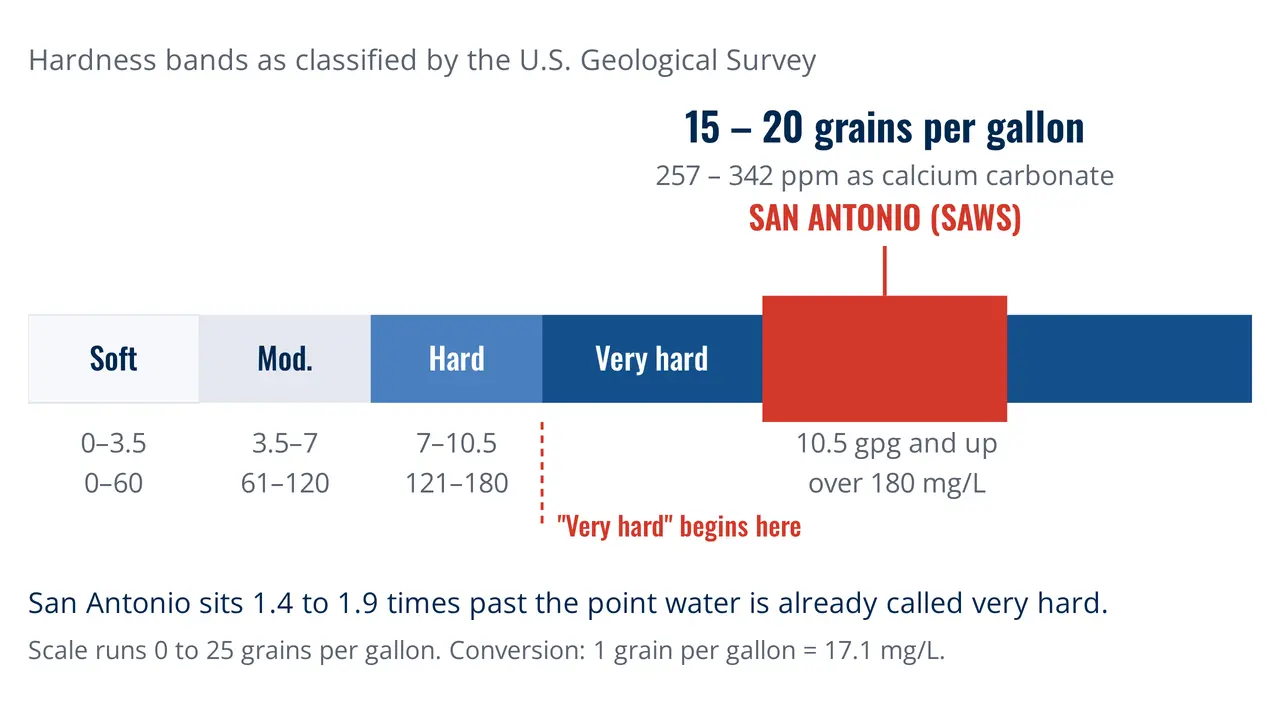
Every extra grain past that line still works on your pipes, fixtures and appliances. The gap between 11 grains and 18 is not academic. It is roughly a 60 percent increase in mineral load through your water heater daily, which is what how hard is San Antonio water costs you in one appliance.
Why You Will Not Find Hardness in Your Annual Water Report
Here is the part that trips people up. If you go looking for the answer to how hard is San Antonio water in the annual water quality report SAWS mails out, it is not there — not in a footnote, not in an appendix. The reports do not include it.
There is a legitimate reason. Federal rules target contaminants with health effects, and hardness is not one. Calcium, magnesium, sodium, total dissolved solids and alkalinity are secondary constituents regulated by the state rather than the EPA, so utilities need not report them. SAWS points people to Texas Drinking Water Watch instead.
So the public answer to how hard is San Antonio water lives on the utility’s FAQ page, not the formal report. That is the citation to use, and the one to ask a salesperson for if they quote something higher. If someone says 30 grains, they are testing a private well or they want you nervous.
A free in-home water test is a sales tool as often as a diagnostic. See the result yourself, in grains per gallon, and check it against the published SAWS range before signing anything. If a technician’s answer to how hard is San Antonio water lands well outside 15 to 20 grains on city water, ask them to explain why.
Six Water Systems, One City
How hard is San Antonio water also depends a little on where you live, because SAWS is not one network. It publishes separate annual reports for six systems: the Main System, Castle Hills, Geronimo Forest, Mountain Laurel, Northeast and Texas Research Park, each with its own source blend.
The Main System alone draws on the Edwards, Carrizo, Simsboro, Trinity and Wilcox aquifers, surface water from Canyon Lake, and water purchased from regional suppliers. Those are not chemically identical. Vista Ridge and Schertz-Seguin groundwater shows disinfection by-products near zero, while Guadalupe-Blanco River Authority surface water runs much higher. Compliant, but the blend genuinely varies.
What SAWS does not publish is hardness by source, and I will not invent one. No public table shows Edwards water at one figure and Carrizo at another. So the honest answer to how hard is San Antonio water on your street is that the system-wide range is 15 to 20 grains, your tap sits somewhere in it, and only a test places it.
Chlorine, Not Chloramine, and Why That Matters
Most national softener guidance assumes your utility disinfects with chloramine, because many large systems do. SAWS does not. Its annual reports record free chlorine residual across every system it monitors, averaging roughly 1.4 to 2.3 ppm depending on the source. Chloramine does not appear in them at all.
That matters for equipment. Free chlorine is an aggressive oxidiser that attacks the polystyrene resin beads inside a conventional softener, fracturing them until the bed loses capacity.
That is why resin here lasts ten to fifteen years rather than indefinitely, why carbon pre-filtration ahead of the softener is a genuine upgrade rather than an upsell, and why higher-crosslink resin is worth asking about when you compare quotes for a whole-house water softener installation. Anyone answering how hard is San Antonio water without mentioning the disinfectant is giving you half the picture.
If a salesperson pitches a chloramine-specific cartridge for a San Antonio address, ask which water system they think you are on, because how hard is San Antonio water is only half the specification.
What 15 to 20 Grains Actually Costs a Household
Hardness does not make you sick. It is a nuisance constituent, which is why the EPA sets no enforceable limit. It costs you money slowly, in places you do not connect back to the water — the practical reason how hard is San Antonio water is worth answering at all.
| Where you see it | What is actually happening | What it costs |
|---|---|---|
| Popping or rumbling water heater | Calcium settling on the tank bottom, insulating the burner. | Shorter tank life, higher energy use. |
| White crust on fixtures and glass | Minerals left behind as water evaporates. | Etched glass and pitted chrome that does not clean off. |
| Weak shower flow within a few years | Scale narrowing aerators and shower heads. | Replacement fixtures, usually blamed on pressure. |
| Soap and shampoo that will not lather | Calcium and magnesium bind with soap instead of foaming. | More detergent per load and per wash. |
| Stiff towels and greying whites | Mineral residue trapped in the fibres. | Linens replaced years early. |
| Dishwasher and ice maker failures | Scale on heating elements, valves and small orifices. | Repairs and early appliance replacement. |
The money concentrates in the water heater, the one appliance that heats hard water and so drives minerals onto metal. That mechanism is covered in what 15 to 20 grain water does to a water heater, and it is the strongest financial argument for treatment here. If you are already shopping for water heater replacement or repair, decide about softening now, not in two years.
What people complain about first is usually personal rather than mechanical. Tight skin after a shower and hair that will not behave come up on nearly every call, which is why hard water, skin and hair has its own post. The whole-system picture is in how hard water wears out a San Antonio home.
The pattern I see most is a homeowner who has replaced the same shower head three times in six years and blames cheap fixtures or street pressure. It is almost never either. Pull the aerator screen and it is packed with white scale, and the same deposit is building everywhere you cannot see, which is what how hard is San Antonio water looks like in practice. In Helotes and the Hill Country the same call comes in, except the water is often from a private well carrying iron as well.
Testing It Yourself in About Ten Minutes
You do not need a sales visit to settle how hard is San Antonio water at your own tap. There are four ways, in ascending order of confidence.
- Start with the published range.On SAWS city water, treat how hard is San Antonio water as 15 to 20 grains per gallon until something says otherwise. For sizing and rough planning that is enough.
- Buy a hardness test strip kit.A few dollars, reads in grains per gallon, thirty seconds at the tap. Run it on cold water after letting the line clear. Accurate enough to confirm you are in the expected band.
- Get a titration test if you are on a well.Strips are fine for city water but too coarse for wells, where you also need iron, manganese, hydrogen sulphide, nitrate and bacteria results. That is a laboratory job.
- Retest after any softener install.A treated tap should read at or near zero grains. If it does not, the system is undersized, out of salt, or set to the wrong hardness. The most useful check a homeowner can run.
On a private well around Helotes, Boerne, Bulverde or Bandera County you are drawing from the Trinity aquifer, so no SAWS figure applies and how hard is San Antonio water is the wrong question for your house. Hill Country well water is often hard and carrying iron, manganese or hydrogen sulphide, and order matters: a softener ahead of untreated iron will have its resin ruined. Sequencing is covered in our salt versus salt-free comparison.
Once how hard is San Antonio water is settled at your tap, the next questions are what system suits it and what the job involves. The permit rules here are unusual and are laid out in the water softener permit rules for this city, and the case for and against treatment is in do you need a water softener system.
If you would rather someone put a gauge on it and tell you straight, that is what our water softener service and installation visit is for; how we build a quote is on the pricing page.
Frequently Asked Questions
Is San Antonio water safe to drink even though it is this hard?
Yes. Hardness is a nuisance issue, not a health one, which is why the EPA sets no enforceable limit on it and classes calcium and magnesium as secondary constituents. SAWS water meets federal drinking water standards. What hardness damages is your plumbing, your appliances and your laundry, not you.
Why is hardness not listed in the SAWS water quality report?
Because it is not required to be. Annual consumer confidence reports cover regulated contaminants with health effects. Hardness, calcium, magnesium, sodium and total dissolved solids are secondary constituents regulated by the state rather than the EPA, so SAWS omits them and points readers to Texas Drinking Water Watch. The 15 to 20 grain figure appears on the utility’s water quality FAQ instead.
Does San Antonio use chlorine or chloramine?
Free chlorine. Every SAWS annual report records free chlorine residual rather than chloramine, averaging roughly 1.4 to 2.3 ppm depending on the source. This matters when you buy treatment equipment, because free chlorine degrades softener resin over time and makes carbon pre-filtration genuinely worthwhile here, while chloramine-specific products are solving a problem this city does not have.
Does hardness change depending on which part of San Antonio I live in?
It varies somewhat, because SAWS operates six separately reported water systems fed by different blends of aquifer, surface and purchased water. What does not exist is a published hardness figure broken out by source or neighbourhood. Treat 15 to 20 grains as the system-wide range and test your own tap if you want to know precisely where you fall.
How many grains per gallon is considered bad?
The USGS calls water very hard above 180 mg/L, which is about 10.5 grains per gallon, and there is no category above that. Most treatment professionals start recommending softening around 7 grains. Anyone asking how hard is San Antonio water is dealing with 15 to 20, so this is not a borderline case in any sense.
Does boiling water get rid of hardness?
Not usefully. Boiling drives some calcium carbonate out of solution, which is exactly why your kettle scales up, but the minerals end up on the kettle rather than gone, and magnesium hardness is largely unaffected. For household purposes the only real options are ion exchange softening, a conditioning system, or reverse osmosis at a single tap.
Want San Antonio plumbing answers from a local licensed plumber at the top of your results? Add Silverback as a preferred source.
Find Out What Your Tap Actually Reads
We will test your water in front of you, show you the reading in grains per gallon, and say honestly whether treatment is worth it. Sometimes a single under-sink filter solves what is actually bothering you.
Serving San Antonio, Helotes, Boerne, Bulverde, Schertz, Somerset and Stone Oak. Open 24/7.Sources
- SAWS Water Quality FAQs — the published 15 to 20 grains per gallon range.
- U.S. Geological Survey — Hardness of Water — the classification bands in mg/L.
- SAWS Water Quality Report archive — the six separately reported water systems.
- SAWS Main System Water Quality Report (PDF) — free chlorine residual figures and aquifer sources.
- EPA Secondary Drinking Water Standards — hardness constituents are non-enforceable guidelines.