

When a bill doubles and nothing about the household changed, the water is going somewhere, and a yard leak is the usual answer. In San Antonio that somewhere is very often underground — between the meter and the house, or out in the irrigation system, where a split line can run for months without ever surfacing. The ten-minute meter test below will tell you whether it is inside or outside before you call anyone.

The meter test you can run yourself
Before you call anyone, this takes ten minutes and tells you a great deal. It is the same first step we take.
- Turn off every water-using fixture and appliance in the house, including the ice maker and any irrigation controller.
- Find your water meter, usually in a box near the street.
- Look for the low-flow indicator — a small triangle, star or dial that turns on very low flow — and watch it for two minutes. Any movement means water is leaving the system.
- Write down the reading, wait an hour with everything still off, and read it again. The difference is your leak rate.
To narrow it further: close the main shutoff valve at the house and repeat. If the meter still moves, the yard leak sits between the meter and that valve, which means it is in the yard. If it stops, the yard leak is inside or under the house and becomes a different job.
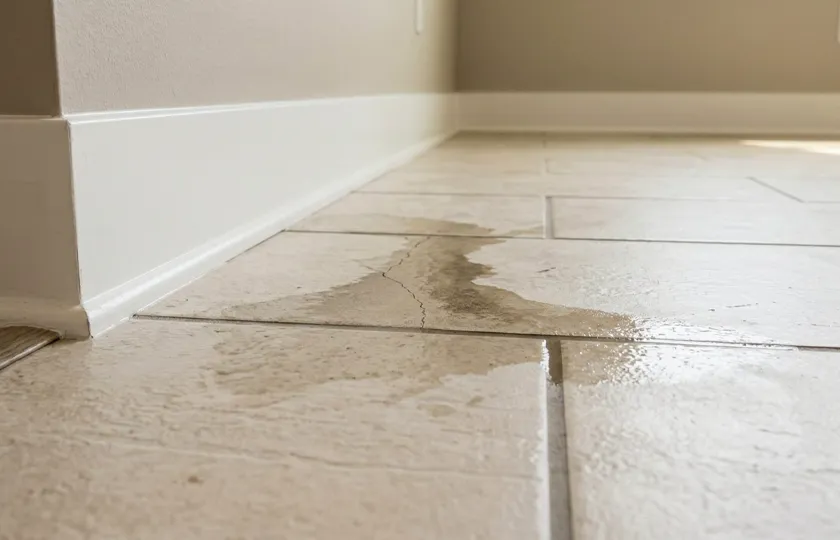
Signs it is outside rather than under the house
A patch that stays green
In an August with no rain, one area of lawn staying lush while everything around it browns is water arriving from below. The most reliable outdoor sign there is.
Soft or sunken ground
Soil that gives underfoot near the meter, along the service line, or beside a bed. Over time a yard leak washes out the soil structure and the surface settles.
The meter moves with everything off
The definitive test, and the one above. Movement means water is escaping somewhere between the meter and the house.
Pressure dropped everywhere at once
A leak large enough to bleed pressure shows at every fixture. If only one fixture is weak, that fixture is the problem.
Water at the curb or in the street
Seepage at the curb line often means the service line has failed near the meter. That portion is sometimes the utility’s responsibility, which is worth establishing before anyone starts.
Irrigation zones behaving oddly
A zone that never reaches full pressure, or heads that weep between cycles, points at the irrigation line rather than the potable supply.
How we pinpoint it without digging up the lawn
Finding the yard leak and fixing it are two separate problems, and the finding is where the money is saved. Excavating on a guess is how a small repair turns into landscape restoration.
| Method | What it is for |
|---|---|
| Acoustic listening | Pressurised water escaping a line makes a distinct sound that carries through soil and hard surfaces. Ground microphones narrow the location to within a small area. |
| Line tracing | Establishes where the pipe actually runs, which is frequently not where the plans or the homeowner expect. |
| Pressure isolation | Sections are isolated and tested in turn to work out which run is losing pressure, separating irrigation from potable supply. |
| Thermal imaging | Useful where a line runs under a driveway, patio or walkway and the temperature difference is readable at the surface. |
What is actually leaking out there
The line from your meter to the house is the water service, and what it is made of depends on when the house went in. Older San Antonio properties tend to have copper or galvanised steel; from the 1980s onward it is usually polyethylene, and newer work is PEX. Each fails in its own way, and each gives a yard leak a different character.
Copper corrodes from the outside where it sits in wet soil, and the failure is a pinhole that weeps for months before anyone notices. Galvanised rusts from the inside until a seam opens. Polyethylene rarely fails along its length — it fails at the fittings, particularly where an insert fitting and a clamp were used on a joint that then got loaded by soil movement. PEX is tough, but a yard leak in PEX is almost always a fitting too.
Knowing the material narrows where to look before any equipment comes out of the van, which is why the first questions on a yard leak call are about the age of the house and whether anything has been trenched across the front since.
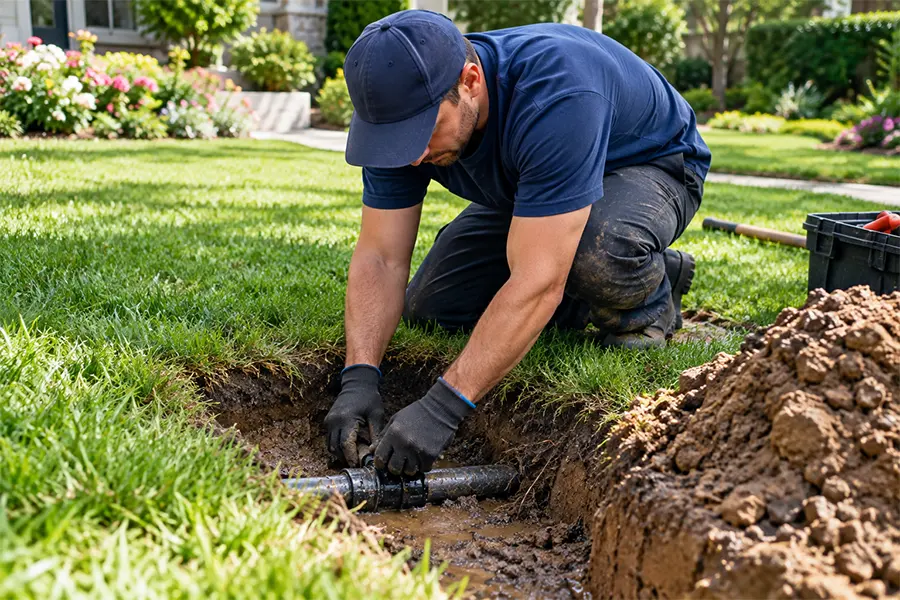
Irrigation leak or supply line leak?
These get conflated constantly and they are not the same repair. An irrigation leak sits downstream of the backflow preventer and only wastes water while the system is running, or if a valve is passing. A supply line leak is on the pressurised line feeding the house, so it runs twenty-four hours a day — which is why it wrecks a water bill so quickly.
The distinction matters for cost too. Irrigation repairs are usually shallow, often a cracked fitting or a head clipped by a mower. A failed supply line can mean replacing a run of pipe, and in older neighbourhoods where the service line is original, replacement is sometimes the sounder choice over patching a line that will fail again somewhere else.
What detection and repair cost
Detection and repair are quoted separately, because until the yard leak is located nobody honestly knows what the repair is.
- DetectionPriced on lot size and how the lines run. Typically one to three hours. You get the location and a repair quote before anything is opened.
- Depth and surfaceA line under lawn is straightforward. Under a driveway, patio or mature tree it is not, and reinstating the surface is part of the job.
- Repair or replace the runA single clean break is a repair. An original service line that has failed once will usually fail again, and replacing the run can be the cheaper decision over a few years.
- Irrigation against potableIrrigation work is generally shallow and quick. Pressurised supply line work is neither, which is the main reason the two are quoted apart.
Spot repair, or re-run the whole service line
Once the yard leak is located, there are two honest options and the right one depends on what the rest of the line looks like.
A spot repair opens a small area, cuts out the failed section and couples in new pipe. It is quick, it is the cheaper number, and on a line that is otherwise sound it is the correct answer. Where it goes wrong is on a line that has already leaked once before: a second yard leak on the same run usually means the material is at the end of its life, and spot-repairing it buys months rather than years.
A re-run replaces the service from meter to house. Modern practice does not trench the whole length — a directional bore pulls new pipe under the lawn between two small pits, so the driveway and the beds stay where they are. It costs more on the day and it ends the problem. When we quote a yard leak we give you both numbers and say which one we would take, with the reason.
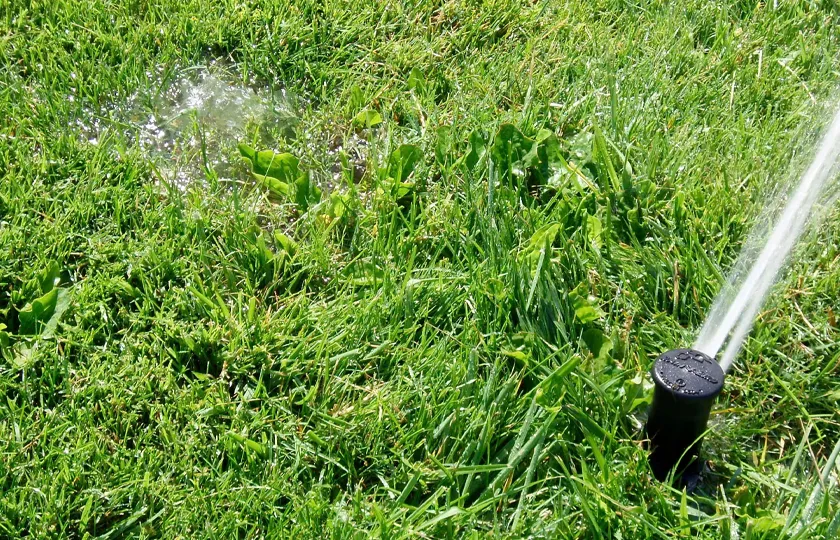
Why this happens so often here
The clay soils across much of the region swell when wet and shrink hard in drought. That movement works on buried pipe joints year after year — a dry summer followed by a wet autumn puts more stress on a buried line here than a decade of stable ground would elsewhere.
Tree roots do the rest. Live oaks and mature landscaping send roots toward the one reliably damp thing in the yard during a Texas August, which is a pipe with a weeping joint. The root does not so much cause the yard leak as find it and widen it.
Pressure at the fixtures, and what a yard leak does to it
A buried yard leak is an open tap that never closes, and the house is downstream of it. The symptom people notice first is not the wet patch — it is that two showers can no longer run at once, or that the sprinklers throw less than they used to on the same zone.
That matters diagnostically, because the same complaint has other causes. A failing pressure regulator, a partially closed meter valve or scale in old galvanised pipe all drop pressure too. The difference is that a yard leak drops it and adds volume to the meter at the same time. Pressure down with consumption up is the combination that points outside; pressure down with consumption flat points to a restriction inside.
If you have a gauge, take a reading at a hose bib with everything else off. Anything under about 45 psi on a street that normally runs 60 to 70 is worth a call, and worth mentioning when you book so the yard leak detection starts in the right place.
About your bill
San Antonio Water System runs conservation programmes worth asking about once your leak is repaired, including a water flow sensor rebate that can warn you about the next one early. SAWS has also operated leak adjustment assistance at various points, with eligibility rules that change — call them at (210) 704-7297 and ask what is available now rather than assuming. Either way, keep your repair invoice: every version of these programmes we have seen requires proof the yard leak was actually fixed.
Pool lines, hose bibs and the things that are not the main
Not every yard leak is on the water service. A pool with an underground return line, an outdoor kitchen fed off a branch, a hose bib with a failed vacuum breaker, or a well-fed livestock line will all put water into the ground and none of them will show on a whole-house meter test the way a service line leak does.
Pool plumbing is its own case: the loss shows up as a falling water level rather than a rising bill, and the isolation test is different. Irrigation is the most common of all — a cracked lateral or a valve that weeps after the zone shuts will hold a patch of ground wet and mimic a yard leak almost exactly, which is why isolating the irrigation system is one of the first things we do.
Tell us what is out there when you call. A yard leak detection visit that already knows about the pool line and the drip zone is a shorter visit than one that discovers them.
When it turns out to be inside
If the meter stops when you close the main, the leak is inside or under the house. Under a slab that is a different piece of work, and it is one of the standing items on our maintenance inspection. A meter that only moves when a fixture runs points back at the fixture — a toilet flapper is the most common silent culprit in the house.
Restoration, and the credit you can ask SAWS for
Two things happen after the repair, and the second one is the part people do not know to ask about.
Restoration comes first. A located repair means a small opening rather than an open trench, so what has to go back is usually a patch of turf and whatever was planted over it. Where a bore was used, the two pits are the only ground disturbed. We agree what gets restored and what is left to you before work starts, because that is a conversation nobody wants to have afterwards.
Then the bill. SAWS operates a leak adjustment for customers who have had a genuine underground leak repaired — the account can be credited against the abnormal consumption once you show the work was done. You need the repair documented: what failed, where, the date, and who carried it out. Every yard leak repair we complete comes with paperwork written for that purpose, because a month of a half-inch line running unchecked is a bill worth appealing.
Where we run yard leak detection
We cover San Antonio and the towns around it — Helotes, Boerne, Bulverde, Schertz, Converse, Somerset and the Hill Country communities either side of them. Older neighbourhoods inside Loop 410 tend to bring copper and galvanised service lines at the end of their lives. Newer subdivisions north and east bring polyethylene that has let go at a fitting. Both get the same yard leak detection method, and both get a located repair instead of an exploratory trench.
Same-day yard leak detection is usually available. Where water is undermining a slab, a driveway or a retaining wall, that call moves up the list rather than waiting its turn.
Work is carried out by licensed plumbers under our Responsible Master Plumber, license RMP-43333, issued by the Texas State Board of Plumbing Examiners. You can verify that license yourself.
What San Antonio homeowners say
Reviews pulled live from our Google Business Profile, not retyped here.


Questions homeowners ask us
How do I know if the leak is in my yard or under my slab?
Close the main shutoff valve at the house and watch the meter. If it keeps moving with that valve closed, the leak is between the meter and the valve, which means it is in the yard. If it stops, the leak is inside the house or under the slab.
How much water can a buried leak waste?
Enough to double or triple a bill, because it runs continuously. A supply line leak does not stop overnight or while you are at work the way an indoor drip does, which is why the bill is usually the first thing anyone notices. It is the reason a yard leak is worth locating the week you suspect it rather than the month after.
Will you have to dig up my whole yard?
No. The entire point of acoustic detection and line tracing is to open one spot rather than trench a line of guesses. Most yard leak repairs involve a single excavation of a few feet. Yard leak detection is the step that makes that possible — without it, finding the fault means opening ground until it appears.
Is the leak between the street and my house my responsibility?
Usually yes, from the meter to the house, with the utility responsible for its own side of the meter. The boundary is not always obvious at the curb, so it is worth confirming with SAWS before work begins — and we will tell you when a leak looks like it sits on their side.
Can I just wait for the wet patch to appear?
Waiting is expensive. A leak deep enough not to surface still runs continuously, and in clay soil it can undermine a driveway, a walkway or a foundation edge long before it ever shows at the surface.
How long does detection take?
Typically one to three hours depending on lot size and how the lines run. The repair is quoted separately once we know what we are dealing with, and you get that number before anything is dug.
Does a yard leak affect my drinking water?
It can. A leak on a pressurised line generally pushes water out rather than drawing anything in, but if pressure drops far enough the risk changes. Any sustained loss of pressure on a potable line is worth dealing with quickly.
Do you handle irrigation systems as well as supply lines?
Yes, both. Establishing which of the two is actually leaking is part of the detection work, and the two are tested separately.
Can I keep using water while I wait for the repair?
Yes, in most cases. If the loss is large enough to be audible at the meter or is undermining a driveway or a slab, we would close the meter valve between uses and we will show you how. Otherwise normal use is fine for the day or two until the yard leak is repaired.
Does homeowners insurance cover a yard leak?
Policies differ, but the common pattern is that the resulting damage may be covered while the pipe repair itself is not. What helps either way is documentation of the date, the location and the failure, which is part of what you get from us regardless of who ends up paying.
How accurate is the location before you dig?
Acoustic correlation and gas tracing put most yard leak locations inside a couple of feet, which is the difference between a small opening and an exploratory trench. Depth is estimated as well, so the excavation is sized to the job rather than the guess.
If the meter is moving, the bill only grows from here.
We locate it acoustically and open one spot. You get the location and the repair number before anyone touches a shovel.