

A toilet is the fixture people put up with longest. It runs intermittently for a year, rocks slightly when you sit down, needs a second flush more often than it used to — and none of it feels urgent, so nobody calls. Two of those three are quietly costing money and one of them is a warning about the floor underneath. Silverback Plumbing and Drain repairs and replaces toilets across San Antonio, usually same day.
What is going on in there
Runs constantly, or cycles on its own
Nearly always the flapper or the fill valve. Hard water stiffens the rubber until it stops sealing, the tank bleeds into the bowl, and the fill valve tops it up all night.
Water at the base
A failed wax ring, sometimes a corroded or broken closet flange. By the time water reaches the visible floor it has been under the toilet for a while, which is why this one is not worth waiting on.
It rocks when you sit down
Loose closet bolts, or a flange sitting below the finished floor. Every rock works the wax seal a little further open, which is how a wobble becomes a leak.
Weak or incomplete flush
Mineral buildup in the rim jets and siphon passage, a flapper closing early, or a tank not filling to the right level. In water this hard, blocked jets lead the list.
It clogs again and again
A toilet that blocks repeatedly is often not the problem. Recurring clogs across several fixtures point at the branch line or further down.
The tank sweats
Condensation in a San Antonio summer dripping onto the floor and reading exactly like a leak. Worth ruling out before anyone pulls the toilet.
The dye test for a silent leak
A toilet leaking internally makes no sound and puts nothing on the floor, and it is the largest single water waster in most homes. This takes fifteen minutes and costs nothing.
- Take the tank lid off and set it somewhere safe and flat.
- Put a few drops of food colouring into the tank water. Do not flush.
- Wait fifteen minutes and do not use the toilet.
- Look in the bowl. Colour in the bowl means the flapper is leaking and the tank has been feeding the bowl continuously.
A flapper that fails this test can pass several hundred gallons a day without ever making a sound. If your bill rose and the yard is dry, test every toilet in the house before assuming the problem is outside.
Rough-in, bowl shape and how high it sits
Three measurements decide whether a new fixture will physically work in the space, and getting one wrong is how a weekend project ends with a return trip.
The rough-in is the distance from the finished wall to the centre of the drain. Twelve inches is standard and covers most San Antonio houses; ten and fourteen exist and turn up in older builds and in awkward corners. Measure to the bolt caps at the base, not to the tank, and measure before anybody buys anything.
Bowl shape is comfort against clearance. Elongated bowls are more comfortable and stick out around two inches further, which in a small guest bath can be the difference between a door that closes and one that does not. Round-front buys back that space.
Height is the one people notice most after the fact. A standard bowl sits around fifteen inches to the rim; comfort height, sometimes sold as chair or ADA height, sits at seventeen or eighteen and is easier on knees and hips. It is also noticeably less comfortable for small children, so it is worth thinking about who actually uses that bathroom rather than buying the taller one by default.
Gravity, pressure-assist and dual flush
Nearly everything in a San Antonio house is gravity fed: the tank holds water, the flapper opens, and the weight of the water does the work. It is quiet, the parts cost a few dollars and every plumber carries them. The weakness is that a gravity flush is only as good as the bowl design behind it, and cheap bowls clog.
Pressure-assist uses a sealed vessel inside the tank that compresses air as it fills, then releases it in one hard push. It clears more per flush than anything else and it is what goes into a busy household or a commercial washroom. It is also loud enough to wake somebody through a wall, and the cartridge is a proprietary part, so the trade-off is real.
Dual flush gives you a short flush for liquid and a full one for solids. On paper it saves water; in practice it saves water only if people use the right button, and the seal on a dual-flush valve is a larger rubber part that tends to fail earlier than a flapper.
One number cuts through the marketing: MaP, which measures how many grams a fixture clears in a single flush. Anything rated 800 or above will not give you trouble. It is published, it is comparable across brands, and it is a better guide than the price tag.
Repair or replace
| Situation | Usually the right call |
|---|---|
| Running, weak flush, or a leak at the supply | Repair Flappers, fill valves and supply lines are inexpensive parts. |
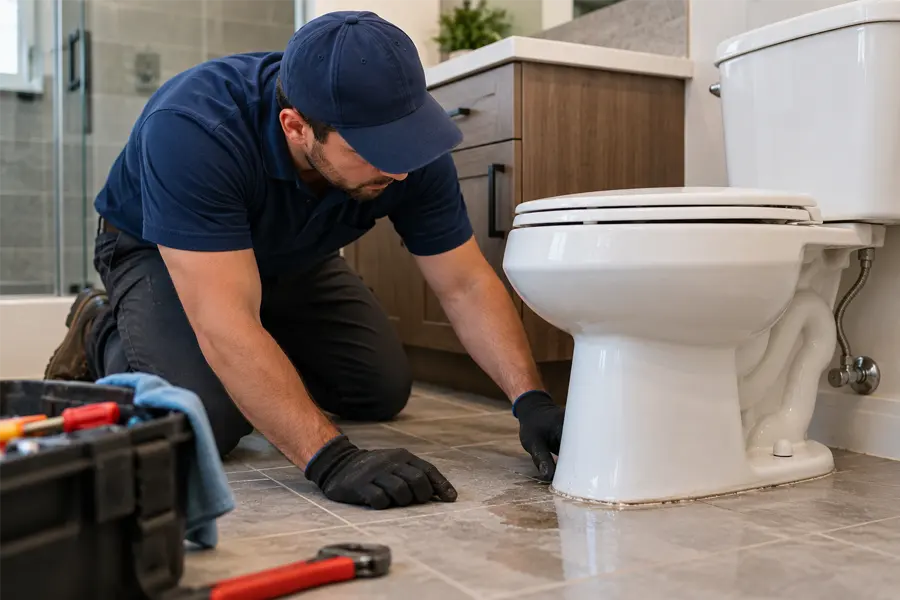
| Leaking at the base, fixture otherwise sound | Repair New wax ring and bolts, flange inspected while the toilet is off. |
| Cracked tank or bowl | Replace Porcelain cracks spread, and a tank that fails does so all at once. |
| Anything predating 1994 | Replace Older units use up to 3.5 gallons a flush against 1.28 for a current high-efficiency model. |
| Third repair on the same toilet | Replace Parts availability and porcelain age are both working against you. |
| Flange broken or below floor level | Fix the flange regardless. A new toilet on a bad flange leaks exactly like the old one did. |
Why toilets wear out faster here
Water across the region tests between 15 and 20 grains per gallon, and inside a toilet that shows up in three places: scale narrowing the rim jets so the flush loses force, deposits stiffening the rubber flapper until it no longer seats, and buildup on fill valve components that makes them stick open or closed.
None of it is dramatic. It is simply why a toilet that flushed perfectly for six years gradually stops doing so, and why homes with a water softener go considerably longer between repairs.
The flange under it is what usually decides the job
The closet flange is the ring bolted to the floor that the fixture sits on and the wax ring seals against. It should sit level with, or very slightly above, the finished floor. When it sits below — which is what happens every time tile goes down over an existing floor without the flange being raised — the wax ring is asked to bridge a gap it was never designed to bridge, and it weeps.
That is the real cause behind most of the water-at-the-base calls we take. The fix is not another wax ring. It is either a flange extender ring properly bedded and sealed, or a new flange, depending on what is under the old one.
Cast iron flanges crack at the bolt slots and the bolts then pull through under any rocking. Plastic ones snap. Either way, once the fixture is not held down firmly the wax seal breaks every time somebody sits down, and no amount of tightening fixes it — overtightening is how porcelain cracks.
We check the flange on every replacement before the new unit goes anywhere near the floor, because it is the one thing that is invisible afterwards and expensive to come back to.

What a replacement involves
A standard swap takes about two hours. We shut off and drain the old unit, remove it, then inspect the closet flange and subfloor while they are exposed — which is the part a rushed install skips — before setting the new toilet on a fresh wax ring, levelling and securing it, reconnecting the supply and testing for movement and leaks under normal use.
If the flange is corroded, cracked or sitting below the finished floor, it gets dealt with then. That is also the moment we find out whether a long-running base leak has reached the subfloor, and we would rather tell you before the new toilet is sitting on it.
What it costs
- Repair or replacementA flapper or fill valve is the low end and finishes in one visit. A full replacement includes removal, disposal and the new fixture.
- The fixture you chooseHeight, one-piece against two-piece, and flushing system account for most of the spread. Comfort height and a good 1.28 gallon flush are worth the difference.
- What is under the toiletIf the flange is broken or below floor level, correcting it is part of doing the job properly rather than an upsell. Subfloor damage from a long leak is priced once we can see it.
- How manyDoing several in one visit costs less per fixture than booking them separately.
Three things that belong in the bin
The list is short and it accounts for a remarkable share of the blockages we clear.
Wipes come first, including every brand that prints “flushable” on the packet. They pass the trap and then stop at the first rough joint or root intrusion downstream, and because they do not break down they catch everything that follows. Sanitary products are the same problem with more absorbency. Dental floss is the one nobody expects: it does not degrade, it wraps around anything already in the line, and it binds a soft blockage into something a plunger cannot move.
Also worth avoiding: cat litter of any kind, cotton buds, paper towel, and old medication — the last one for the water supply rather than the pipe. Kitchen grease poured into a bowl rather than a sink is still grease in the same lateral.
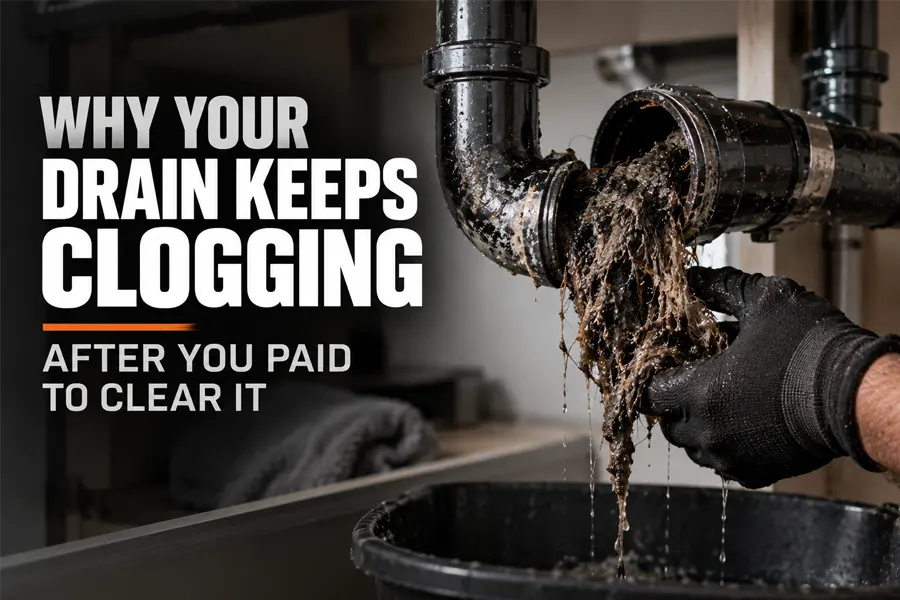
If something has already gone down and the bowl is rising, stop flushing. A second flush on a blocked line is what turns a clog into a floor to clean. Why the same drain keeps clogging covers what happens further down the line.
When the toilet is the symptom
One toilet clogging occasionally is a toilet. A toilet that backs up when the washing machine drains, or gurgles when a nearby shower runs, is telling you about the line it shares — that belongs with drain cleaning, or with sewer line repair where roots or a collapsed section are involved. Sewage on a floor is an emergency rather than a scheduling matter, any hour.
Bidet seats, heated seats and the electrics behind them
Washlet-style seats have gone from rare to routine here in the last few years, and fitting one is mostly a plumbing job with an electrical footnote.
The water side is straightforward: a tee at the supply stop feeds the seat, and if the existing stop is an old multi-turn valve it gets replaced at the same time because it will be handled. The electrical side is the part people get caught by. These seats need a GFCI-protected outlet within reach of the unit, and most bathrooms built before the 1990s have exactly one outlet, usually beside the basin and often not GFCI. Running a new circuit is an electrician’s job, and it is worth pricing that before buying the seat.
One practical note on water: hard water is as hard on a bidet seat’s nozzle and solenoid as it is on anything else. Units with a self-cleaning nozzle and a serviceable inline filter last considerably longer in San Antonio than ones without.
Work is carried out by licensed plumbers under our Responsible Master Plumber, license RMP-43333, issued by the Texas State Board of Plumbing Examiners. You can verify that license yourself.
What San Antonio homeowners say
Reviews pulled live from our Google Business Profile, not retyped here.


Questions homeowners ask us
Why does my toilet keep running?
Almost always a worn flapper that no longer seals against the flush valve. Hard water stiffens the rubber until it stops seating, the tank bleeds into the bowl, and the fill valve keeps topping it up. It is an inexpensive part and a quick repair.
Is water around the base serious?
Usually yes. It generally means the wax ring has failed, and by the time water reaches the visible floor it has typically been seeping underneath for some time. Left alone it damages subfloor and, upstairs, the ceiling below.
How much water does a running toilet waste?
A badly seated flapper can pass several hundred gallons a day, silently. It is frequently the single largest water waster in a home, which is why a fifteen-minute dye test on every toilet is the right first move when a bill jumps.
Should I repair or replace?
Repair if the fixture is sound and the fault is a flapper, fill valve or wax ring. Replace if the porcelain is cracked, if it predates 1994 and uses 3.5 gallons a flush, or if you are on your third repair of the same unit.
Why does my toilet rock slightly?
Either the closet bolts are loose or the flange sits below the finished floor. Either way it needs correcting, because every movement works against the wax seal and a rocking toilet reliably becomes a leaking one.
Can I install a toilet myself?
You can, and plenty of people do it successfully. The two things that go wrong are a flange problem nobody noticed until the new toilet leaks, and a wax ring compressed unevenly while setting it. Both mean pulling the toilet again.
Why does it gurgle when the shower runs?
That is a venting or drain line issue rather than a toilet issue. Air is being pulled through the toilet trap because the line cannot breathe, usually from a partial blockage further down. Worth investigating before it becomes a backup.
Do you offer same-day toilet repair?
Yes, for most of the San Antonio area. We carry common flappers, fill valves and wax rings so the majority of repairs finish on the first visit.
What is a MaP rating and where do I find it?
It is an independent flush performance score in grams, published by the manufacturer and searchable by model. Anything at 800 or above clears comfortably. It is the single most useful number on the spec sheet and it is not usually on the box.
Do I need a permit to swap one out?
For a straight like-for-like replacement, no. Moving the drain, altering the vent or adding a fixture where there was not one is permitted work, and that permit is pulled by the licensed plumber doing it.
Why does the water level in the bowl drop overnight?
Usually a partial blockage in the trapway or a venting problem pulling the seal down. Occasionally it is a hairline crack in the china below the waterline, which is not repairable. If the level drops and the bowl is dry in the morning, the trap seal is gone and sewer gas has a way in, so it is worth looking at promptly.
If it is leaking at the base, sooner is better.
That water is going somewhere, and the somewhere is your subfloor. Most repairs are done in one visit with the parts already on the van.