

If you are on a private well around Helotes, Boerne, Bulverde or Bandera County, you are drawing from the Trinity aquifer and no SAWS figure applies to your house. Your water is whatever your own ground gives you, and it can carry iron, sulphur and bacteria that city water never does. That changes both what well water treatment your house needs and the order it has to go in.
Sediment first, then iron and hydrogen sulphide, then softening, then disinfection. Put a softener ahead of untreated iron and it will foul and destroy the resin bed. That is the single most expensive mistake made on well installations, and it is usually made by someone who sized the equipment without reading a laboratory result.
The pressure tank and the pump behind all of it
Treatment equipment can only work with the flow and pressure the well actually delivers, so on any well water job the pump side gets looked at before anything is specified.
The pressure tank holds a cushion of air above a bladder so the pump is not starting every time somebody opens a tap. When that bladder fails or the air charge is lost, the pump short-cycles — starting and stopping every few seconds — and short-cycling is what burns out well pumps. The test is simple: tap the tank, and if it sounds solid rather than hollow near the top, it is waterlogged.
Pressure switch settings matter for well water treatment specifically. A 30/50 switch gives you less working pressure than a 40/60, and a backwashing filter that needs a minimum flow to lift its media will underperform on the lower setting. Getting that sequence right — pump, tank, switch, then treatment — is what stops a correctly specified system from behaving as though it were faulty.
If your pump is running more than it used to and nothing else has changed, deal with that before adding equipment behind it.
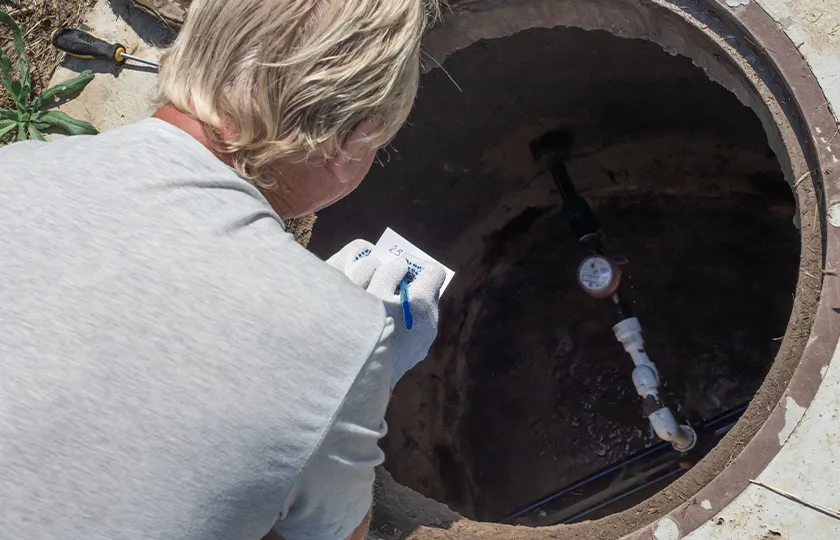
What Hill Country well water actually carries
Hardness, often higher than the city figure
Anyone quoting you the San Antonio number is quoting the wrong water. Wells in this ground routinely test differently, and the softener has to be sized to your reading.
Iron
Orange staining in the toilet bowl, the shower and the laundry, and a metallic taste. It has to be oxidised out before the well water reaches a softener.
Hydrogen sulphide
The rotten-egg smell, usually worse on the hot side. Oxidation or a dedicated filter deals with it. A softener does not.
Sediment and fine sand
Straight from the formation or from a pump drawing low. It blocks aerators, jams fill valves and shortens everything downstream of it.
Bacteria
A well is not disinfected by a utility, so this is on you. Ultraviolet disinfection is the usual answer and it goes last, after the well water is already clear.
Pressure and flow from the pump itself
Treatment equipment adds resistance. A system sized without accounting for the pump and the pressure tank gives you clean water and disappointing showers.
The four stages, in the order they have to go
Not every well needs all four. The analysis decides which stages come out of the specification, and dropping one you do not need is the cheapest change we can make to a quote. What cannot change is the sequence of the ones you keep.
| Stage | What it handles | Why it sits here |
|---|---|---|
| 1. Sediment | Sand, silt, formation fines | Protects every piece of equipment behind it, and it is the cheapest thing to replace. |
| 2. Iron and sulphide | Staining, metallic taste, rotten-egg smell | Must come out before the softener, or the resin bed is destroyed. |
| 3. Softening | Hardness: scale and spotting | Only works properly on water that is already clear of iron. |
| 4. Ultraviolet | Bacteria | Goes last, because UV only disinfects water that is already clear enough to pass light. |
Iron, manganese and the staining nobody warns you about
Well water in the Hill Country often carries iron, and iron is the reason a house turns orange.
Dissolved ferrous iron comes out of the tap clear and then rusts on contact with air, which is why the stain appears in the toilet cistern and on the tub a while after the well water sat there. Ferric iron has already oxidised underground and arrives visibly discoloured. The two need different handling: oxidation and filtration for the first, sediment filtration for the second, and a lab result is what tells them apart.
Manganese does the same job in black rather than orange, and it stains at concentrations roughly ten times lower than iron does — so a well water report showing a manganese figure that looks negligible can still be the cause of grey-black marks on laundry and around fixtures.
Iron bacteria is the third one. It is not a health hazard, but it forms a reddish slime in the tank and the pipework, it fouls filters quickly, and it needs shock chlorination rather than filtration. If your well water leaves a slippery film in the cistern, that is what you are looking at.

Ultraviolet disinfection, and what it does not do
UV is the standard answer to bacteria on a private well. It uses no chemicals, changes nothing about the taste, and needs no contact tank. What it needs is clear water: turbidity and iron block the light and a lamp shining through cloudy water is not disinfecting it. That is the whole reason it sits at the end of the train rather than the start.
It is also the one stage with a service interval you cannot skip. The lamp loses output long before it stops glowing, so an annual lamp change is the job, not a repair you do when something looks wrong. Chlorination is the alternative where flow rates or water quality make UV impractical.
What drives the price
A well water system covers more ground than a city install, so a single published figure would be meaningless. These are what actually move it. You get the full number, and the annual running cost separately, before anything is ordered.
| Factor | Why it moves the price |
|---|---|
| How many stages the analysis calls for | A well needing only softening is a fraction of one needing iron removal and UV as well. |
| Iron concentration | Low iron can go on a filter. High iron needs oxidation, which is a larger installation. |
| Flow rate the house needs | Equipment is sized to peak demand. Undersizing shows up as poor shower pressure. |
| Where the pressure tank sits | A well house with room and a drain is straightforward. A cramped utility closet is not. |
| Drain and power at the equipment | Backwashing stages need a drain, UV needs a receptacle. Adding either is separate work. |
| Laboratory analysis | A real lab panel costs more than a strip and is the only basis we will specify from. |
Nitrate, and why it is the one to take seriously
Most well water problems are a nuisance. Nitrate is the exception, and it is worth understanding rather than skimming.
It enters groundwater from fertiliser, from septic systems and from livestock, so it turns up in exactly the rural settings where private wells are common. It has no taste, no smell and no colour — nothing about the well water tells you it is there. The EPA limit is 10 mg/L measured as nitrate-nitrogen, and the risk at elevated levels falls on infants under six months and on pregnant women rather than on the general household.
Nothing conventional removes it. Carbon does not touch it. A softener does not touch it. Boiling makes it worse by concentrating it. What works is reverse osmosis, anion exchange or distillation, and on well water the usual answer is an RO unit at the kitchen tap for drinking and cooking rather than treating the whole house.
If there is a baby in the house and the well has never been tested for nitrate, that is the test to run first, before anything else on the list.

How we approach well water treatment
- Laboratory analysis first. Hardness, iron, manganese, hydrogen sulphide, pH, turbidity and a bacteriological result.
- We read the pump and pressure tank as part of the job, because treatment equipment has to live within the flow they can deliver.
- We specify stages in treatment order and tell you which ones your well water does not call for.
- Installation with bypass valves on every stage, so any one of them can be serviced without taking the house off water.
If you have an existing system that was fitted in the wrong order, we will say so and tell you what it would take to re-sequence it. Sometimes that is a smaller job than people expect, because the equipment is fine and only the plumbing around it is wrong.
Testing, and how often it needs repeating
A well is not a supply anyone else is monitoring, so the testing schedule is yours.
Annually: bacteria, nitrate, pH and total dissolved solids. That is the baseline set and it is inexpensive. Every three years or so, broaden it to the full mineral panel including iron, manganese, hardness, sulfate and chloride — that is what a well water treatment specification is built from and it is what tells you whether anything has drifted.
Test out of sequence whenever something changes: after any work on the well itself, after flooding in the area, if a neighbouring well has a problem, if the taste or the colour shifts, or if anybody in the house has recurrent stomach upsets with no other explanation. New property, new baby and new treatment equipment are all reasons to test as well.
Use a state-certified laboratory rather than a strip. A strip tells you a rough hardness figure and nothing else, and no responsible well water treatment gets designed from one.

Servicing an existing well water system
| Situation | The usual call |
|---|---|
| Staining came back after the softener was serviced | Iron reaching the resin. Re-sequencing, not new equipment |
| Pressure dropped across the whole house | Blocked sediment stage. Cartridge or media change. |
| Smell returned on the hot side only | Sulphide plus the anode rod in the well water heater. Often solved at the heater. |
| UV lamp is past its service interval | Annual lamp change. Routine service |
| Softener resin fouled by years of untreated iron | The bed does not recover. Replacement, plus iron removal ahead of it |
- Have the well tested after any change to the pump, the casing or the surrounding ground
- Change the UV lamp annually whether or not it is still lit
- Keep sediment cartridges on a schedule rather than waiting for pressure to fall
- Retest bacteriologically at least once a year
- Keep bypass valves on every stage so one failure does not take the house off water
Well water treatment across the Hill Country
We work on private wells around Helotes, Boerne, Bulverde, Somerset and the surrounding Hill Country, as well as inside San Antonio where properties still sit off the municipal supply. Well water varies street by street out there in a way city supply does not, so nothing gets quoted from a neighbour’s system.
Bring us the lab result and we will read it with you, including the lines that do not need acting on. If you have not tested yet, we will tell you which panel to order before spending anything on equipment.
Work is carried out by licensed plumbers under our Responsible Master Plumber, license RMP-43333, issued by the Texas State Board of Plumbing Examiners. You can verify that license yourself.
What Hill Country homeowners say
Reviews pulled live from our Google Business Profile, not retyped here.


Frequently asked questions
Does the San Antonio hardness figure apply to my well?
No. SAWS figures describe city supply. On a private well you are drawing from the Trinity aquifer and your reading is your own. Anyone quoting the city number for your house is quoting the wrong water.
Why does a test strip not count?
A strip gives you a rough hardness reading and nothing else. It will not tell you iron, manganese, sulphide, pH, turbidity or whether there is bacteria present, and those decide both the equipment and the order it goes in.
Can I just put in a softener?
Only if the analysis says hardness is the whole problem. If there is iron in the well water, a softener on its own will foul and you will be replacing the resin bed early.
Does UV change the taste of the well water?
No. It adds nothing and removes nothing chemically. It deals with bacteria and leaves everything else exactly as it was.
How often does a UV lamp need changing?
Annually, as a rule, and it is not optional. Output falls off well before the lamp stops visibly glowing, so a lamp that still looks fine may have stopped disinfecting.
What about the rotten-egg smell in only the hot water?
That usually points at the reaction between sulphide and the anode rod inside the well water heater rather than at the well itself. It is worth checking the heater before specifying treatment for the whole house.
Do you handle well water outside San Antonio proper?
Yes. Helotes, Boerne, Bulverde, Schertz, Somerset, Stone Oak and the surrounding Hill Country, which is where most of the well water work is.
Can you fix a system that was installed in the wrong order?
Usually. Often the equipment itself is sound and only the pipework sequence is wrong, which is a smaller job than replacing it.
Do I need a permit for well water treatment equipment?
It depends on the jurisdiction and on what the installation involves, particularly where a drain connection is added. We handle the permit where one is required.
How often should I shock chlorinate the well?
When a bacteria test comes back positive, after any work that opened the well, and after local flooding. Routine annual shocking without a reason is not necessary and it is hard on the well water system components.
Can I run treatment equipment off a weak pump?
Not well. Backwashing filters need a minimum flow to lift the media, and a pump or pressure tank that is struggling will make a correctly specified system look faulty. The pump side gets sorted first.
Do I need to treat the whole house or just the kitchen?
It depends what the lab found. Bacteria, iron and hardness are whole-house problems because they affect bathing, laundry and every appliance. Nitrate is usually handled at the kitchen tap alone, since the risk is from drinking it. Most well water setups end up being both.
What does a full well water treatment setup cost to run?
Less than people expect. Salt for the softener, replacement sediment cartridges a few times a year, a UV lamp annually and media renewal every five years or so on a backwashing filter. The largest single running cost is usually the UV lamp, and skipping it is the one economy that defeats the point of having it.
We have just bought a house on a well. Where do we start?
With a full lab panel, before anything else. Whatever equipment is already installed may be correct, oversized, wrongly sequenced or simply dead, and you cannot tell which without knowing what the well water actually contains. Once the result is in, we can look at the existing system and tell you what is worth keeping.
A well deserves a laboratory result, not a doorstep guess.
We analyse what your ground is actually giving you, specify the stages in the order they have to go, and give you the number in writing before anything is ordered.