

Water Heater Replacement Cost in San Antonio: What You Actually Pay
One plumber says $1,800, the next says $4,500, and the unit itself is $700 at the big-box store. Here is what actually moves the number in this market.
License: RMP-43333

No hot water or a leaking tank? We diagnose it right, then fix it.

When your water heater fails, it doesn’t wait for a convenient time. One morning you have hot showers, clean dishes and laundry that actually gets done; the next morning you’re standing under cold water wondering what changed. Silverback Plumbing and Drain repairs and replaces water heaters across San Antonio, on traditional tank units, electric units, and tankless systems, and we diagnose the part that’s actually failing instead of guessing or swapping parts at random.
These are the issues we see most in San Antonio homes, and most of them get worse the longer they sit.
Often a failed heating element, a tripped thermostat, or — on gas units — a pilot light that won’t stay lit.
Usually means your tank is undersized for the household, or sediment buildup has cut into its usable capacity.
Once the tank itself is leaking, repair usually isn’t an option — the tank has to be replaced.
A thermocouple, gas valve, or burner problem that can leave gas units without hot water entirely.
Popping and banging usually point to sediment buildup; a rotten-egg smell can mean a reaction happening inside the tank.
Tankless systems display specific fault codes. We read the code and diagnose the actual part behind it instead of guessing.
| What’s Going On | What We’d Usually Recommend |
|---|---|
| Unit is under 8 years old, tank isn’t leaking | Repair |
| Unit is 10–12+ years old | Replace |
| Tank itself is leaking | Replace |
| You’ve needed two or more repairs this year | Replace |
| Energy bills climbing with no change in usage | Replace |
| Household hot water demand now exceeds tank size | Replace — consider tankless or a larger tank |
If you’re replacing your water heater anyway, it’s worth comparing both systems before defaulting to the same type you had.
| Feature | Tank | Tankless |
|---|---|---|
| Upfront cost | Lower | Higher |
| Hot water supply | Limited by tank size | On-demand, doesn’t run out |
| Long-term energy cost | Higher | Lower |
| Space needed | Larger floor footprint | Wall-mounted, compact |
| Best fit | Households running multiple fixtures at once on a budget | Households wanting hot water that never runs out and lower bills over time |
For an independent breakdown of the energy difference between the two systems, the U.S. Department of Energy’s water heater efficiency guide is a useful outside reference.
San Antonio’s hard water is one of the biggest reasons local water heaters need more attention than the owner’s manual suggests. Mineral sediment settles at the bottom of the tank faster here than in softer-water regions, insulating the heating element and forcing the unit to work harder than it should. That’s usually the real cause behind popping noises, slower heating, and a shortened tank life not a defective unit. Annual flushing helps, but once sediment has built up for years, the damage isn’t always reversible. If you want to stop the buildup before it starts, pairing your water heater with a water softener is one of the most effective long-term fixes we recommend to San Antonio homeowners.
Switching from a tank to a tankless system isn’t a one-for-one swap, which is why DIY conversions usually run into trouble. Tankless units need a larger gas line or a dedicated 240V electrical circuit depending on the model, proper venting rated for the unit’s output, and a mounting location that meets code clearances. We size the unit to your home’s fixture count and peak demand first, then handle the gas, water, and electrical connections as one job instead of treating them as separate problems for separate trades.
A few habits make a real difference in how long a water heater lasts in a hard-water city like San Antonio:
Flush the tank annually to clear sediment before it hardens
Check the anode rod every 2–3 years and replace it when worn
Set the thermostat to 120°F to reduce strain and scalding risk
Test the pressure relief valve once a year for proper function
If you’d rather not track these on your own, our plumbing maintenance plan covers annual water heater flushing along with the rest of your home’s plumbing, so nothing gets missed between visits.
We evaluate your home’s hot water usage and current setup
We safely remove and dispose of your old unit
We install and connect your new system to code
We test performance before we call the job done
We don’t ask for five stars, we earn them by showing up, fixing it right, and telling you the cost before we start.
Here’s what real customers across San Antonio have to say.
Posted on Google
 Xochitl GarciaJune 24, 2026
Trustindex verifies that the original source of the review is Google.
Service itself for the work was good, they communicated thoroughly and effectively, any issues i had they worked on resolving them. Would turn to them for any plumbing and draining needs. They are reliable and honest.Posted on Google Lisa PenaJune 21, 2026I was very happy with the job that David and Brendan from Silverback Plumbing & Drain performed on my toilet. They were able to come out to my house within a day of my phone call, which was wonderful. They replaced the seal in my toilet tank quickly and showed me how my old seal had bumps on it (causing it not to seal properly anymore). Additionally, they fixed the chain that connected to the handle for free after I explained that sometimes the handle doesn’t flush properly. I also was satisfied with the price that I was charged for replacing the seal in my tank. David informed me that I should contact SAWS to let them know that I had the seal in my tank repaired in order to possibly get them to reimburse me some money (if the most recent bill that I had was higher than my previous bills). David and Brendan were very knowledgeable, professional, and personable. If you need to have a plumbing job done, don’t hesitate to use Silverback Plumbing & Drain!Posted on Google
 Leslee BrandtJune 19, 2026Great communication with quality work. Definitely recommend them!Posted on Google
 Jennifer EbingerJune 16, 2026We had a great experience with Silverback Plumbing! Brian and Brendon recently replaced our water heater and repaired a leaky tub faucet, and they did an outstanding job from start to finish. Both of them were professional, friendly, and took the time to explain everything clearly before and after the work was completed. They arrived on time, worked efficiently, and left the area spotless when they were finished. It's refreshing to work with technicians who truly care about the quality of their work and customer service. Silverback Plumbing has earned our trust with their reliability, honesty, and excellent workmanship. We highly recommend Silverback Plumbing, and a special thank you to Brian and Brendon for providing such exceptional service. We will definitely call them again for any future plumbing needs!Posted on Google
 Shane BeckJune 2, 2026Team was great!Posted on Google
 Jessica Ann Figueroa-JoubertMay 22, 2026Mario came and resolved our problem, thank you.Posted on Google
 Johnny VillanuevaMay 19, 2026Great work took pictures and provided a detailed report which was exactly what I needed
Inconsistent or no hot water, leaks around the tank, rust-colored water, rotten-egg odors, and popping or banging noises are the most common signs. Any one of these is worth a professional look before it turns into a bigger repair.
Traditional tank water heaters usually last 8 to 12 years, while tankless systems can run 20 years or more with proper maintenance. Annual inspections and timely repairs are what stretch a unit toward the longer end of that range.
Yes — tankless systems provide hot water on demand, lower energy bills over time, and take up far less space than a tank. They’re a strong fit for energy-conscious homeowners or households that regularly run out of hot water.
Cost depends on the type of unit, its size, and whether venting or gas line work is needed for the new system. We diagnose your specific situation and give you a clear price before any installation begins.
Yes. A slow leak can warp flooring, damage drywall, and lead to mold if it goes unnoticed for long. If you see water around your tank, it’s worth shutting off the water supply to the unit and calling a plumber the same day.
A rotten-egg odor from hot water is usually a reaction between the anode rod and bacteria inside the tank — unpleasant, but typically not dangerous on its own. A rotten-egg smell elsewhere in the house, however, can indicate a gas leak and should be treated as an emergency.
One plumber says $1,800, the next says $4,500, and the unit itself is $700 at the big-box store. Here is what actually moves the number in this market.
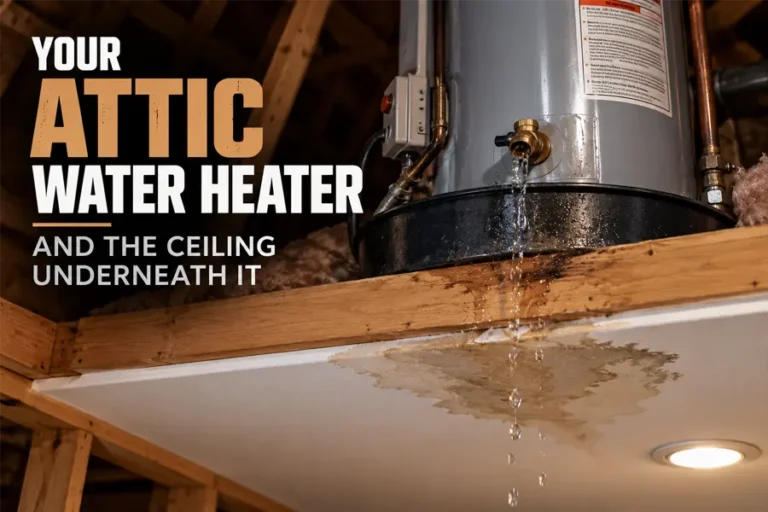
A tank in the attic almost never bursts. It weeps, quietly, into a pan nobody has looked at in nine years — and by the time the ceiling tells you, the water heater is the cheapest part of the bill.

Every gallon SAWS delivers carries calcium and magnesium out of the Edwards Aquifer and drops some of it on the bottom of your tank. Here is the mechanism, and the maintenance that answers it.