


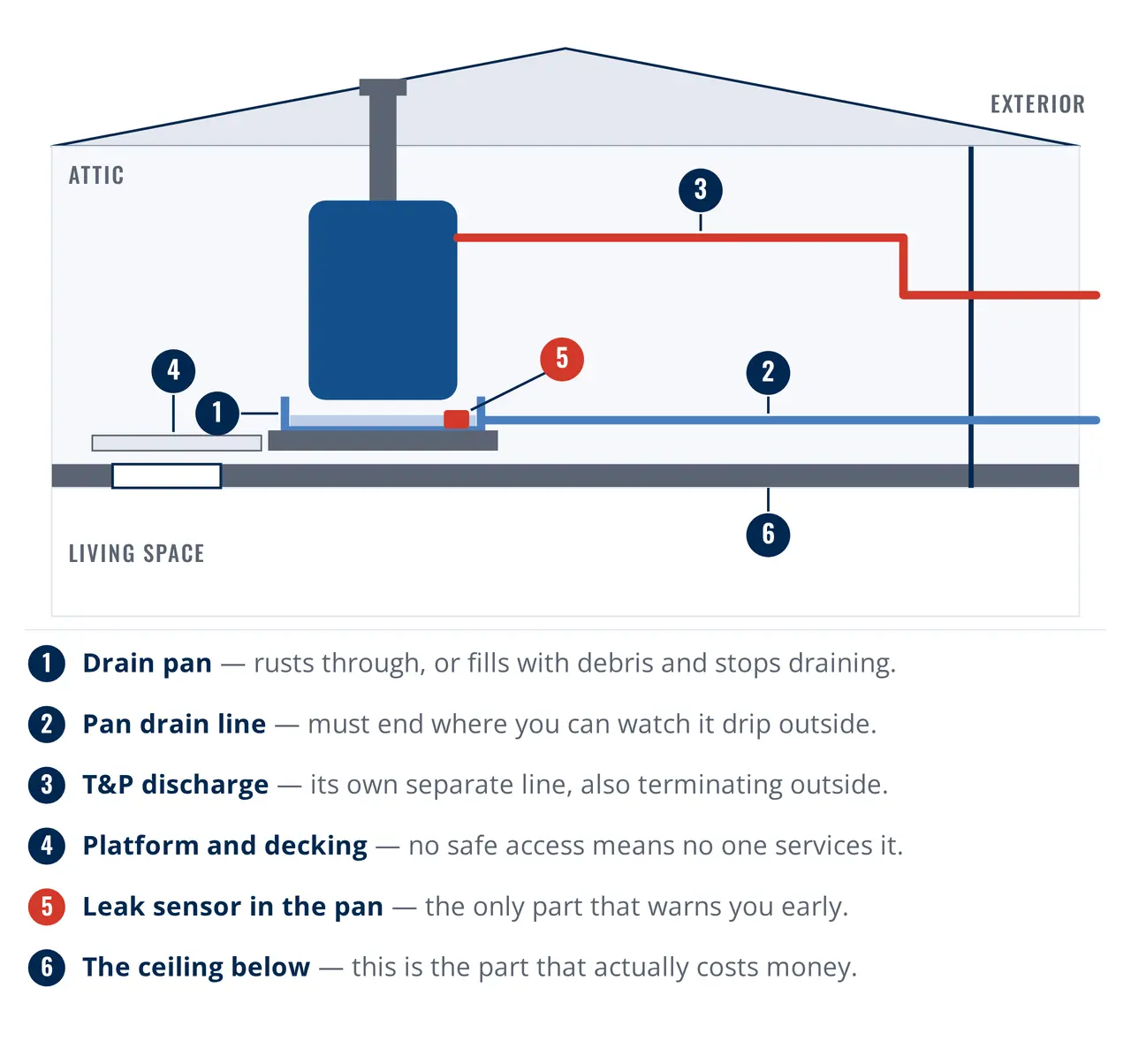
An attic water heater is safe when four things are right: a sound drain pan, a pan drain line that ends somewhere outside where you can see it drip, a separate T&P discharge, and walkable access so it actually gets serviced. Attic tanks rarely burst. They weep for weeks, and the ceiling repair usually costs more than the heater.
- An attic water heater is safe when four things are right: a sound drain pan, a pan drain line that ends somewhere outside where you can watch it drip, a separate T&P discharge, and walkable access so it actually gets serviced.
- Attic tanks rarely burst. They weep for weeks, and the ceiling usually tells you before the heater does.
- By the time a stain shows up downstairs, the water heater is often the cheapest line on the bill.
- A leak sensor paired with an automatic shutoff valve is the cheapest insurance an attic installation can carry.
People who move here have the same reaction the first time an inspector points a flashlight at the attic hatch. Fifty gallons of hot water sits above the master bedroom, draining into a pan they have never checked. It feels like something has gone wrong. Nothing has: an attic water heater is how most San Antonio homes built since the 1980s were designed.
The instinct is still fair. Putting the tank overhead does not make it likelier to fail. It changes what happens when it does, and removes the thing that protects you everywhere else in the house: walking past it. A garage tank puts a puddle on the slab you step in. An attic water heater puts a stain on the ceiling, and by then the water has been moving for weeks.
Why the Builder Put It Up There
There is no mystery and no shortcut taken. Almost every home here sits on a slab, so there is no basement and no crawlspace. The heater has to live somewhere, and every square foot it takes is one the builder cannot sell you as a pantry. A fifty gallon tank with clearances eats seven to nine square feet. The attic is free volume.
A second reason favors you. In a two-story house an attic water heater sits above most of the fixtures it serves, so the run to the upstairs bathrooms is short — less waiting at the tap, less water down the drain. Gas units also vent straight out through the roof.
From a design standpoint it is sensible. From a risk standpoint it moves every failure mode directly over finished drywall and flooring. That trade is made safely in thousands of homes in Stone Oak, Alamo Ranch and Helotes — but only when the plumbing protecting the tank is correct and has been looked at since install day.
What a Correct Attic Installation Actually Includes
The heater is the simple part. What separates a good install from a bad one is the assembly around it, none of which is visible from inside your house. Here is what a correct attic water heater installation includes, and what the inspector checks at permit close-out.
The tank sits on a solid platform rather than on the ceiling joists, with a pan beneath it. That pan has a drain line, and where that line ends is the most important detail in the installation. It must terminate where a human being will notice — a soffit or sidewall where you or a neighbor will see water running on a dry day. A pan draining into the attic, into a bathroom vent, or into a line a previous owner capped is not a pan. It is a bucket.
The relief valve gets its own discharge line, separate from the pan drain and also terminating outside. Then access: a walkable, decked route from the hatch and clearance to service the unit. Gas units also need correct combustion air and a vent that still passes.
If someone offers you a heat pump or hybrid unit for the attic, stop. The U.S. Department of Energy specifies these need a space holding 40°F to 90°F year-round with at least 1,000 cubic feet of air around them. A San Antonio attic in July is not within fifty degrees of that window. They are excellent machines, but in this climate they belong in the garage, and that relocation has to be in the quote rather than discovered on install day.
The Leak Nobody Finds for Three Weeks
Homeowners picture failure as a sudden event: a seam lets go, forty gallons comes down, the ceiling opens up. That happens, but it is not the common case. The common case is a slow weep of a few ounces an hour. Forty gallons at once you cannot miss. A few ounces an hour you will not notice for a month, and it does more damage.
Here is why the pan so often fails to save you. Pans are galvanized steel or aluminum, collecting dust, insulation fibers and the occasional dead wasp for a decade. Water trickling in slowly does not flush that debris toward the drain, it packs it around the outlet. Thin steel sitting in intermittent moisture with hard water in it eventually pinholes, and a pan with a hole does nothing.
Even an intact pan only helps if the drain goes somewhere useful. We regularly find drains cut during a roof job and never reconnected, drains tied into a clogged condensate line, and drains ending in a soffit nobody walks past. The line was right on install day. Nine years of other trades changed it.
The water then does what water does. It wets the blown insulation, which holds it against the drywall like a sponge. Paint underneath slows evaporation, so you get no stain, no drip and no sound — just a growing wet zone and, eventually, a section of ceiling that lets go.
The appliance is almost never the big number. After the February 2021 freeze the Texas Department of Insurance reported 510,772 claims statewide, 434,135 of them residential, averaging $17,600. Those were freeze claims rather than attic water heater claims specifically, but they make the point every adjuster knows: water damage is what costs money. A replacement tank is a four-figure job. Drywall, insulation, flooring and the remediation behind them is a different category entirely.
Six Warning Signs From an Attic Water Heater
You do not need to climb into a 130-degree attic for this. Most early tells are visible from the ground or inside the house, and the habit worth having is checking twice a year. Here is what an attic water heater tells you, and how fast each sign matters.
| What you notice | What it usually means | How fast to act |
|---|---|---|
| Water dripping from the exterior pan drain | The pan is working and the tank or a fitting is leaking. The assembly is doing its job; the heater is not. | Same day |
| Brown ring or soft spot on the ceiling | The pan or its drain has already failed. Water has been up there a while. | Same day |
| Musty smell in a hallway or closet | Damp insulation or drywall above, often weeks ahead of any visible stain. | Within days |
| Popping or rumbling from overhead | Sediment on the tank bottom. Not urgent, but the tank is aging fast. | Schedule service |
| Hot water runs out noticeably faster | Sediment is taking up volume, or an element or dip tube has failed. | Schedule service |
| You have never seen the drain drip, ever | Possibly nothing. Possibly a drain line that was disconnected or capped years ago. | Have it verified |
Symptom guidance based on common residential failure patterns in this market. If you are not sure which category yours falls into, the common water heater problems guide walks through each symptom in more detail.
There is a seventh situation that is not a warning sign at all, and people skip past it. A dry, working, ten-year-old tank overhead is not an emergency, and we will say so rather than sell you a job.
What it is, though, is a decision you still make on a Tuesday morning with three quotes in hand, rather than on a Saturday night with water coming through a light fixture. A planned water heater replacement is cheaper by a wide margin.
The pattern we see over and over is not a failed attic water heater. It is a failed pan drain nobody knew about, found only because the tank finally started weeping. Homeowners are always shocked the drain was already disconnected, and always right that they had no way of knowing. That is why we follow the line to its exterior termination on every attic job, even when the call is about something else.
Leak Sensors and Shutoff Valves: What Is Worth Buying
This is the part of an attic water heater where a small amount of money genuinely changes the outcome, so it is worth being specific about what to buy.
At the cheap end is a battery leak puck that sits in the pan and alarms when wet. The ones that only beep are useless here, because an alarm above an insulated ceiling in an empty house is a sound nobody hears. What you want is a sensor that notifies your phone. That twenty to fifty dollar device turns a three-week leak into a three-hour one — the highest-return purchase an attic water heater owner can make.
At the other end is an automatic shutoff valve, pairing a sensor with a motorized valve on the cold supply, so the water closes by itself. Some monitor whole-house flow and catch abnormal usage anywhere. Installed, these run several hundred dollars and up. For a tank over finished living space, the math is straightforward.
We covered whole-home monitoring in smart home plumbing technology. Since these devices depend on power and a working supply valve, fold them into your seasonal plumbing preparation.
Neither SAWS nor CPS Energy offers a rebate on a water heater — if a salesperson says otherwise, ask to see the program page first. What SAWS does list among its residential programs and rebates is a Water Flow Sensor Rebate. Check current terms on the SAWS page, since details change, but for a household with an attic water heater it is the one local incentive that fits the risk you actually have.
Is Moving It to the Garage Worth It?
This comes up on nearly every attic replacement quote, and it depends almost entirely on whether you are already replacing the unit. Moving a working attic water heater on its own is rarely money well spent. Moving it during a replacement you were doing anyway is different, because the labor overlaps.
A relocation means new hot and cold runs, a new gas line if the unit is gas, new venting, a new circuit for a heat pump unit, and patching where the old lines ran. The market-typical San Antonio range is roughly nine hundred to twenty-five hundred dollars on top of the replacement. The spread is wide because the routing in your house is the whole variable, which is why we put ranges in context on our pricing page.
The full picture is in our breakdown of what a water heater replacement really costs here.
Relocating makes sense in three cases. You want a heat pump unit, which cannot live in an attic here. Your access is genuinely unsafe, common in older homes with a scuttle hole and no decking. Or the install has problems expensive to fix in place, such as a rotted platform or a pan drain with no route outside.
We would tell you not to bother in the opposite case, and we do. If your pan and drain are sound and the unit is under about eight years old, leave it and spend the money on a wifi sensor, a pressure check and a flushing schedule. People forget the downside too: moving the tank down lengthens the run upstairs, so you wait longer for hot water every morning.
Whichever way you go, the water entering that tank is the other half of the problem. San Antonio water runs 15 to 20 grains per gallon, which is what shortens the life of an attic water heater in the first place — explained in what water heater sediment does inside a tank. A whole-home water softener does more than any brand upgrade.
Frequently Asked Questions
How do I check my attic water heater pan without going into the attic?
Find where the pan drain exits the outside of your house, usually a small pipe stub through a soffit or sidewall near the eave. If you cannot find one at all, have that verified, because a pan with no working drain offers almost no protection. Once you know where it is, checking an attic water heater becomes a two-second habit.
Is it legal to have a water heater in the attic in San Antonio?
Yes, and an attic water heater is extremely common in slab-on-grade homes here. The city adopted the 2024 International Plumbing and Residential Codes effective May 1, 2025, and the unit must meet the pan, drainage, relief valve discharge, access and venting requirements the inspector checks at permit close-out. Some other Texas cities restrict attic installs; San Antonio does not.
My attic water heater is dripping from the pipe outside. Is that an emergency?
Treat it as one. Water from that exterior stub means something upstairs is discharging: either the pan is catching a leak or the relief valve is releasing. Both mean active water in the attic. Shut off the cold supply valve and the gas or breaker, then call. The good news is the drain line is working, which is why you found out this early.
Can I put a tankless unit in the attic instead?
Often yes, and it answers the weight problem, since there is no fifty gallon reservoir over your ceiling. It still needs a condensate drain, correct venting, freeze protection and annual descaling in water this hard, so it still needs real service access. A tankless unit in an attic you cannot safely reach will not get maintained, and an unmaintained one here fails early.
Does homeowners insurance cover ceiling damage from an attic water heater leak?
Policies commonly cover sudden and accidental water damage while excluding long-term seepage, and a slow attic water heater leak can fall on the wrong side of that line. We are plumbers rather than adjusters, so read your policy and talk to your carrier. The faster the leak is found, the better that conversation goes, which is the practical argument for a sensor that reaches your phone.
How often should an attic water heater be inspected?
Once a year, and have the pan, the drain routing and the relief valve discharge checked rather than just the tank. Attics get worked in by roofers, insulation crews and HVAC techs, and drain lines get knocked loose. An annual look also catches sediment early, which decides whether you get eight years out of the tank or thirteen.
Want San Antonio plumbing answers from a local licensed plumber at the top of your results? Add Silverback as a preferred source.
Have the Attic Checked Before It Tells You Itself
We follow the pan drain to where it actually terminates, check the relief valve discharge and test your pressure. If your attic water heater is sound, you get that in writing. If it is not, you find out on a weekday instead of through the ceiling.
Serving San Antonio, Helotes, Boerne, Bulverde, Schertz, Somerset and Stone Oak. Water in the ceiling right now? We answer emergency calls 24/7.Sources
- U.S. Department of Energy — Heat Pump Water Heaters — the 40°F to 90°F range and 1,000 cubic foot air space requirement.
- Texas Department of Insurance — February 2021 Winter Weather Claims Summary (PDF) — 510,772 claims, 434,135 residential, $17,600 average residential claim.
- SAWS Residential Programs & Rebates — the Water Flow Sensor Rebate; no water heater rebate is offered.
- City of San Antonio Chapter 10, Building-Related Codes (PDF) — adoption of the 2024 codes, effective May 1, 2025.
- Texas State Board of Plumbing Examiners — consumer information — license verification.