

Water heater sediment is the chalky mineral bed that hard water leaves on the bottom of your tank. SAWS states local hardness typically runs 15 to 20 grains per gallon, and that layer insulates the burner from the water it is heating, so the steel runs hotter than it was built for. Flushing, a live anode rod and softened water are what answer it.
- SAWS puts local hardness at 15 to 20 grains per gallon. That mineral load settles into a chalky bed on the floor of your tank.
- Sediment insulates the burner from the water it is heating, so the steel runs hotter than it was built for. That is what shortens the tank’s life, not age alone.
- The anode rod is designed to corrode so the tank does not. In this water it is usually spent long before anyone thinks to look at it.
- National flushing advice assumes softer water than San Antonio has, and high street pressure makes every part of it worse.
Most people here learn about hard water from spots on the glassware and a shower door that never looks clean. Those are the cheapest symptoms. The costly one happens inside a steel tank you never look at, and it is why a heater that should give you twelve years gives many San Antonio households seven or eight.
What follows is the mechanism rather than a warning. Once you understand what water heater sediment is doing in there, the maintenance schedule stops sounding like an upsell and starts sounding like arithmetic.
Fifteen to Twenty Grains Is Not a Rounding Error
San Antonio’s water comes out of the Edwards and Trinity aquifers, and those aquifers are limestone. Water moving through limestone dissolves calcium and magnesium carbonate, and that dissolved mineral is what hardness measures. SAWS publishes the number: typical hardness runs 15 to 20 grains per gallon, roughly 257 to 342 parts per million as calcium carbonate.
Water is classed as hard above about 7 grains, so San Antonio sits at two to three times that. It is not a health problem, and SAWS is clear about that. It is mechanical, and it starts only when you heat the water, because heating drives dissolved mineral out of solution and deposits it as water heater sediment.
That is the whole story. Cold pipes carry the same mineral load and scale very little. The heater is where the mineral comes out, which is why it, the dishwasher and the coffee maker take the damage while the cold line does not. See how hard water wears out a San Antonio home and hard water, skin and hair.
What Water Heater Sediment Actually Does to a Tank
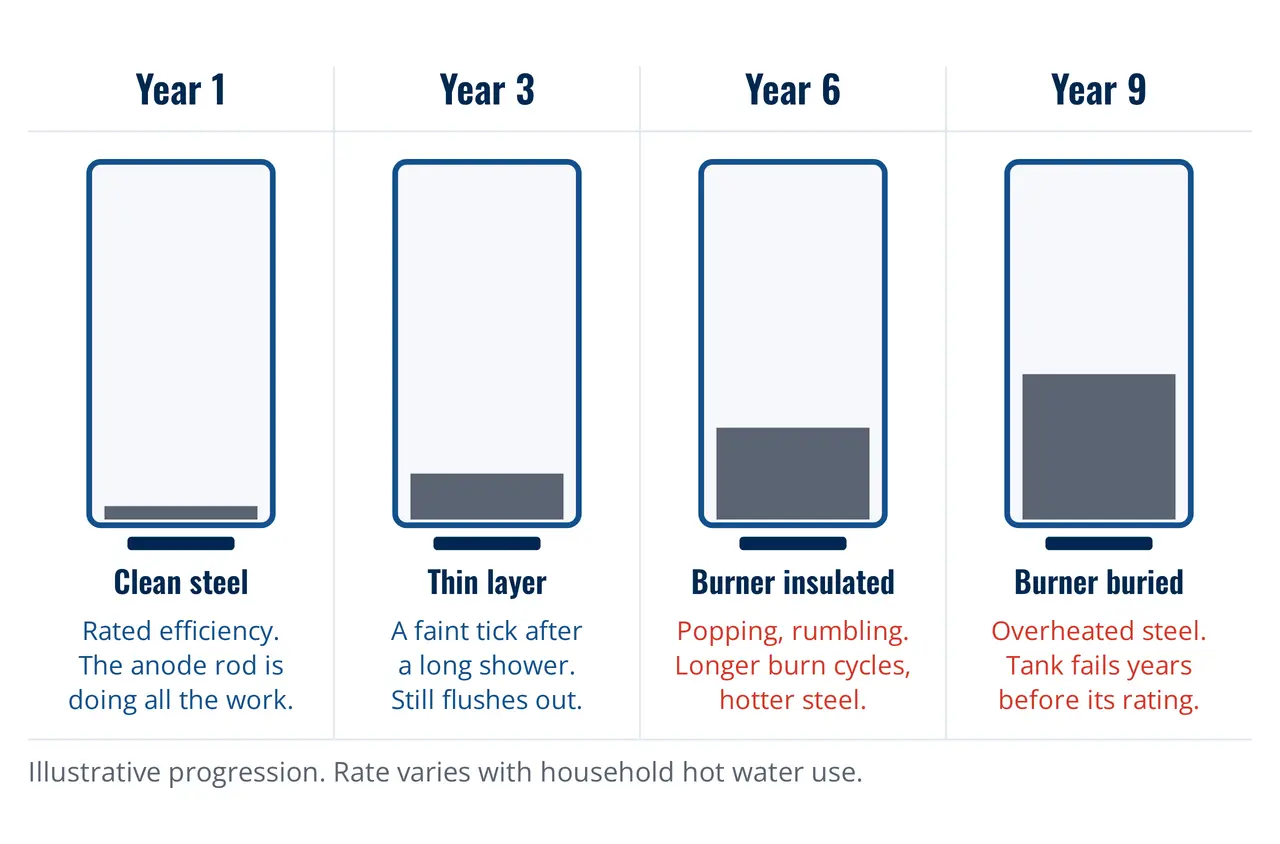
Picture a gas tank heater. The burner sits under the steel bottom and heats the water through it. Now put half an inch of water heater sediment between the flame and the water. That mineral bed does not conduct heat well, and it creates three problems at once.
The burner stays lit longer to reach the same setpoint, because it is heating through an insulator. The steel between flame and bed runs hotter than designed, accelerating corrosion. And the layer occupies volume, so a fifty gallon tank stops holding fifty gallons of usable hot water.
Electric units fail differently but no better. The lower element sits in the sediment zone, gets buried, and burns out dumping heat into a mineral bed instead of water. People replace the element, it fails again within a year, and nobody flushes the tank causing it.
That popping deserves its own note, because it is the most common thing homeowners call about and the most ignored. You are hearing water trapped under the bed flashing to steam. It is not the tank about to explode. It confirms the water heater sediment layer has formed, so the heater is aging faster than the calendar says. More in common water heater problems.
Five Warning Signs of Water Heater Sediment
You do not need to open the tank to know the layer is there. These five signs of water heater sediment arrive roughly in order, and the first usually shows up years before anything looks wrong.
- Popping, rumbling or cracklingSteam escaping from under the mineral bed. The earliest reliable sign, and the one most people wait out.
- Hot water runs out sooner than it used toThe layer occupies volume, so a fifty gallon tank stops holding fifty gallons of usable hot water.
- Longer recovery between showersThe burner is heating through an insulator, so it runs longer to reach the same setpoint.
- Cloudy, gritty or rust-tinged hot waterLoose mineral carried out with the flow. If the cold side is clear, the tank is the source.
- The drain valve runs slow or will not clearCompacted debris around the outlet, and where a do-it-yourself flush goes wrong.
The Anode Rod Is Meant to Die. Yours Probably Already Has.
Inside every tank heater is a rod of magnesium or aluminium threaded into the top, there to corrode. Those metals are more active than steel, so the rod gives up its own material instead of the tank doing it. It is the cheapest part in the appliance and the most important one for how long the tank lives.
When the rod is consumed the corrosion moves to the steel shell and works on any flaw in the glass lining. From there the tank is on a countdown no repair reverses. Rusty hot water with clear cold water is often exactly this.
Manufacturers differ on the interval, which tells you how much local water chemistry matters. Rheem advises replacing the anode every three to four years; A.O. Smith says five, or whenever it is significantly corroded. In water that lays down this much water heater sediment we inspect at year three.
One more detail explains a misdiagnosed noise. A.O. Smith notes that crackling, often with beads of aluminium hydroxide, means an aluminium anode reacting with excess chlorine, and recommends an aluminium-zinc rod. That rod also fixes a rotten-egg smell. If your hot water smells and your cold does not, look at the anode.
When you have your heater serviced, ask for the anode rod to be pulled and shown to you. It takes a few minutes with the right socket, and a rod that is down to bare wire tells you more about the remaining life of your tank than the manufacture date on the label does. If a company will not do this, or tells you the rod does not need checking, that is useful information about the company.
Flushing: The National Advice Versus This Water
Nearly every manufacturer says flush annually, and every national article repeats it. That advice was written for the average American supply, which lays down water heater sediment far more slowly than ours. A.O. Smith’s own guidance acknowledges the gap, recommending an annual flush and adding that it should be more frequent with hard water.
| Task | Published guidance | What we recommend here | Why it differs |
|---|---|---|---|
| Flush the tank | Annually | Every 6 months if unsoftened | At 15–20 grains, a year’s build-up is often too compacted to flush cleanly. |
| Inspect the anode rod | Every 3–5 years | Inspect at year 3 | Rheem says 3–4 years, A.O. Smith says 5 or when corroded. Our mineral load argues for the short end. |
| Descale a tankless unit | Annually | Annually with a softener, more often without | Narrow heat exchanger passages restrict flow far sooner than a tank does. |
| Check static water pressure | Rarely specified | Annually | SAWS delivers 35 to 175 psi and recommends staying at or below 80. |
| Test the T&P relief valve | Annually | Annually | No local difference, but scale can seize an untested valve. |
| Full professional service | Varies | Once a year | Catches a dead anode and a blocked pan drain while both are cheap. |
Published intervals come from the manufacturer sources listed below. The San Antonio column reflects our field practice in 15 to 20 grain water rather than a published standard. See our pricing page for scheduled service.
One caution about flushing a tank that has never been flushed, because this is where do-it-yourself goes wrong. On an eight or ten year old unit with a compacted bed, opening the drain valve can dislodge material that jams the valve partly open, and now you cannot stop it draining. Start the habit early rather than skipping it.
On unsoftened houses here we see tanks fail around year seven or eight rather than the eight to twelve the manufacturer prints. It is almost never a defective unit. It is a tank never flushed, with an anode consumed around year four, in water two or three times the hardness the design assumed. Softened houses on the same street go past twelve.
Hard Water Changes the Tankless Math
Tankless units get recommended here constantly, and they are genuinely good machines. Rheem puts a well-maintained tankless unit at fifteen to twenty or more years against eight to twelve for a tank. The phrase doing the work is “well-maintained,” and hard water is what makes the gap between those outcomes wider here than almost anywhere.
The reason is geometry. A tank has a broad flat bottom, so water heater sediment settling there is a slow, forgiving failure. A tankless unit runs water through narrow passages and heats it hard on the way past. Because those passages are small, a layer that would be trivial in a tank measurably restricts flow. You get reduced volume, temperature swings, and eventually an error code.
None of that makes tankless wrong here. It makes two things non-negotiable: isolation valves fitted at install, so descaling is a routine call, and a softened house, because descaling a softened unit once a year is easy while descaling an unsoftened one is a chore most households abandon by year three.
Commit to that and a tankless unit here is an excellent twenty-year appliance. If you know you will not, a tank is the more honest purchase. A heat exchanger gives none of the slow warning water heater sediment gives you in a tank — it just starts throwing codes. Install costs are in what a water heater replacement really costs here.
Pressure Makes Every Bit of It Worse
Here is the local factor almost nobody raises on a sales call. SAWS publishes that pressure in its service area can range from 35 to 175 psi and recommends household pressure stay at or below 80 psi. Where you fall in that spread depends largely on elevation, and parts of the Hill Country side of town sit well up it.
High pressure alone shortens the life of every connector and supply line. Combined with water heater sediment it does something specific. The relief valve has a seat that must seal, and high pressure with mineral-laden water makes it either weep continuously or seize shut. A weeping valve gets misread as a leaking water heater constantly. A seized one is a safety device silently out of service.
Checking costs almost nothing. A gauge that threads onto a hose bibb is cheap and takes a minute. Above 80, a pressure reducing valve is the fix, and it sits on your side of the meter, which SAWS is explicit about. With a PRV in place your plumbing is a closed system, so a thermal expansion tank belongs on the heater.
Does a Softener Actually Pay for Itself Here?
The weak argument is energy savings on the heater alone. The U.S. Department of Energy puts water heating at about 18 percent of home energy use, and water heater sediment does cut efficiency. But nobody should buy a softener on that line alone, because the saving is real and modest rather than dramatic.
The strong argument is equipment life across the whole house. A properly sized whole-home softener protects the heater, dishwasher, clothes washer, ice maker and every fixture finish from one cause. Heaters we see comfortably past twelve years here almost always have softened water and very little water heater sediment. Costs are in whether you need a water softener.
A few honest caveats. A softener is equipment, with its own maintenance, salt cost and failure modes: one out of salt for two years does nothing while its owner believes they are protected. Salt-free conditioners change how the mineral behaves rather than removing hardness, and the confident percentage claims online are ones we will not repeat.
Neither SAWS nor CPS Energy offers a rebate on a softener or a water heater, so if a salesperson says a utility incentive will offset the price, ask to see the program page.
The right order is simple. Test pressure first, the cheapest problem to find. Then flush the heater and inspect the anode. Then decide about softening the water coming into the house, ideally before your next heater, so the new tank spends its whole life in treated water. Homeowners in Helotes ask most, and the aquifer geology is why.
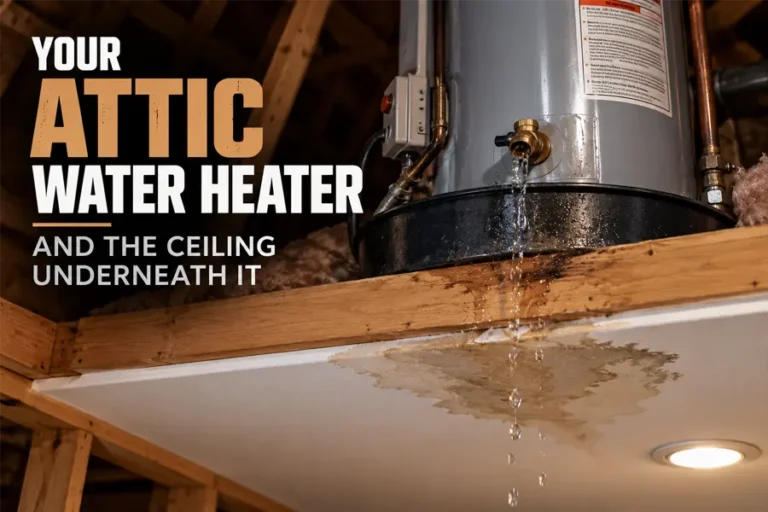
And if your heater lives in the attic, water heater sediment and high pressure are the leading cause of the leak that shows up on your ceiling — covered in what stands between an attic water heater and your ceiling.
Frequently Asked Questions
How hard is San Antonio water, exactly?
SAWS states typical hardness runs 15 to 20 grains per gallon, about 257 to 342 parts per million as calcium carbonate, from the limestone Edwards and Trinity aquifers. Hard starts around 7 grains, so San Antonio sits at two to three times that — which is why water heater sediment builds so fast.
Will flushing remove water heater sediment that has already formed?
Often yes, if it is still loose. On a regularly flushed tank it usually quiets things. On a ninth-year tank never flushed, the water heater sediment is compacted and a flush removes only part of it. The noise may improve without disappearing, which tells you the tank is further along than the calendar suggests.
My hot water smells like rotten eggs but the cold water is fine. Why?
That is almost always the anode rod rather than the water supply, which is why only the hot side smells. Certain bacteria react with a magnesium or aluminum rod and produce hydrogen sulfide. A.O. Smith recommends an aluminum-zinc rod for this, and it is the usual fix. Have the existing rod pulled and inspected at the same time, since it is already out.
Can I flush the water heater myself?
On a maintained unit, yes, with a hose and an hour. The caution is a tank eight or more years old never flushed, where dislodged water heater sediment can jam the drain valve partly open and leave you unable to stop the flow. If yours is in that category, or in the attic, have the first one done by someone carrying a replacement valve.
Does a water softener make a tankless heater unnecessary to descale?
No, but it turns annual descaling from a chore into a routine. Softened water slows scale in the heat exchanger without removing the requirement, and manufacturers specify the service regardless. Skipping it also tends to affect warranty coverage. Descale yearly and fit isolation valves so it is quick.
Is a whole-house filter the same thing as a softener?
No, and this mix-up costs people money. A sediment or carbon filter removes particulate, chlorine taste and odor. It does not remove dissolved calcium and magnesium, so it does nothing about water heater sediment. If you want scale protection you need a softener or conditioner — get in writing which one is quoted.
Want San Antonio plumbing answers from a local licensed plumber at the top of your results? Add Silverback as a preferred source.
Find Out What Your Water Is Actually Doing
We test hardness and pressure, flush the tank, pull the anode rod and show it to you. If the heater has years left, that is what you will hear — and you will know how much water heater sediment you are working against.
Serving San Antonio, Helotes, Boerne, Bulverde, Schertz, Somerset and Stone Oak. We also handle water heater service and replacement, and answer questions on our FAQ page.Sources
- SAWS Water Quality FAQs — typical hardness of 15 to 20 grains per gallon.
- SAWS — Water Pressure Problems — the 35 to 175 psi range and the 80 psi household recommendation.
- A.O. Smith — What to Do When Your Water Heater Is Making Noises — popping attributed to sediment, the aluminium hydroxide reaction, and anode replacement every five years.
- Rheem — Water Heater Lifespan: When to Repair vs. Replace — 8 to 12 years for tanks, 15 to 20+ for tankless, anode replacement every three to four years.
- U.S. Department of Energy — Water Heating — water heating as roughly 18 percent of home energy use.