

The typical water heater replacement cost in San Antonio, for a like-for-like 40–50 gallon tank in a garage or closet, is $1,800 to $2,900 installed. Put that same heater in the attic and add roughly $300 to $700. A heat pump unit lands around $2,500 to $4,500, and converting to gas tankless runs $4,500 to $8,000 or more. The city permit itself is $8, plus a $50 inspection.
- A like-for-like 40–50 gallon tank in a garage or closet runs $1,800 to $2,900 installed. The same heater in the attic adds roughly $300 to $700.
- The permit is not what makes a quote expensive. San Antonio charges $8 for the permit and $50 for the inspection — the gap between two quotes is scope, not paperwork.
- Two honest quotes can land $2,000 apart because they assume different units, different locations and different code work. Compare what is included before you compare the number.
- San Antonio water heaters die young for a reason, and it is not the brand. Replacing the tank without addressing the water buys you the same failure again.
When your water heater quits, you get a fast education in how far apart two water heater replacement cost quotes can sit. The tank at the home center says $700. The first company says $1,800. The second says $4,500 and hands you a folder about tankless. Most people end up picking a number rather than a solution.
The spread is real, and it comes down to four things that have little to do with the brand on the tank: what kind of heater goes back in, where in the house it lives, what the current setup is missing under today’s code, and whether the company is pricing the job or pricing your emergency. It helps to know what a complete water heater installation includes here.
Below is what each of those four adds to a water heater replacement cost, using San Antonio and Hill Country ranges for 2026 rather than a national average built from markets nothing like ours.
Why Two Honest Quotes Can Land $2,000 Apart
Two plumbers can look at the same garage, do equally good work, and write very different numbers, because they are solving different problems. One is quoting a swap. The other is quoting a swap plus everything the original installer skipped fifteen years ago. Neither is lying to you.
Here is what genuinely moves the price, roughly in order of how often it shows up on a San Antonio job:
| Cost driver | Typical add | Why it comes up |
|---|---|---|
| Attic location | $300–$700 | Two people, stairs, tight framing, and a pan and drain line that has to be right. |
| Thermal expansion tank | $150–$350 | Required on a closed system. Many older installs never had one. |
| Pressure reducing valve | $350–$700 | Street pressure above 80 psi will shorten the life of the new tank. |
| Gas or vent correction | $200–$900 | Undersized gas line, missing sediment trap, or a vent that no longer passes. |
| Electrical for a heat pump unit | $400–$1,200 | Dedicated circuit, and a condensate drain the old tank never needed. |
| Moving the unit out of the attic | $900–$2,500 | New water and gas runs, new venting, and patching where it used to live. |
| After-hours or same-night | 1.5–2× labor | A leaking tank at 9pm is a different job than one scheduled for Thursday. |
Market-typical San Antonio water heater replacement cost ranges for 2026, not a Silverback rate card. Your written quote is the only number that counts — see our pricing page for how we put one together.
Only one line on that table is about the water heater itself. The rest of your water heater replacement cost is about the house, which is why a good plumber wants to see the space — and why a phone quote given without a single question should worry you.
Water Heater Replacement Cost by Type of Unit
Once the house-specific work is accounted for, the remaining decision is what you put back in, and that single choice moves the water heater replacement cost further than anything else on the quote. The field here is narrower than the internet makes it sound, mostly because of our water and our attics.
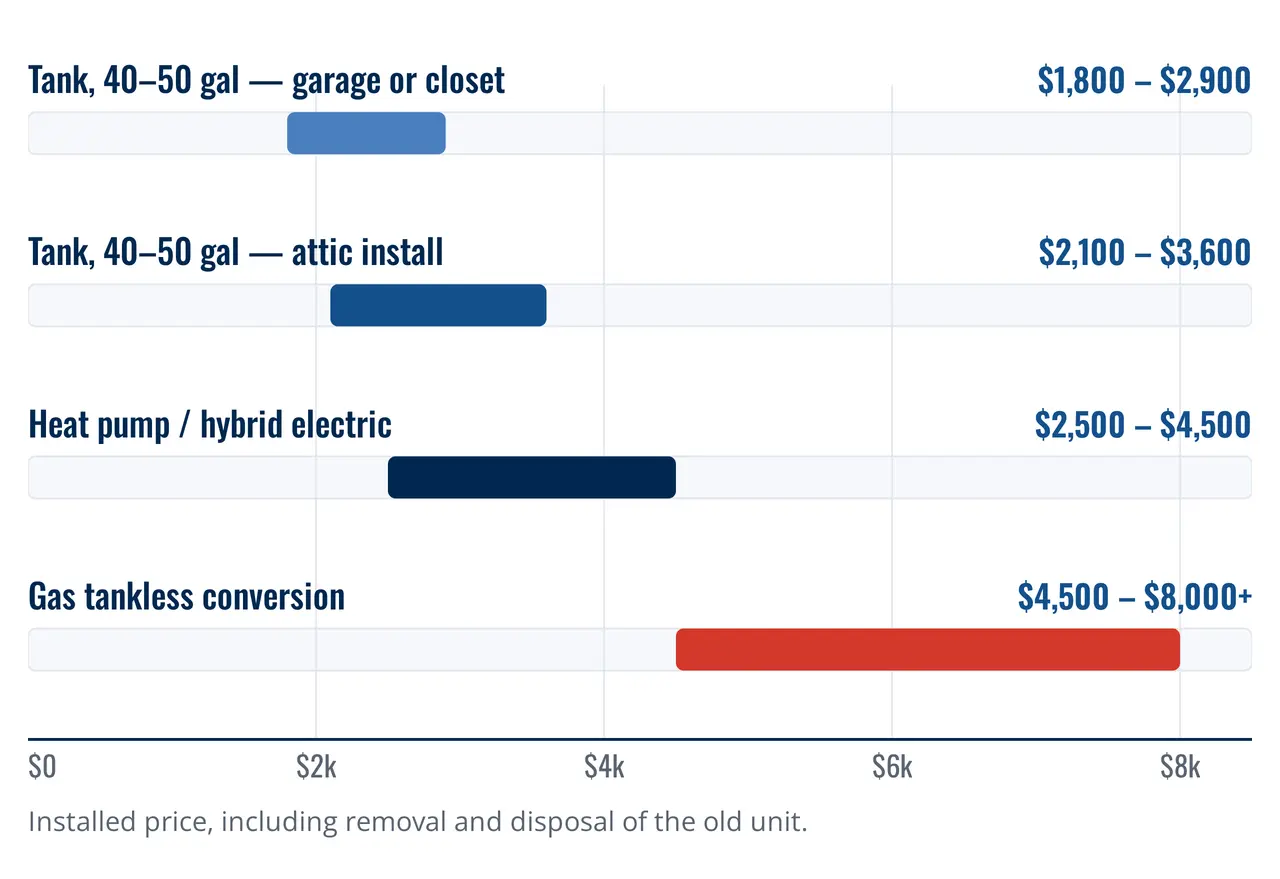
The tankless number surprises people most. A tankless unit fires much harder than a tank, so a conversion usually means upsizing the gas line, adding a dedicated vent, a condensate drain and an isolation valve kit for descaling. The appliance is maybe a third of that water heater replacement cost. The rest is infrastructure a tank never needed.
Heat pump water heaters are genuinely efficient, but the U.S. Department of Energy specifies that they need to sit in a space that stays between 40°F and 90°F year-round with at least 1,000 cubic feet of air around them. A San Antonio attic in August is nowhere near that window. If you want one it belongs in the garage, and that relocation belongs in the water heater replacement cost you are quoted, not discovered on install day.
Repair or Replace: The Rule We Actually Use
Most people calling hope a $300 part buys two more years and defers the whole water heater replacement cost. Sometimes it does. The honest answer depends almost entirely on age, because no repair addresses the tank itself rusting from the inside.
| Age of unit | What’s usually worth fixing | Call it |
|---|---|---|
| Under 6 years | Thermostat, element, thermocouple, gas valve, T&P valve, anode rod. | Repair |
| 6–9 years | Repair if the fix is under roughly a third of replacement cost and the tank is dry. | Judgment call |
| 10+ years, dry | Small repairs only. Start planning the replacement on your schedule, not the tank’s. | Plan ahead |
| Any age, leaking from the tank | Nothing. A weeping tank seam is not repairable. | Replace |
| Any age, rusty hot water only | Anode rod if it’s young; otherwise the tank lining is going. | Inspect first |
The line that matters most is the last-but-one. A dry, merely old tank is a very different situation from a dripping one, and the difference is whether you choose the timing. A Tuesday morning replacement costs meaningfully less than a Saturday night one, and it lets you compare quotes instead of accepting whoever answers.
The calls we get most often are not from people whose heater failed suddenly. They are from people who heard it popping for six months, meant to get it looked at, and then found the ceiling wet. Sediment noise is not cosmetic. It is the sound of a tank working hotter than it was designed to, and in this city it brings the water heater replacement cost forward years before the national averages say it should.
The $8 Line Item Nobody Explains
Most homeowners assume the permit line on a water heater replacement cost quote is padding, and most companies never explain it. The numbers are public. The City of San Antonio charges $8 for a water heater permit, gas or electric, and $50 for the inspection that follows. Scheduling it through the online portal is free.
What it really buys you is a record. When you sell and the buyer’s inspector asks about the water heater, a permitted install is a clean answer. An unpermitted one becomes a negotiating point exactly when you have the least leverage.
Texas law is clearer here than most people expect. Under the state Occupations Code, a property owner needs no plumbing license to work on their own homestead, and San Antonio will issue a homeowner a plumbing permit on that basis. The exemption is narrow, though: it covers the home you actually live in, and you sign an affidavit committing to do the work yourself. It does not cover a rental or a flip.
Anyone doing this work for pay in Texas has to be licensed, and you can verify that in about thirty seconds. The Texas State Board of Plumbing Examiners publishes a searchable license lookup, and Master Plumber license numbers all begin with the letter M.
Neither SAWS nor CPS Energy offers a rebate on a residential water heater. If a salesperson says a rebate will offset the price, ask to see the program page first. SAWS rebates are all outdoor and irrigation related, with one exception: a water flow sensor rebate, genuinely useful if you have an attic unit.
Why San Antonio Water Heaters Die Young
Manufacturers put a tank’s life at eight to twelve years. Here a neglected unit often falls short, pulling the water heater replacement cost forward for two local reasons that have nothing to do with the brand you bought.
The first is hardness. SAWS states its water typically runs 15 to 20 grains per gallon, from the Edwards and Trinity aquifers. The USGS classifies anything over about 10.5 grains as very hard, so San Antonio is well past that line.
Every gallon drops calcium and magnesium on the tank bottom. That layer insulates the burner from the water it is meant to heat, so the steel runs hotter than it was built for. That is the popping sound, and the main reason a water heater replacement cost lands years earlier here than the warranty implies. It is why softening the water coming into the house pays back more than any brand upgrade.
The second is pressure, and almost nobody mentions it. SAWS publishes that delivered pressure can range from 35 to 175 psi, and recommends staying at or below 80. A house at 140 psi stresses every fixture, supply line and relief valve continuously. A pressure reducing valve is the homeowner’s responsibility, on the homeowner’s side of the meter, and it is often why a second water heater replacement cost arrives five years after the first.
The longer version of the hardness story is in how hard water wears out a San Antonio home. The mechanism doing the damage is in what water heater sediment does to a tank, and the symptom guide is common water heater problems.
Five Questions to Ask Before You Sign Anything
Any quoted water heater replacement cost is really the answer to questions the plumber has already asked themselves about your house. These five are worth asking out loud.
- Is the permit and inspection in this price?Get it in writing. It is $58 of actual cost, so if someone is charging hundreds for it, ask what else is in that line.
- What’s my static water pressure at the hose bibb?A plumber who has not checked is quoting a tank into conditions that may kill it. It takes ninety seconds with a gauge.
- Does this quote include an expansion tank, and do I need one?On a closed system you do. If it is not on the quote and it is required, it will appear later.
- If it’s going in the attic, what does the pan drain to?A pan with nowhere to go is decoration. The drain line has to terminate somewhere you will actually notice.
- What’s the warranty on the labor, not just the tank?Manufacturer tank warranties are common. Labor coverage is where companies actually differ.
If a quote is missing those answers, that is a follow-up call rather than a signature. More sit on our frequently asked questions page, and who is responsible for the work is public too. Everything we install across San Antonio and the Hill Country gets permitted and inspected as a matter of course.
Frequently Asked Questions
How long should a water heater last in San Antonio?
Plan on eight to twelve years for a tank and fifteen or more for a tankless unit that is descaled on schedule. Local water at 15 to 20 grains per gallon pushes neglected tanks toward the short end. Annual flushing and a softener are the cheapest way to push the water heater replacement cost further out.
Can I replace my own water heater in Texas?
On your own homestead, yes. Texas exempts property owners from licensing for plumbing work on the home they live in, and San Antonio will issue you a homeowner plumbing permit. You sign an affidavit committing to do the work yourself, and it does not extend to rentals. Doing it yourself takes the labor out of the water heater replacement cost, but gas connections and venting are where DIY installs most often fail inspection.
Why is my water heater in the attic, and is that safe?
It is a builder decision, not a mistake — slab-on-grade homes have no basement and attic space is cheap floor plan. It is safe when it is installed correctly, which means a proper drain pan plumbed to a visible exterior termination, correct venting, and a walkable path to service it. The risk is not the heater, it is a leak you do not find until the ceiling tells you.
Is a tankless water heater worth it with water this hard?
It can be, but only if you commit to descaling. Tankless heat exchangers scale faster than tank bottoms do, and a neglected unit in San Antonio will start throwing flow errors within a few years. If you install tankless here, add a softener and budget for descaling. If you will not do the maintenance, a tank is the more honest choice and the lower water heater replacement cost.
My water heater is 12 years old but working fine. Should I replace it?
Not because of the calendar alone. Have it inspected — the anode rod, the T&P valve, the base of the tank and the connections will tell you more than the age does. What age does change is your planning. Past ten years, decide now where the replacement happens, so the water heater replacement cost is a scheduled job rather than a flood.
What is the small tank my plumber wants to add above the heater?
That is a thermal expansion tank. When water heats it expands, and if your home has a check valve or pressure reducing valve, that expansion has nowhere to go and drives pressure up inside the system. The expansion tank absorbs it. On a closed system it is required, and it is one of the cheapest things that protects a new heater.
Want San Antonio plumbing answers from a local licensed plumber at the top of your results? Add Silverback as a preferred source.
Getting a Number You Can Actually Compare
We check pressure, look at the space, and tell you what the job needs before we put a water heater replacement cost in writing — including the parts that are not the water heater. If the honest answer is that yours has a few years left, that is what you will hear.
Serving San Antonio, Helotes, Boerne, Bulverde, Schertz, Somerset and Stone Oak. Open 24/7.Sources
- SAWS Water Quality FAQs — San Antonio hardness of 15 to 20 grains per gallon, Edwards and Trinity aquifer sources.
- SAWS — Water Pressure Problems — delivered pressure range of 35 to 175 psi and the 80 psi household recommendation.
- City of San Antonio Plumbing, Gas & Sewer Permit Application (PDF) — $8 water heater permit fee and $50 plumbing inspection fee.
- Texas Occupations Code Chapter 1301 — the homestead exemption and the licensing requirement for paid plumbing work.
- U.S. Department of Energy — Heat Pump Water Heaters — the 40°F to 90°F and 1,000 cubic foot installation requirements.