
Yes — and skipping the gas line permit does not get you a fine, it gets you no gas. CPS Energy states that where required inspections have not been received, it cannot set your gas meter. On a renovation the utility will install the meter and leave it in a locked position until the paperwork arrives. Skipping the permit does not save money — it leaves you without gas.
- Skipping the gas line permit does not get you a fine. It gets you no gas.
- CPS Energy states that where required inspections have not been received, it cannot set your gas meter. On a renovation the utility installs the meter and leaves it locked until the paperwork arrives.
- So the permit is not the expensive part of the job — it is the part that decides whether the job works at all.
No Permit, No Gas: What Actually Happens
Most articles about permits argue from the rulebook, and homeowners quietly discount that argument. Enforcement is thin and a gas line permit looks like a tax on something you were doing anyway. It is a reasonable gamble until you see how the city and the utility hand off to each other here.
CPS Energy does not decide on its own whether your gas piping is safe to energize. It relies on the municipal inspection, and says so plainly: if gas permit inspections are required and not received, CPS Energy cannot set your gas meter. On a renovation it goes further — the utility installs your infrastructure and meters, but in a locked position, and leaves them that way until the inspections come through.
That is the whole point of this article. The failure mode is not a citation months later. It is a meter on the side of your house, installed, visibly finished, delivering nothing. You cannot cook, run a gas water heater, or start the generator you spent five figures on. The only route out is backwards: pull the gas line permit you skipped and open up whatever the inspector needs to see.
That last part is the expensive half. San Antonio inspects gas piping before concealment, so a line already behind sheetrock, brick or stone is not grandfathered in because it is finished. It gets exposed. The utility’s standards say the same about buried pipe: it stays open until inspected and approved, and pipe covered early is uncovered at the direction of the authority having jurisdiction. You pay twice, plus the finish repair.
The worst case we see is not a homeowner who skipped a gas line permit. It is one who hired someone who said they would handle it and did not. The work looks finished, the invoice is paid, the contractor is unreachable, and the meter is locked. Ask for the permit number before final payment, not after, and confirm it exists. A licensed plumber can send you that in a text message.
What the City Inspects, and When
A gas line permit in San Antonio carries two inspections, and they happen at very specific moments. Getting the timing wrong is the most common reason a job stalls.
The rough-in inspection happens once all the gas lines are installed and before any concealment — before sheetrock, insulation, paneling, metal lath, plaster, brick or stone goes over them. The inspector checks pipe sizing, materials, how the piping is secured, and whether the system holds test pressure. The final inspection comes once installation is complete, covering gas valves, appliance connections, equipment accessibility, and again that the system holds pressure.
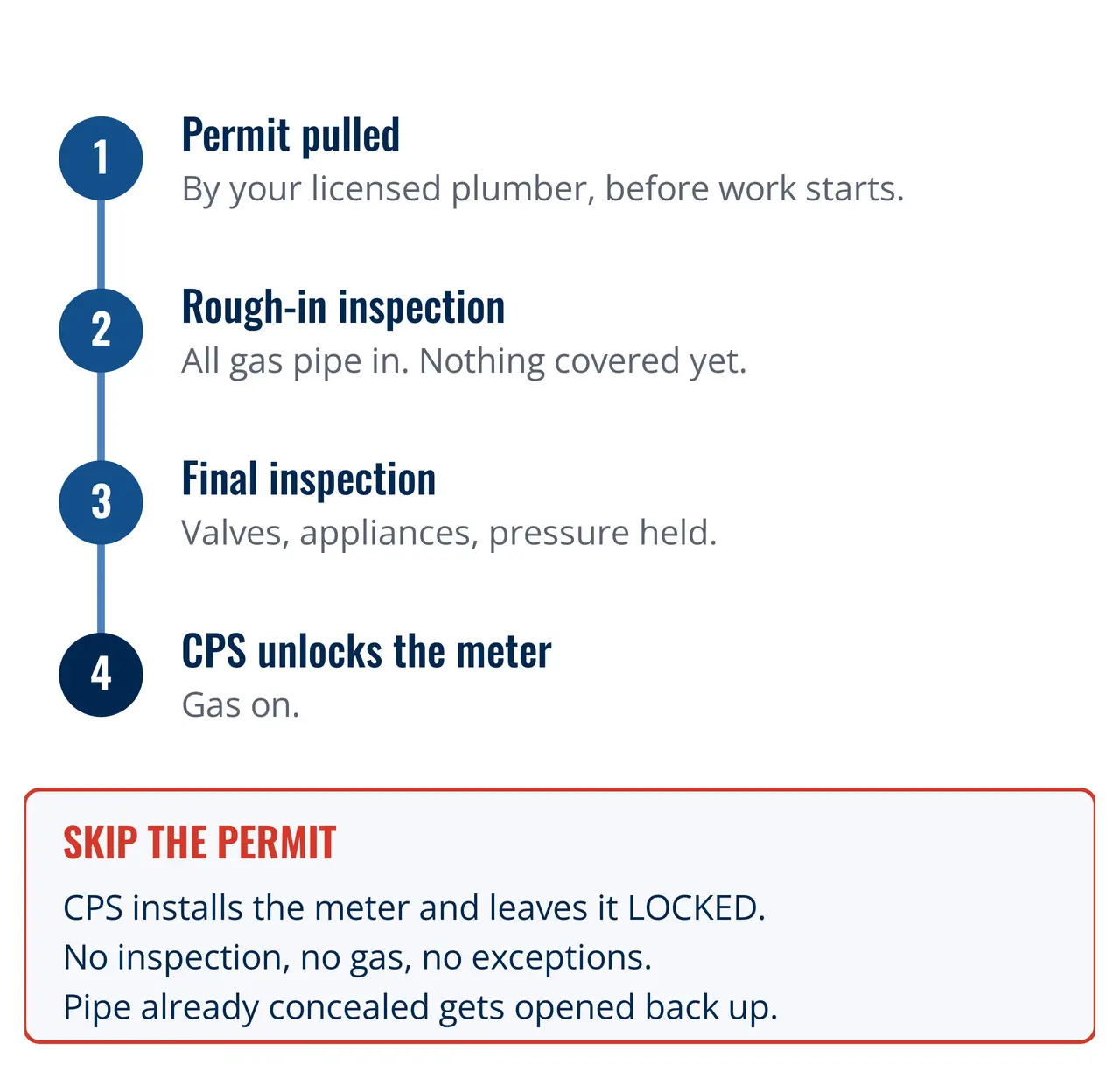
The scheduling lesson is that the rough-in has to line up with your builder’s drywall schedule, and those two trades do not automatically talk to each other. On a remodel with several contractors, the gas rough-in is the one somebody else’s crew covers if nobody is watching the calendar. Have that conversation at the start, not the morning the sheetrock arrives.
One more piece of timing sits outside the city’s hands. Where a job needs new or upgraded service, CPS Energy runs its own design and construction process, adding weeks to a schedule people plan around the gas line permit alone. Both tracks have to start early. We cover the budget side in the cost guide, and this process applies anywhere in our San Antonio service area.
Can You Pull Your Own Gas Line Permit?
Sometimes, and the conditions are narrower than almost anyone expects. San Antonio will issue a homeowner a gas line permit, but only for an existing residence that is your homestead, and only if you will personally do the work. You must be registered with Bexar County as the property owner, and you sign an affidavit to get it.
The affidavit is where people get caught. It commits you to making the installation personally, in its own words, without the assistance of any person or persons. That is not boilerplate about supervision — it rules out a handyman, a friend with a truck, and an unlicensed helper paid cash. It also confirms the property is your home, not a business or rental. The work still gets inspected.
So the homeowner gas line permit does not cover a rental, a flip, a property you are about to list, a second home, or new construction. It covers exactly one situation: you, doing the work alone, on the house you live in.
If any part of that is not true, a licensed plumber under a Responsible Master Plumber pulls the gas line permit. Texas law treats gas piping as plumbing, not a separate trade, which is why there is no such thing as a gas specialist who is not a plumber. We cover that in our guide to handling a gas leak, and the general case in why hiring a licensed plumber matters.
We are called fairly often to take over a homeowner gas line permit partway through, and it is rarely a clean handoff. The permit was issued on an affidavit saying one specific person would do the work alone, so a licensed plumber stepping in usually means re-permitting rather than finishing under the existing one. Decide at the start. Whose license the work would sit under here is on the owner’s page.
What a Gas Line Permit Costs
Here we are going to be less definitive than most pages, deliberately. The city’s plumbing, gas and sewer permit application lists a gas inspection fee of $50, plus small per-opening charges and flat fees for scope items like a gas test, a line extension or replacement, a meter split or a relocation. In-person submissions add a processing fee and a surcharge, and phone scheduling carries a small fee.
| Item | Listed fee | Notes |
|---|---|---|
| Gas inspection fee | $50 | See the caution below — confirm this figure before you budget on it. |
| Openings, 1 to 5 | $10 | Each additional opening beyond five adds a few dollars. |
| Gas test | $8 | Listed as its own scope item on the application. |
| Gas line extension or replacement | $8 | Each listed separately on the application form. |
| Meter split or relocation | $8 | The utility-side work is priced separately by CPS Energy. |
| In-person submission | $10 + 6% | A processing fee plus a surcharge. Online avoids it. |
Fees as listed on the city’s permit application. Verify current amounts with Development Services before budgeting — see the caution below.
Now the caution. Cross-checked against the Development Services fee schedule, that document appeared to show a gas inspection fee of $100 rather than $50. Its tables did not render cleanly enough for us to be confident, so we will not tell you which is right. Call Development Services at 210-207-6000 and ask what a gas line permit costs before relying on either figure. Publishing a number we are unsure of would be worse than admitting it.
Either way, a gas line permit is a rounding error against the job — rarely more than one percent of it, which makes it the cheapest insurance on the invoice. The numbers that actually matter are in our gas line cost breakdown. How we fold permits and inspections into a written quote rather than surfacing them later is on our pricing page.
Two Local Rules That Fail National Installs
This is where a gas line permit stops being paperwork and starts being technical. San Antonio amends the fuel gas code in ways the model code does not, and two of those amendments will fail an install that would pass almost anywhere else — which matters most if you are working from a YouTube video or a contractor who mostly works outside Bexar County.
The first concerns corrugated stainless steel tubing, the flexible yellow or black line that has largely replaced rigid pipe for interior runs. San Antonio prohibits it in the meter loop, and prohibits it in exterior walls. Both are placements the model code permits, so an installer following national practice puts tubing exactly there without a second thought, and the gas line permit inspection fails.
The second concerns pressure testing. San Antonio does not simply adopt the national requirement. It sets its own, and the local numbers are more demanding than the baseline most national articles quote.
| Stage | Required test | Hold |
|---|---|---|
| Rough-in | A column of mercury 15 inches in height, or a 10 psi air test. | Held without loss for the inspection. |
| Final | A column of mercury 6 inches in height, or a 5 psi air test, with shutoff valves attached. | Held without loss for the inspection. |
| High-pressure systems | 1.5 times the operating pressure for the system. | Minimum 30 minutes. |
| Test gauge | Grade 1A or better per ANSI/ASME B40.100-2005. | Applies to all of the above. |
Two other amendments catch experienced installers too. Thread joint sealants must be nonhardening and resistant to the gas constituents, so the wrong pipe dope fails. And unions are prohibited in concealed spaces: legal in an open garage, not legal once it disappears into a wall.
The amendment text above comes from Development Services training material issued for the 2021 code cycle. San Antonio has since adopted the 2024 International Fuel Gas Code and International Plumbing Code, effective May 1, 2025, under Ordinance No. 2025-01-30-0075. The substance very likely carried forward, but section numbering may have changed — verify against the current amendments before quoting a section to an inspector.
The Bonding Item That Ambushes You at Resale
If you have flexible tubing anywhere in the house, one more requirement has nothing to do with the gas line permit and everything to do with lightning — which in this part of Texas is not theoretical.
Corrugated stainless tubing has a thinner wall than rigid iron pipe. When lightning strikes nearby, current can travel through a home’s metallic systems and arc to or from the gas line, and a thin wall perforates far more easily. The fix is bonding: a conductor tying the gas piping to the electrical service grounding system so everything rises and falls in potential together instead of arcing.
The requirement is specific. The bonding conductor must be a minimum of 6 AWG copper or equivalent aluminum, and may not exceed 75 feet. Only a single point of attachment is required regardless of system size, and it goes downstream of the meter and regulator, to rigid pipe, a malleable iron fitting, a prefabricated manifold or a brass tubing fitting. Critically, the tubing itself cannot be the attachment point.
Yellow, non-arc-resistant tubing must be bonded. Black arc-resistant jacketed products are exempt, unless mixed with yellow tubing or there is no equipment grounding conductor present.
Where this bites is at resale. Missing bonding is among the items Texas home inspectors flag most consistently, surfacing at the worst moment for the seller’s leverage. Remediation runs $150 to $400 depending on access and conductor length — trivial before listing, irritating during an option period. Our gas line team checks bonding on any call, and our water softener permit guide covers similar local requirements.
Frequently Asked Questions
Do I need a permit to run a gas line to my outdoor grill?
Yes. The city’s application lists underground gas lines and extensions as permitted scope, and a grill line is both. Because the run is outside, the gas line permit inspection focuses on the buried portion, which has to stay open until inspected. Backfilling first means digging it up again.
What happens if I already ran a gas line without a permit?
It is fixable, and better dealt with now than at closing. A licensed plumber pulls a gas line permit for the existing work, and the inspector needs to see the piping, so anything concealed or buried gets exposed. Expect to pay for the permit, inspection, exposure and finish repair — far cheaper than discovering it during a sale.
Can my general contractor pull the gas permit for my remodel?
No. The gas line permit has to be pulled by a plumbing contractor registered with the city, working under a Responsible Master Plumber, because gas piping is plumbing under Texas law. A general contractor coordinates it but does not hold it. Ask who is pulling it and get the number, because this is the trade most often assumed to be someone else’s job.
How long does a gas inspection take to schedule in San Antonio?
Inspections are requested through Development Services, and phone scheduling carries a small fee while the online portal does not. Turnaround varies with workload, so request the rough-in as soon as piping is complete rather than waiting for drywall. The delay that hurts is not the queue, it is uncovering work that got closed up early.
Does my existing yellow flexible gas line have to be replaced?
Not usually. Yellow corrugated tubing that was legally installed does not have to come out, but it must be bonded, and in San Antonio it cannot sit in the meter loop or an exterior wall. If yours does, or has no bonding conductor, that is a correction rather than a replacement and costs far less than repiping.
Want San Antonio plumbing answers from a local licensed plumber at the top of your results? Add Silverback as a preferred source.
We Pull the Permit and Meet the Inspector
The gas line permit, rough-in, final and the coordination with CPS Energy are part of the job, not an upcharge you find later. If your line went in without a permit, we will tell you honestly what it takes to bring it current.
Serving San Antonio, Helotes, Boerne, Bulverde, Schertz, Somerset and Stone Oak. Open 24/7.Sources
- CPS Energy — New Home Construction Underground Service — CPS cannot set a gas meter where required permit inspections have not been received.
- CPS Energy — Home Renovation — the locked-meter policy on renovations, and supplying the permit and city inspection to the utility.
- City of San Antonio Plumbing Affidavit for Homeowner’s Permit (PDF) — the homestead conditions and the commitment to work without the assistance of any person or persons.
- City of San Antonio Plumbing, Gas & Sewer Permit Application (PDF) — gas scope categories and the listed permit and inspection fees.
- City of San Antonio Development Services — Fuel Gas Code training (PDF) — amendments prohibiting flexible tubing in the meter loop and exterior walls, plus local test pressures and gauge grade.
- ICC — CodeNotes: Bonding of CSST Gas Piping Systems — the 6 AWG minimum, 75-foot maximum, single attachment point, and the arc-resistant exemption.