
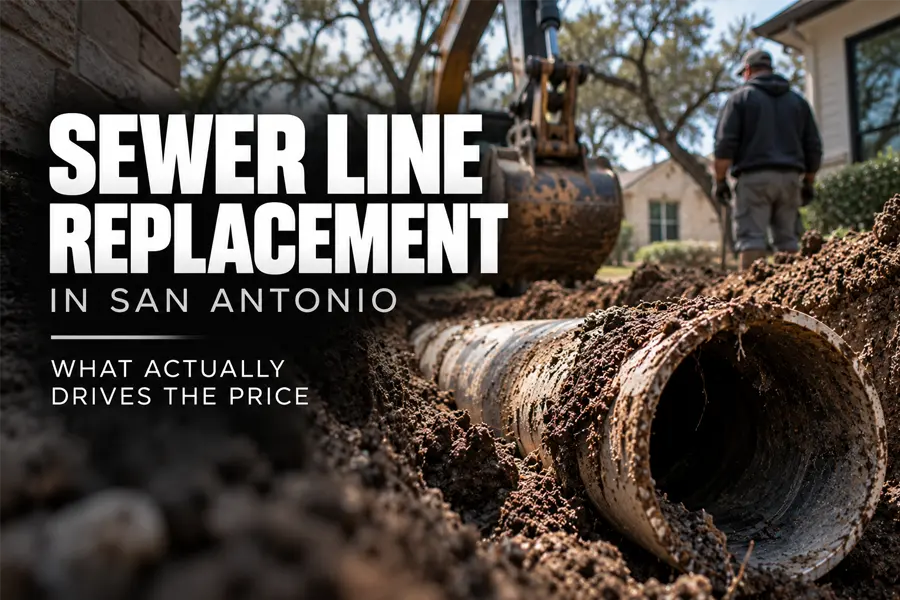
A sewer line replacement is priced in four layers, not one. Market-typical San Antonio rates run $80 to $250 per linear foot for trenchless against $50 to $200 for open-cut, but once a dig crosses the sidewalk the city’s permit tier flips: $170 total for an excavation of 49 feet or less, versus a daily-fee permit plus a 30-day submission lead time at 50 feet or more.
- A sewer line replacement is priced in four layers, not one. A single per-foot number tells you almost nothing about the final bill.
- Market-typical San Antonio rates run $80 to $250 per linear foot trenchless against $50 to $200 open-cut.
- Once the dig crosses the sidewalk the city’s permit tier flips: $170 total at 49 feet or less, versus a daily-fee permit plus a 30-day submission lead time at 50 feet or more.
Two licensed companies look at the same camera footage. One quotes a liner for around six thousand dollars; the other says lining would waste your money and quotes a full sewer line replacement closer to eleven. Both sound certain, and neither is necessarily wrong.
The numbers diverge because a sewer line replacement is not one price. It is four stacked on top of each other: the pipe and the labor, the excavation and access work, the surface that has to go back afterward, and the permitting and traffic control your location forces on the job.
Change where the pipe runs and the same fifty feet can swing by thousands. Below is how each layer behaves, and the one local rule that moves the number most.
Why Two Honest Quotes Recommend Opposite Things
Lining and a full sewer line replacement solve different problems, so a company leading with one is describing a different repair. Cured-in-place lining restores a host pipe that is still structurally there; pipe bursting and open-cut remove the old line entirely. If your pipe is cracked at the joints but still round, both are legitimate. If it has lost its shape, only one is real.
A company invested in one method describes your pipe in the terms that method solves, and that is not always cynical. Your job is not to referee their honesty but to get the camera footage and ask both the same three questions, which we walk through at the end.
If sewage is coming up through a floor drain right now, that is an after-hours emergency call, not a shopping exercise. Whether the blockage is even on your side of the property line has its own answer here, covered in who pays for a SAWS sewer backup.
What Each Sewer Line Replacement Method Does to Your Yard
Cured-in-place pipe lining, or CIPP, pulls a resin-saturated tube through the existing pipe and cures it hard against the old walls. You get a continuous jointless pipe inside the old one, slightly smaller in diameter, with no open joints for roots to find. Access is typically the existing cleanout, so this sewer line replacement method can finish in a day with almost nothing dug up.
Pipe bursting reaches a similar outcome differently. A bursting head is pulled through the old line on a cable, fracturing it outward while dragging a new polyethylene pipe in behind it. This sewer line replacement method needs a pit at each end rather than a trench, so the yard damage is two holes instead of a scar.
Open-cut sewer line replacement is not the primitive option people assume. You trench the line, lay new pipe on compacted bedding at the grade you want, and see every inch of what you installed. When a line has lost its shape, when the fall is wrong, or when the route itself is the problem, open-cut is the only method that fixes the actual defect. The cost of that certainty is the trench.
Where Lining Genuinely Does Not Apply
Most pages about trenchless work leave this section out, and it is the one that protects you from paying for a repair that will not hold. A liner needs a host pipe, and it conforms to whatever shape it cures inside.
A collapsed line cannot be lined: there is no continuous path to pull a tube through and nothing sound to cure against. A significant belly, where the pipe has dropped below grade and standing water sits in it, cannot be corrected by lining either. The liner follows the sag.
Lining fixes joints and cracks, not grade, and anybody who says otherwise is describing a product rather than your pipe. A pipe deteriorated past a certain point also stops being a viable host. In each case a full sewer line replacement is the honest recommendation rather than an upsell.
So: lining suits a structurally intact line with cracked or root-infiltrated joints, pipe bursting handles badly deteriorated runs, and open-cut sewer line replacement is for when the geometry is wrong or the line has failed outright. The rest of the disagreement is usually about permits.
A written camera report should give you the material, the distance from the cleanout to each defect, and whether standing water was visible. That is the belly question, and it decides whether lining is on the table. NASSCO, the standards body for pipeline assessment in North America, treats internal television inspection as the foundation of any condition assessment, so a sewer line replacement recommendation made without it is a guess with a price attached.
The 49-Foot Line That Changes the Whole Job
Here is the local detail that moves more money than any material decision in a sewer line replacement. The City of San Antonio prices right-of-way work in tiers, and the boundary sits at fifty feet of excavation. Forty-nine feet or less is a Point Repair Permit, a flat fee. Fifty feet or more becomes a Project Permit, with an escalating daily fee and a thirty-day submission requirement.
Think about what thirty days means. If your lateral fails and the route crosses into the right-of-way at fifty feet or more, you are looking at a month of lead time on a house with a compromised sewer line.
That single fact is often the strongest argument for a trenchless sewer line replacement, because bursting or lining the same run keeps excavation down to entry and exit pits, which can land the job in the flat-fee tier and skip the queue.
| Requirement | What the city charges or requires | When it applies |
|---|---|---|
| Point Repair Permit | $170 total | A $50 application fee plus a $120 inspection fee. |
| Project Permit | $50 + daily fee | Daily tiers from $60 under 60 days to $150 past 180 days. |
| Submission lead time | 30 days | Required at least 30 days before excavation begins. |
| Lane or sidewalk closure | $50 + formula | 0.0629 multiplied by closed area in square feet, times days. |
| Contractor insurance | $5M / $1M / $1M | General liability and umbrella combined, plus auto and workers comp. |
| Performance bond | $100K or $10K | $100,000 for unlimited permits, or a $10,000 bond per permit address. |
| Working without a permit | $600 per day | Charged per day, per violation. |
| SAWS tie-in | GCP first | Required before the city permit is paid for. |
Fees published by the City of San Antonio Public Works right-of-way program, current September 2026. Your quote depends on route, depth and surface — see our pricing page.
Two rows deserve attention. The insurance and bonding figures explain why a suspiciously cheap right-of-way quote should worry you: a contractor not registered and bonded for that work cannot legally pull the permit. And the violation figure is not theoretical. It lands on the property, at exactly the moment you are least able to argue.
Sequencing matters too. On any job tying into the public main, the SAWS permit comes before the city’s, and a crew that does not know that order will burn a week discovering it. Our sewer line repair and replacement crew handles that sequencing as part of the job rather than as a surprise.
What a Sewer Line Replacement Costs, Layer by Layer
Put that together on one job and the per-foot comparison stops being the point. Consider a sixty-foot lateral running from the house, under the front walk and into the right-of-way. That layout is common here, and it is where two sewer line replacement methods separate most clearly.
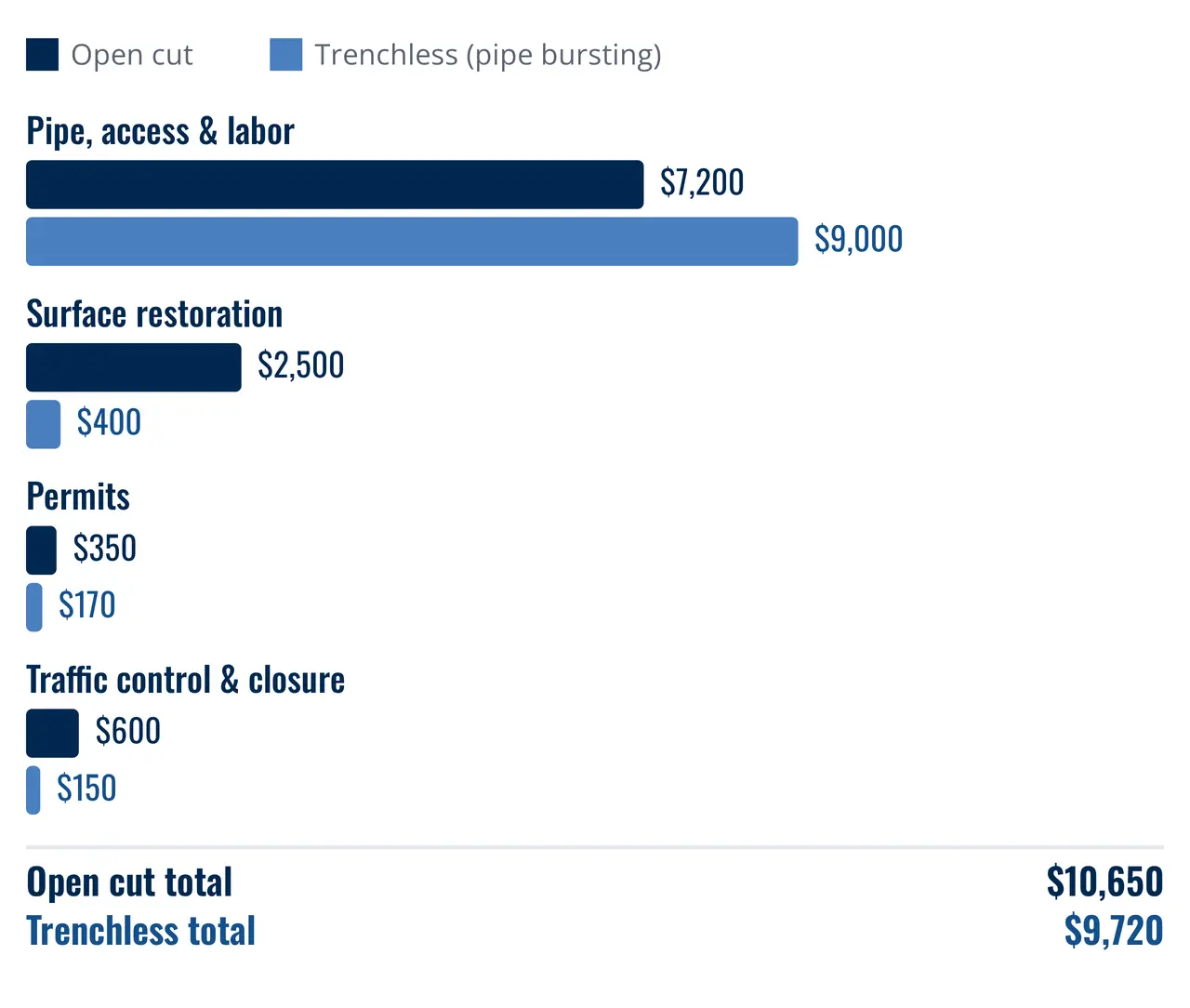
Open-cut wins on the line item everyone shops on and loses on the three nobody asks about. Trenchless loses on the headline rate and wins downstream. Which is cheaper depends on what sits on top of the pipe, which is why distance to the main is the biggest cost variable in any sewer line replacement. Ten extra feet of driveway can move a quote more than the pipe material will.
Market-Typical Sewer Line Replacement Ranges
These reflect what sewer work generally runs in the San Antonio and Hill Country market in 2026. They are a sanity check for a sewer line replacement quote you have been handed, not a rate card.
| Work | Typical range | What moves it |
|---|---|---|
| Camera inspection | $250–$500 | Cleanout access. No cleanout means pulling a fixture. |
| Spot repair, 2–4 ft | $1,500–$4,000 | Depth, and whether it sits under a slab, drive or walk. |
| Belly repair | $2,500–$7,500 | Length of the sag and how much must be re-graded. |
| CIPP lining, 40 ft | $3,200–$10,000 | Diameter, bends, and whether a branch needs reinstating. |
| Pipe bursting, 40 ft | $2,400–$8,000 | Pit locations, soil, and nearby utilities. |
| Open-trench replacement, 40 ft | $2,000–$10,000 | Turf is cheap, stamped concrete is not. |
| Collapsed line replacement | $5,000–$25,000+ | Depth, and whether the failure sits in the right-of-way. |
| Trenchless, per linear foot | $80–$250 | Method, diameter and access. |
| Open-cut, per linear foot | $50–$200 | Depth and restoration on top. |
Market-typical sewer line replacement ranges for the San Antonio area in 2026, not a Silverback rate card. Every one depends on what the camera finds — see how we price work.
One range deserves a caution. The collapsed-line spread is not vagueness: a collapse in your front yard and one under the curb are different projects with the same name, and the second brings the whole permit and restoration apparatus. A firm collapsed-line sewer line replacement price quoted over the phone, without locating the failure, is the cheap version of an expensive job.
The pattern we see most often is a homeowner who has paid to clear the line two or three times over a couple of years and reads each clearing as a fix. By the time somebody puts a camera down it, the repair that would have worked at the first backup has grown into a sewer line replacement.
Three Questions That Settle Competing Quotes
You do not need to become a pipe expert to choose between two sewer line replacement bids. You need both companies to answer the same small set of factual questions, because where the answers diverge is exactly where the real disagreement lives.
- Was there standing water anywhere in the run, and at what distance?This decides whether lining is legitimately available. If one says no belly and the other says significant belly, ask both to point at the footage. One is reading it wrong, and that is factual rather than opinion.
- How many feet of excavation will be in the public right-of-way?Forty-nine and fifty-one produce completely different permits, fees and schedules. A company that cannot tell you this number has not planned the job yet.
- What surface has to come out, and who is putting it back?Restoration is where quotes hide. Get sidewalk, driveway apron, turf and irrigation named explicitly in writing, or you will negotiate them after the trench is open.
If both bids survive with matching answers, you are choosing between two valid approaches and can decide on disruption and warranty. For the symptom side, the walkthrough lives in sewer line problems and what to do about them. If clearing might still be the whole answer, jetting versus snaking covers that fork honestly.
It is worth knowing why your line failed before choosing how to fix it. Seasonal ground movement in our clay soils shears joints along the whole run rather than at one spot, which changes the case for a spot repair against a full sewer line replacement. We covered that in why San Antonio sewer lines fail. If you are buying rather than repairing, the sewer scope guide for buyers is the one to read first.
Frequently Asked Questions
Is trenchless sewer replacement always cheaper than digging?
No. Trenchless carries a higher per-foot rate, typically $80 to $250 against $50 to $200 for open-cut here. It wins on total cost mainly when the run crosses hard surfaces or reaches the right-of-way, because it avoids most restoration, traffic control and often the higher permit tier. Under an open lawn, digging is frequently cheaper.
Can a collapsed sewer line be lined instead of dug up?
No. Cured-in-place lining needs an intact host pipe to cure against and a continuous path to pull the tube through, and a collapse eliminates both. Pipe bursting can sometimes handle a badly deteriorated but continuous line. A true collapse means excavation at the failure point.
Will lining fix a belly in my sewer line?
It will not. A liner conforms to the shape of the pipe it cures inside, so a sag stays a sag and standing water still collects in the same low spot. Lining solves cracked joints and root intrusion, not grade. Correcting a belly means excavating that section and re-laying pipe at the right fall.
Why does my quote change so much based on distance to the street?
Because distance decides which permit tier the job falls into and how much surface has to be restored. An excavation of 49 feet or less takes a flat $170 Point Repair Permit, while 50 feet or more becomes a Project Permit with daily fees and a 30-day submission requirement. Ten extra feet can add weeks and thousands.
Do I need a permit to replace a sewer line on my own property?
Yes. The City of San Antonio issues a plumbing, gas and sewer permit with fees banded by the length of the run, and the work is inspected. A separate right-of-way permit applies once excavation reaches public property, and a SAWS General Contractors Permit comes first on a tie-in to the public main.
How long does each method take from start to finish?
Lining a straightforward lateral is often a single day, and pipe bursting one to two. Open-cut depends more on surface and depth than length, and can stretch across several days once restoration is counted. The larger risk is administrative: excavation of 50 feet or more must be submitted 30 days ahead.
Want San Antonio plumbing answers from a local licensed plumber at the top of your results? Add Silverback as a preferred source.
Get the Footage First, Then the Number
We camera the line, tell you where the defect sits relative to the right-of-way, and quote the sewer line replacement method the pipe needs. If lining is the right call we will say so, and if not we will show you why on the screen.
Serving San Antonio, Helotes, Boerne, Bulverde, Schertz, Somerset and Stone Oak. Open 24/7 for sewer emergencies.Sources
- City of San Antonio — Right-of-Way Permit Types — the $170 Point Repair Permit, Project Permit daily tiers, and the closure formula.
- City of San Antonio — Right-of-Way Permits — insurance and bond thresholds, the 30-day submission rule, the $600 per day violation fee, and the SAWS permit sequence.
- City of San Antonio Plumbing, Gas & Sewer Permit Application (PDF) — sewer permit fees banded by length of run.
- NASSCO — Pipeline Assessment — television inspection as the basis of condition assessment.
- Texas State Board of Plumbing Examiners — license verification for any contractor quoting the work.