

A sewer scope is worth it on almost any older San Antonio home, because your general inspection does not include one. It falls outside the TREC Standards of Practice, so a standard Texas home inspection skips the line entirely. Market-typical cost runs $250 to $500 standalone, or $100 to $250 added to the home inspection, against a replacement that can reach five figures.
- A sewer scope falls outside the TREC Standards of Practice, so a standard Texas home inspection skips the line entirely. Nobody is checking it unless you ask.
- Market-typical cost runs $250 to $500 standalone, or $100 to $250 added to the home inspection.
- That is set against a replacement that can reach five figures — which is the whole argument for scoping an older home before you buy it.
There is a specific and expensive assumption Texas buyers make, and almost nobody corrects it until after closing: that the home inspection covered the sewer line. It is reasonable to believe, since the report is long, thorough and covers the roof, the slab, the electrical panel and the water heater. If it covers all that, surely somebody looked at the pipe carrying everything out of the house.
Nobody did, and that is not an oversight by your inspector. A sewer scope falls outside the Standards of Practice that govern Texas real estate inspectors, so it is not part of the inspection they are licensed to deliver. Inspectors have been able to offer it as an optional ancillary service since September 2020, but you must ask and pay separately. If you did not order a sewer scope, the most expensive repair a house can hand you was never examined.
Your Home Inspection Does Not Cover This
The gap is narrower than people think, which is why it is easy to miss. A Texas inspector will report visible symptoms that touch the drainage system: slow drainage, standing water, evidence of past backups, a toilet that does not clear. All of that belongs in the report if it is present on inspection day.
What the report cannot tell you is the condition of the buried pipe, which is what a sewer scope is for. A lateral can be cracked at half a dozen joints, hold standing water in a belly, be root-filled, and still move a single flushed toilet without complaint. Drainage problems announce themselves under load, and an empty house is the lowest-load condition that home will ever see.
That is the entire case for the sewer scope. You are not buying a second opinion on the inspector’s work. You are buying information about a component that was never in scope, cannot be assessed from inside the house, and is among the costliest things on the property to put right.
What a Sewer Scope Sees, and What It Misses
Overselling one is easy and counterproductive, so here is an honest account of the range. The camera goes in at a cleanout and travels the main line toward the street, recording as it goes. You get pipe material, the location and nature of every defect, and the distance from the access point to each, which makes a repair quotable rather than speculative.
| Question | Can the scope answer it? |
|---|---|
| Is the main line cracked, offset or separated at the joints? | Yes — this is its core purpose |
| Are roots growing into the line, and where? | Yes, with distance from the cleanout |
| What material is the lateral, and how old does it look? | Yes |
| Is there a belly holding standing water? | Usually visible on the footage |
| Is a branch line under the slab failing? | No — the camera is not typically run through branch lines |
| Is the drainage system leaking anywhere? | No — a scope is not a definitive leak test |
| Exactly how many years are left in the line? | No — nobody can tell you that from footage |
Sewer scope limitations reflect the Texas Real Estate Commission’s treatment of sewer inspection as outside the standard inspection.
The two rows with a no beside them matter most, because they are where a sewer scope alone can leave you falsely reassured. A clean main line does not certify the drainage system. If you are worried about a slab leak or a failing branch under the foundation, the camera is the wrong instrument and you need a pressure test. That is a different procedure with different paperwork.
A written summary is fine, but the footage is the asset. If you negotiate a repair credit, the sewer scope recording turns your request into a documented defect rather than an opinion. Any company following NASSCO’s approach to pipeline assessment treats internal television inspection as the basis of the whole exercise, so the recording should be a normal deliverable. Ask for it up front.
Hydrostatic Testing and the Form That Authorizes It
When a sewer scope raises a question it cannot settle, the next step is usually a hydrostatic test. The plumber isolates and fills the drain system with water and watches whether the level drops. A drop means the system is losing water somewhere, which a camera cannot confirm.
Here is the part every buyer and agent should commit to memory. A hydrostatic test cannot be performed on a house you do not own without the seller’s written permission. Access and testing fall under Paragraph 7A of the TREC residential contract, and the instrument granting permission is the Addendum for Authorizing Hydrostatic Testing, catalogued as TAR 1949 and TREC 48-0. The buyer pays, and the addendum lets both sides negotiate who carries liability if the test causes damage.
That liability clause is why sellers hesitate, and it deserves a fair hearing rather than suspicion. Filling an old drain system with a static column of water does stress pipe that has handled nothing but gravity flow for decades. A seller advised that the test carries risk is not necessarily hiding anything. Knowing the addendum exists to allocate that risk is what makes the conversation calm rather than a standoff.
Where a Sewer Scope Fits in the Option Period
Timing trips people up. Everything here happens inside the option period, a short window in most San Antonio contracts, and a sewer scope ordered on day eight of a ten-day option is not a plan. Below is what a buyer’s timeline looks like when it works.
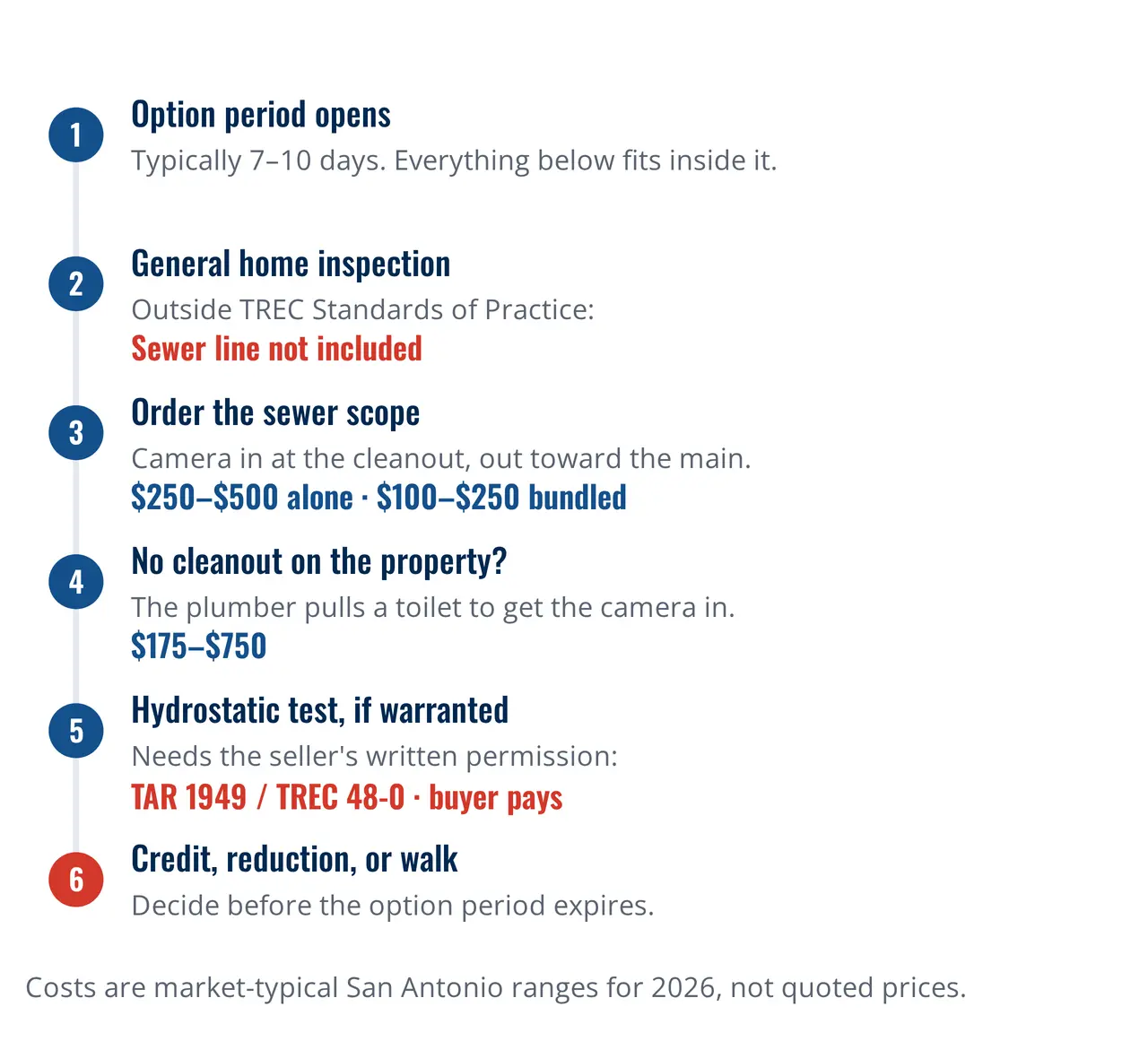
Step four surprises people and is worth planning for. Plenty of older San Antonio homes have no accessible exterior cleanout, so the only way in for the camera is to pull a toilet, run the inspection, then reset the fixture with a fresh wax ring. That is more labor and costs accordingly. If the house is old and there is no visible cleanout, budget the higher end of that range.
Which San Antonio Homes Most Warrant a Sewer Scope
It is not automatically necessary on every purchase, and pretending otherwise would be the overselling this post is trying to avoid. On a five-year-old house on PVC, the odds of finding anything meaningful are low. The case strengthens sharply with two local factors: the age of the lateral, and the ground it sits in.
Age is the blunt instrument. Older San Antonio homes were laid with cast iron and vitrified clay in rigid bell-and-spigot sections, and the joints are the failure point. Monte Vista began development in 1889 and was largely built out by the 1930s; a lateral of that era that has never been replaced has been through an extraordinary number of seasonal cycles. Any pre-war house without documented sewer work is a strong sewer scope candidate.
The ground is the factor most buyers never consider, and it is why risk genuinely differs across this city. Much of mid-county San Antonio sits on Houston Black clay, a vertisol the USDA records as forty to sixty percent clay with high shrink-swell potential, opening cracks up to four inches wide that stay open for months each year. That movement works rigid joints apart over decades.
A house in the mid-county clay belt carries more sewer risk for its age than one on the shallow limestone soils of the far north side. We explain that in why San Antonio sewer lines fail.
If the sewer scope finds a defect out near the street, do not assume the whole repair lands on the buyer. San Antonio splits sewer responsibility at the property line rather than at the main, which changes what a defect near the curb is worth in negotiation. The boundary and claim process are in who pays for a SAWS sewer backup.
Turning Sewer Scope Findings Into a Number
Getting a defect on video is the easy half. Deciding what to ask for is where buyers either overreach and blow up the deal or underreach and eat the cost later. Convert the finding into a repair scope and a price before you ask for anything, because a number backed by a quote is far more persuasive than a general concern about roots.
There are three ways to handle it, and the right one depends on how firm the number is. A repair credit at closing works well when the work is clear and quoted, and it leaves you in control of who does it and when.
A price reduction suits situations where the extent is uncertain and you accept some risk for a discount. Asking the seller to complete the repair before closing sounds appealing but is usually weakest: their incentive is to satisfy the contract at the lowest price, and you inherit whatever they chose.
Walking is right less often than people fear, but it is genuinely right when the footage shows a collapse in the right-of-way, when the seller will not permit the testing needed to size the problem, or when the number changes whether you can afford the house.
Before deciding, get the repair priced properly: a line that can be rehabilitated without opening the street is a very different figure from one that cannot. That comparison is in trenchless versus digging, and the broader cost picture is on our pricing page.
The sewer scope calls that change a transaction are rarely dramatic. A genuine collapse is obvious and gets dealt with. What shifts outcomes is the ordinary-looking older lateral where the camera shows separation at several joints rather than one bad spot, because that is the difference between a manageable repair and a full replacement. Buyers who order early have that conversation calmly.
When a Seller Says No
Occasionally a seller declines the sewer scope or the hydrostatic test, and it is worth reading that correctly rather than assuming the worst. A camera inspection is non-invasive, so refusing one is unusual and warrants real curiosity. A hydrostatic test is different, because it does stress old pipe, and a seller advised to decline may be acting on that advice rather than concealing a defect.
A refusal shifts risk onto you, and you get to price that. If the seller will not permit testing, you are being asked to buy without knowing the condition of the sewer line. Treat the unknown as a cost and negotiate accordingly, or decline. Your agent’s read on the situation matters more than any general rule.
One last note for after you close. If a line you inherited backs up, resist treating repeated clearings as maintenance. That pattern is usually a structural defect announcing itself, covered in why your drain keeps clogging and in sewer line problems and what to do. Sewage entering a new home is an emergency call, and once flow is restored, a camera on the line is how you stop guessing. Our sewer line inspection and repair service handles a pre-purchase sewer scope across San Antonio on option-period timelines.
Frequently Asked Questions
Does a Texas home inspection include the sewer line?
No. Camera inspection of the sewer line falls outside the Texas Real Estate Commission’s Standards of Practice, so it is not part of a standard inspection. Inspectors have been able to offer it as an optional ancillary service since September 2020, but you must request and pay for it separately. Your inspector will report visible drainage symptoms inside the home, not the condition of the buried lateral.
How much does a sewer scope cost in San Antonio?
Market-typical is $250 to $500 as a standalone camera inspection, and $100 to $250 when bundled with the general home inspection, which is the cheaper route if you schedule it together. If the house has no accessible cleanout and the plumber has to pull a toilet to insert the camera, expect $175 to $750 because of the added labor and the fixture reset.
What is the Addendum for Authorizing Hydrostatic Testing?
It is the form that gives a buyer written permission to hydrostatically test a seller’s drain system, catalogued as TAR 1949 and TREC 48-0. Access and testing fall under Paragraph 7A of the TREC residential contract, and this addendum grants specific consent for that test. The buyer pays for it, and the addendum lets both parties negotiate who is liable if the test causes damage.
Is a sewer scope the same as a leak test?
No, and conflating them is a common and costly mistake. A scope is a visual camera inspection of the main line that shows cracks, offsets, roots and standing water. It is not a definitive leak test, and the camera is not typically run through branch lines. Confirming whether the system holds water requires a hydrostatic test, which is a separate procedure needing the seller’s written permission.
Should I still scope a newer San Antonio home?
The case is much weaker. A recent build on PVC in a newer subdivision rarely turns up anything that changes the transaction, and we will tell you so rather than sell you an inspection you do not need. The argument gets strong with age and with soil: pre-war construction, cast iron or vitrified clay laterals, or a location in the mid-county clay belt all shift the odds substantially.
The scope found roots. How much should I ask the seller for?
Get the repair quoted before you ask for anything, because roots can mean a modest spot repair or a full replacement depending on whether the intrusion sits at one joint or several along the run. A specific credit backed by a written quote and the video negotiates far better than a general concern. Roots also indicate the pipe was already open at that point, so the quote should address the joint rather than just the roots.
Want San Antonio plumbing answers from a local licensed plumber at the top of your results? Add Silverback as a preferred source.
Book a Pre-Purchase Sewer Scope Inside Your Option Period
We run the camera, hand you the footage, and tell you plainly whether what we found is a negotiating point or a non-issue. If the line is sound, that is what the sewer scope report will say.
Serving San Antonio, Helotes, Boerne, Bulverde, Schertz, Somerset and Stone Oak. Also drain and sewer clearing, and 24/7 emergency service if a line fails after you move in.Sources
- Texas Real Estate Commission — Inspector Standards of Practice — the scope of a standard Texas real estate inspection and what falls outside it.
- Texas REALTORS — Testing for Plumbing Leaks — Paragraph 7A written permission, the Addendum for Authorizing Hydrostatic Testing (TAR 1949 / TREC 48-0), who pays, and liability negotiation.
- USDA NRCS — Houston Black Official Series Description — clay content of 40 to 60 percent, high shrink-swell potential, and seasonal crack dimensions.
- NASSCO — Pipeline Assessment — internal television inspection as the basis of sewer condition assessment.
- Texas State Board of Plumbing Examiners — license verification for whoever runs your scope.