

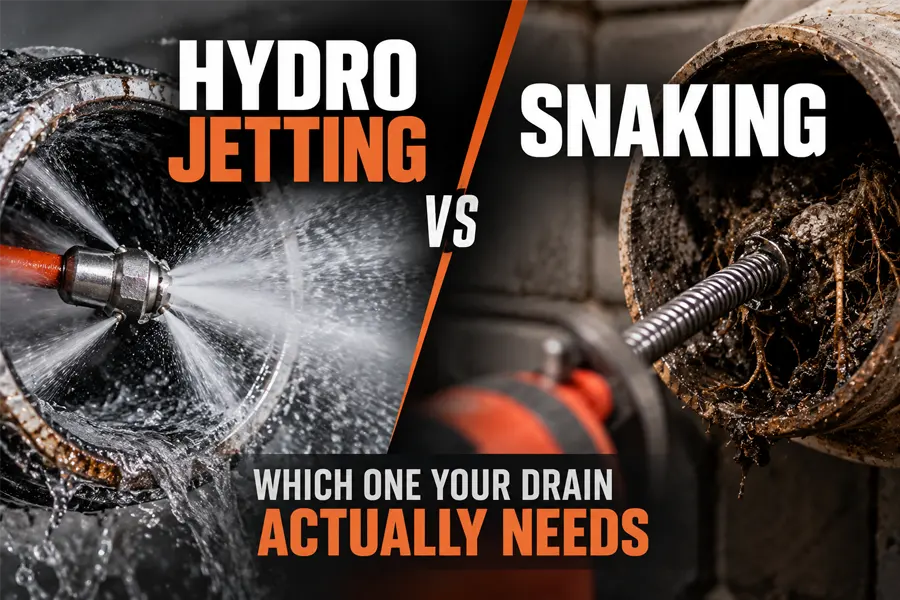
Snaking cuts a channel through a blockage; hydro jetting scours the pipe wall back to full bore. A single slow fixture needs a cable, not a jetter. On a main line we camera first, then jet at 2,500–3,500 PSI on sound PVC, 1,500–2,500 PSI on pre-1980 cast iron, and 1,500–2,000 PSI on clay. If the camera shows a collapse, we do not jet at all.
- Snaking cuts a channel through a blockage. Hydro jetting scours the pipe wall back to full bore. A single slow fixture is a cable job — a jetter is the wrong tool for it.
- Pressure is set by the pipe, not the clog: 2,500–3,500 PSI on sound PVC, 1,500–2,500 PSI on pre-1980 cast iron, 1,500–2,000 PSI on clay. Nothing in a residential line should run above roughly 3,500 PSI.
- The camera goes in first on any main line. If it shows a collapsed section, jetting is off the table — pressure does not fix a broken pipe.
- Roots grow back. Jetting buys a clean bore and a predictable interval, not a permanent fix. The cracked joint feeding them is the actual repair.
Almost everyone who calls us about hydro jetting has already been quoted it by someone else, and wants a second opinion because the number felt high and the explanation felt thin. That instinct is worth respecting. It is genuinely the better tool for certain problems, and also the easiest thing in this trade to sell to someone who does not need it.
The choice between a cable and hydro jetting is not a choice between good and better. They do different things, and the right one depends on how many fixtures are affected, what your pipe is made of and how old it is. On some lines the correct answer is that we will not jet at all.
What Each Tool Is Genuinely For
A drain cable, which most people call a snake or an auger, is a flexible steel shaft with a cutting head on the end. A motor drives it, it follows the bend of the pipe, and the head chews a path through the blockage. What a cable does not do is clean the pipe wall, and that distinction is the whole argument.
If your kitchen line has a half-inch of hardened grease coating a three-inch pipe, a cable punches a hole through the middle and the water runs again. The grease is still there. The clog returns within months, and people blame the plumber when the tool was never going to solve that problem.
Hydro jetting uses a hose with a reverse-facing nozzle that pulls itself up the pipe while firing water backwards against the walls. It strips the pipe back toward its original diameter and flushes the debris out to the main. That is a real difference in outcome, not marketing, and it is why the service costs more and needs water volume many older homes struggle to supply.
The two tools fail in opposite directions. Cabling a grease-packed line buys a result that will not last. Hydro jetting a simple hair clog buys capability you did not need, and occasionally buys damage. Matching the tool to the defect is the entire job, which is why we look before we quote. Our full scope of drain cleaning service in San Antonio starts with that diagnosis.
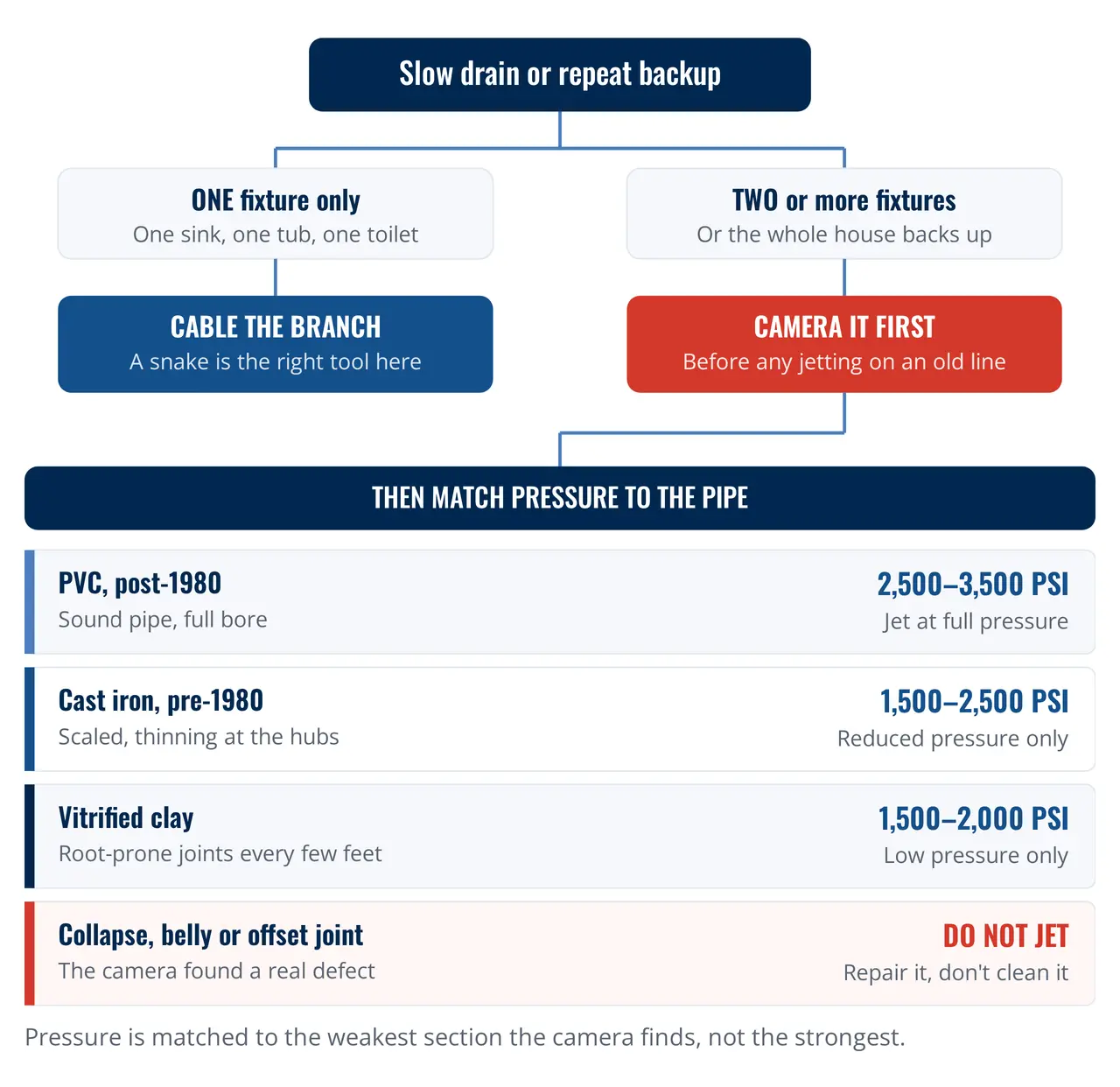
Why Hydro Jetting Waits for a Camera on an Older Line
Here is the part most cost articles skip. Hydro jetting assumes the pipe can take it. On a house built in the last forty years with PVC drains, that is almost always safe. On a house in Monte Vista, Alamo Heights or Terrell Hills with original cast iron under the slab, it is not an assumption to make from the driveway.
Cast iron does not fail evenly. It corrodes from the inside outward, so a pipe that looks sound where it exits the wall can be scaled to half its diameter and paper-thin at a hub twenty feet under the house. Push full pressure into that and you are not cleaning a pipe, you are finishing it off. The failure surfaces weeks later as a damp patch in the yard, by which time the cause is easy to argue about.
A camera takes that argument off the table. It tells us the material, the diameter we actually have left, whether the joints are aligned and whether a low spot is holding water. Twenty minutes of video turns a guess into a plan, and often changes the recommendation entirely — a line with a cracked hub and root intrusion needs a sewer line repair, not a cleaning schedule.
Two local conditions work on these lines constantly. SAWS reports household water here typically runs 15 to 20 grains per gallon, and that mineral load feeds the scale narrowing older drain lines from the inside. The expansive clay soil across much of the city also swells and shrinks seasonally, working at buried joints. Both are why a fifty-year-old line here rarely matches a national maintenance chart.
Hydro Jetting Pressure Limits, and Where We Stop
Most companies will not publish their hydro jetting pressures. We would rather you had them, because they separate a service that protects your pipe from one that gambles with it, and you can put the same question to any plumber.
| Application | Pressure | Flow | Notes |
|---|---|---|---|
| Interior branch drains | 1,500–2,500 PSI | 4–8 GPM | Kitchen and laundry lines where grease is the problem. |
| Main line, sound PVC | 2,500–3,500 PSI | 8–12 GPM | Full working pressure. The pipe is rated for it. |
| Main line, pre-1980 cast iron | 1,500–2,500 PSI | 8–12 GPM | Capped after camera confirms wall thickness. |
| Vitrified clay lateral | 1,500–2,000 PSI | 8–12 GPM | Joints are the weak point, not the barrel. |
| Confirmed collapse or offset | No jetting | — | Excavation or lining. Cleaning cannot fix a defect. |
These are operating limits for residential work, not a price list. What a job costs depends on access, length and what the camera finds — see how we build a quote and what drain cleaning costs in San Antonio.
Some national cost pages quote hydro jetting pressures many times higher than anything in that table. Those figures come from industrial hydro-demolition equipment used to cut concrete. Nothing we would put in a residential line runs above roughly 3,500 PSI.
There are four conditions where we decline to jet and say so plainly. The first is a camera showing a collapsed or fractured section, because pressurised water simply leaves the pipe through the break. The second is a significant belly, since hydro jetting clears the debris settled in the low spot and changes nothing about the sag.
The third is cast iron with visible wall loss, where we either cable it gently or move straight to a repair conversation. The fourth is simply not knowing — a line old enough to be questionable that nobody has looked inside. There the answer is “camera first, then we will tell you.”
If someone quotes you hydro jetting on a house built before 1980 without having put a camera in the line, ask what pipe material they are jetting and what pressure they intend to run. A plumber who has looked will have both answers ready; one who has not will change the subject, and that tells you what you need to know.
Roots Grow Back. Here Is the Honest Timeline.
When a cable with a root-cutting head goes through a mass of roots, it shears them off at the pipe wall. Flow returns immediately, which is why root clearing feels like a decisive fix. It is not. The root system outside the pipe is untouched, the crack that let them in is untouched, and the pipe still carries what the roots were looking for in a dry Texas summer.
The U.S. EPA lists tree roots entering through defects or openings in a sewer line among the standard causes of blockages, and the phrasing matters. Roots do not drill through sound pipe. They find a joint that has separated or a hub that has cracked, and follow the moisture in. The durable question is never how to get the roots out, but what opening they are using.
On a mature live oak or pecan — and this city is full of both — roots extend far beyond the canopy, so the tree responsible for a blockage is frequently not the one standing over the line.
Once roots are established, cleared lines re-block on a seasonal rhythm, and a pipe cut clear several times is a pipe on a shortening leash. Hydro jetting cuts roots back more thoroughly than a cable does, but it still does not close the opening. If you are on an annual root-cutting schedule, the useful conversation is lining or replacing that section, which we cover in sewer line problems and repair costs.
The pattern we see most on older inner-loop properties is a homeowner who has paid someone to clear the same line every spring for four or five years and has never once been shown video of it. Cumulatively that often exceeds what a spot repair would have cost. Nobody lied to them. They were sold the service they asked for instead of the answer to why they kept needing it.
How Often a Line Actually Needs Cleaning
Maintenance intervals are where upselling lives, so it is worth being concrete. A healthy modern line in a careful household may go years without attention. An old line under a big tree is a different animal, and pretending otherwise helps nobody.
| Situation | Interval | What drives it |
|---|---|---|
| Modern PVC, no large trees | Every 3–4 years | Nothing is attacking the pipe. This is housekeeping. |
| Pre-1980 cast iron | Every 18–30 months | Scale narrows the bore faster than a smooth pipe. |
| Mature trees near the line | Annually | Root regrowth on a seasonal cycle. |
| Documented root intrusion | Annual, plus camera | You are managing a defect, not maintaining a pipe. |
| Heavy cooking, no grease habit | Kitchen line yearly | Grease is the one clog homeowners fully control. |
The row worth arguing about is the first one. If you have a nineteen-year-old house in Stone Oak or Alamo Ranch with PVC drains and no oak over the lateral, an annual hydro jetting contract is selling you a solution to a problem you do not have. Decline it without guilt. If your line is cast iron and nobody has seen inside it, the honest first step is one camera inspection.
Telling a Real Recommendation From a Sales Pitch
A genuine hydro jetting recommendation has a shape to it. It names the defect, shows you the evidence, and says what the work will and will not accomplish. It sounds like: the kitchen branch is coated with grease to the stack, a cable will open it for a few months, hydro jetting will take it back to full bore, and none of that addresses the belly at the property line.
A pitch sounds different. It leads with the method rather than the finding, treats jetting as categorically superior rather than situationally correct, and gets vague when you ask what happens if you decline. Urgency without evidence is the clearest signal — a real emergency is visible on a screen, and a plumber who has one will be eager to show you.
Two practical protections are worth insisting on. Ask for the video, and ask for it before you approve any hydro jetting; any shop running a camera can hand you the footage, and reluctance is informative.
Then verify the license, which takes a minute through the Texas State Board of Plumbing Examiners; we wrote more on why that matters in hiring a licensed plumber. If the whole house is backing up now, our emergency plumbing team is on call around the clock — and whether the blockage is even on your side of the property line is covered in who pays for a sewer backup in San Antonio.
Frequently Asked Questions
Is hydro jetting safe for old cast iron pipes?
It can be, at reduced pressure, after a camera confirms the pipe still has wall thickness. We cap pre-1980 cast iron at 1,500 to 2,500 PSI rather than the 2,500 to 3,500 we would use on sound PVC. Where the camera shows wall loss, cracking or a separated hub, we quote the repair instead.
Do I really need a camera inspection before hydro jetting?
On any line built before about 1980, yes. Without it nobody knows the material, the remaining diameter or whether there is an existing break, and pressure gets chosen by guesswork. On a documented modern PVC line with a known grease problem, jetting without a camera is defensible. On an unknown old line it is not.
Will snaking fix roots permanently?
No. Cutting roots restores flow but leaves the root system alive and the crack or open joint they entered through unchanged. Expect regrowth on a seasonal cycle. Jetting cuts them back more completely than a cable does, but the durable fix is closing the opening by lining or replacing that section of pipe.
My plumber wants to jet one slow bathroom sink. Is that necessary?
Almost certainly not. A single slow fixture with every other drain in the house running normally is a branch-line or trap problem, and a cable handles it. Jetting is a main-line and grease-line tool. If only one fixture is affected, ask what a cable would cost and why it would not work.
How long does hydro jetting take, and will it make a mess?
A residential main line typically takes one to two hours including setup and a verification camera pass. Debris flushes downstream to the sewer rather than into the house, and the work is done from an exterior cleanout. If your home has none, adding one is usually the honest first recommendation.
Can I rent a jetter and do this myself?
We would not. Rental units cannot match pressure to pipe condition, the nozzle can reverse and whip back toward the operator, and without a camera nobody knows whether the line can take the pressure. Damage almost always happens where nobody looked first.
Want San Antonio plumbing answers from a local licensed plumber at the top of your results? Add Silverback as a preferred source.
See Your Line Before You Pay to Clean It
We camera first on anything old enough to warrant it, show you the footage, and tell you whether hydro jetting is the right call — including when a cable will do the job for less.
Serving San Antonio, Helotes, Boerne, Bulverde, Schertz, Somerset and Stone Oak. Open 24/7.Sources
- U.S. EPA — Sanitary Sewer Overflow Frequent Questions — tree roots entering through defects or openings as a standard cause of sewer blockages.
- SAWS — Plumbing Backed Up? — the utility’s own instruction to have a licensed plumber televise the line before clearing it.
- SAWS Water Quality FAQs — San Antonio household water hardness of 15 to 20 grains per gallon.
- SAWS — Grease FAQs — how fats, oils and grease coat and block sewer lines.
- Texas State Board of Plumbing Examiners — license verification for any plumber quoting this work.