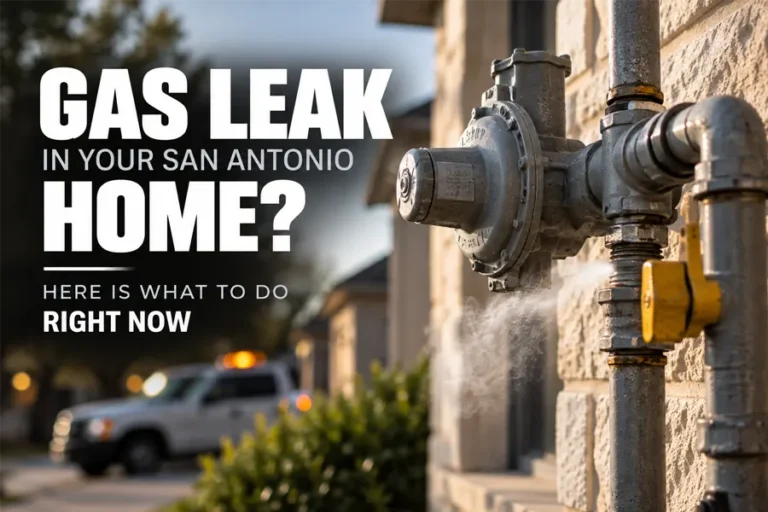

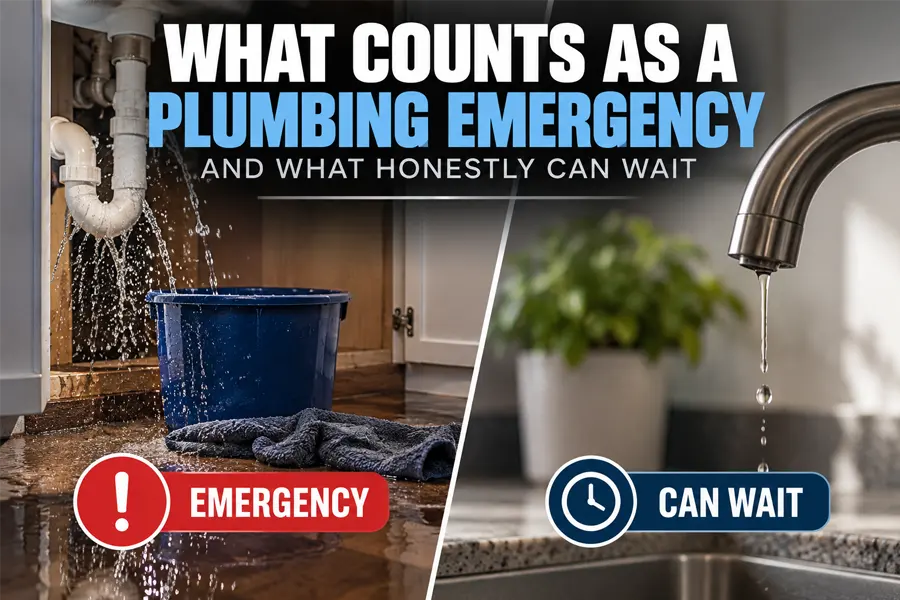
You have a real plumbing emergency if water is moving and you cannot stop it, sewage is inside the living space, you smell gas, you have no water at all during a freeze, or water is near electrical equipment. Nearly everything else can wait for a normal appointment. Expect after-hours labor to run 1.5 to 3 times standard rates, plus a call-out fee.
- It is a real emergency if water is moving and you cannot stop it, sewage is inside the living space, you smell gas, you have no water at all during a freeze, or water is near electrical equipment.
- Nearly everything else can wait for a normal appointment — and waiting is usually the cheaper, better-diagnosed call.
- After-hours labor runs 1.5 to 3 times standard rates. Knowing which list your problem is on is what that premium buys or saves you.
Almost everybody who calls a plumber late at night carries two fears at once: looking foolish for treating a drip like a disaster, and finding that the word emergency turns the price into whatever the person on the phone decides. Between them, those fears make people watch a real plumbing emergency get worse for six hours.
The honest version is simpler. A small number of situations genuinely cannot wait, for reasons of damage, contamination or safety. A much larger number feel urgent, are not, and cost you a premium for nothing. A company running genuine around-the-clock service has no interest in selling you a midnight visit either, because that truck is then unavailable for an actual plumbing emergency.
Three Questions, in This Order
Before you weigh cost or inconvenience, work through three questions that sort a plumbing emergency from a problem that can hold. The first overrides everything else, and the third is the one most people skip.
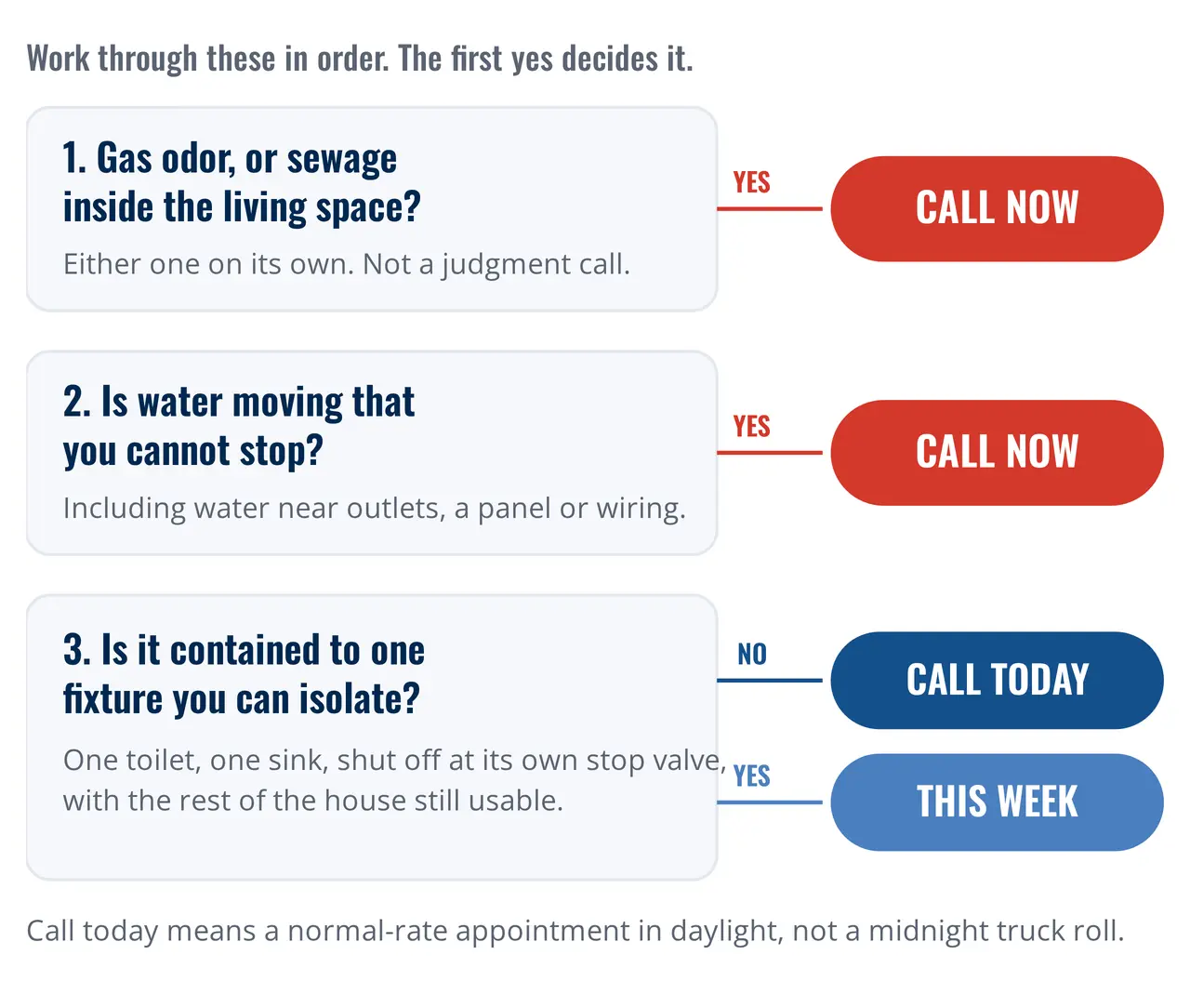
The third question saves the most money, because isolation changes everything. A weeping toilet supply line is a plumbing emergency if you cannot stop it and a Tuesday appointment if you can close the stop valve behind the bowl. Same part, very different bill. Learn which fixtures have working stops before anything goes wrong.
The Five Situations That Are a Real Plumbing Emergency
Five categories are a plumbing emergency every time, and each one gets worse on a clock rather than staying still.
Water you cannot stop is the obvious one, because volume compounds. A supply line at street pressure puts a great deal of water into a building in the time it takes to find a valve, and once it reaches flooring the repair stops being about plumbing. If that is you now, the steps are in the first ten minutes after a pipe bursts.
Sewage inside the living space is the second, and it is a health threshold rather than a convenience one. Grey water on a garage slab is unpleasant; black water coming up through a shower pan into a room where people live is a contamination event, and every hour increases what has to be torn out.
The third is any smell of gas, covered on its own below. The fourth is no water at all during a freeze, which is a plumbing emergency because a frozen line is a leak that has not happened yet and the window closes as the house warms. The fifth is water near outlets, a panel or an attic air handler, where the risk is shock rather than damage.
A sewer backup affecting more than one fixture at once is a main line problem, not a fixture problem, and it will not resolve itself. If the toilet gurgles when the washing machine drains, the blockage is downstream of both and everything you run into the house has nowhere to go. That is a plumbing emergency: stop using water, then call. Whether the line is yours or the utility’s depends on where the blockage sits, which we mapped in who pays for a sewer backup.
What Can Honestly Wait Until Monday
Here is the part most companies leave out, because there is no money in telling you that what you have is not a plumbing emergency. A large share of after-hours calls describe problems that are annoying rather than urgent, and paying the premium at eleven at night buys only an earlier end to the annoyance.
| What you are seeing | When to call | Why |
|---|---|---|
| Any smell of gas | Now — from outside | 911 and CPS Energy first. Leave the building before you call anyone. |
| Water running that you cannot shut off | Now | Damage compounds by the minute, and drying has to start the same day. |
| Sewage backing up into a living space | Now | Contamination, and every additional fixture used makes it worse. |
| Water near outlets, a panel or an air handler | Now | Shock risk. This is a safety call before it is a plumbing call. |
| No water at any fixture during a freeze | Now | A frozen line is a leak that has not happened yet. The window closes on the thaw. |
| Every drain in the house is slow at once | Today | Points at the main line rather than a fixture. It will not clear itself. |
| Water heater leaking from the tank body | Today | A weeping seam becomes an open failure without warning, especially in an attic. |
| Toilet overflowing, but the stop valve works | Today | Once it is isolated, the emergency is over. Daylight is cheaper. |
| Sewer smell indoors with no backup | This week | Usually a dry trap or a vent issue. Unpleasant rather than dangerous. |
| One slow drain, rest of the house fine | This week | A fixture-level blockage. Nothing changes by waiting three days. |
| Dripping faucet or a running toilet | This week | Wastes water and money, damages nothing. Shut the stop valve and sleep. |
| Low pressure at one fixture only | This week | Usually an aerator or a cartridge. Genuinely a routine appointment. |
Urgency reflects damage and safety risk, not our schedule. If you sit between two rows, call and describe it; that conversation is free.
One caveat on the “this week” rows. Waiting is right when a problem is stable and wrong when it is changing. A drain slow for a year is stable; a drain fine on Monday and nearly stopped by Thursday is telling you something is moving. That pattern is in why your drain keeps clogging.
The call we most regret not getting is never the dramatic one. It is the homeowner who saw a damp patch on a ceiling, decided it could keep until the weekend, and by Saturday had drywall on the floor and an adjuster asking how long it had been like that. Water visible on a ceiling has already traveled where you cannot see. That is a plumbing emergency that looks like nothing.
Gas Odor Is Not a Plumbing Call
If you smell rotten eggs anywhere in or around the house, stop reading and go outside. Gas piping is plumbing work under Texas law and a licensed plumber repairs it, but this is the one plumbing emergency you never troubleshoot yourself. The first response is evacuation, and it belongs to the fire department and the utility.
CPS Energy publishes the protocol plainly. Leave the building immediately and leave the door open on your way out. Once away from the house, call 911 and CPS Energy at 210-353-HELP (4357), staffed around the clock.
Do not operate any electrical device, do not turn lights on or off, do not use a phone while still in the area, do not use a flashlight, do not open the garage door, and do not light a match or any other flame. Stay away until someone with a meter says it is safe.
A leak announces itself two other ways: a hissing or roaring sound near a line or appliance, and outdoor signs such as dead plants in a line across the yard, blowing dirt, or bubbling in standing water. Treat any of them as the same plumbing emergency as the odor.
Once the utility has made the property safe, the repair is plumbing work. In Texas, gas piping falls under the plumbing license, so whoever repairs your line should work under a Responsible Master Plumber — not a handyman. The full protocol is in what to do when you smell gas, and the repair side under gas line installation and repair.
What After-Hours Really Costs, and Why
This is the fear nobody says out loud, so let us put numbers on it. A plumbing emergency genuinely does cost more than scheduled work, and the honest range is wide enough that any single figure quoted to you is that company’s price rather than the market’s.
Across the market, after-hours labor runs roughly one and a half to three times a company’s standard rate, with a separate call-out fee on top.
Published San Antonio figures vary widely. One local guide puts evening surcharges at 30 to 50 percent and holiday work at 75 to 100 percent; another puts the same evening window at 20 to 30 percent. That disagreement is the real state of the market, and it is why a written number before work starts beats any average.
| When you call | Typical premium over standard | What it reflects |
|---|---|---|
| Standard business hours | None | Local labor commonly runs $75–$150 per hour in daylight. |
| Weeknight, after about 6pm | 20–50% | On-call staffing and overtime for a technician who was off shift. |
| Weekend | 25–75% | Same, plus no supply house open if the truck lacks the part. |
| Holiday or late night | 40–100% | The widest spread in the market, and the widest disagreement between companies. |
| Call-out or trip fee | $150–$300 | Charged in addition, often whether or not the repair proceeds. |
Market-typical San Antonio ranges for 2026 from published local price guides, not Silverback rates — how we build a quote is on our pricing page. Your written quote is the only binding number.
It is worth understanding what the premium buys, because “they charge more at night” sounds like opportunism until you look at what must exist for the truck to arrive. Somebody has to be on call and paid to be available whether or not the phone rings.
That person is a licensed plumber rather than whoever is cheapest, because unlicensed work at two in the morning is still unlicensed work. The truck has to be stocked, because no supply house is open and a missing part means a second visit. A company pretending a plumbing emergency costs the same as a Tuesday appointment is recovering the difference somewhere less visible.
What is not legitimate is a number that appears only after the work is done, a quote that changes once the water is off, or pressure to authorize a large job while you stand in it. Stopping the damage and pricing the repair are two conversations. That is how we run emergency and after-hours service.
Hiring Under Pressure Without Getting Taken
Choosing a plumber during a plumbing emergency is the worst possible shopping environment, which is why it helps to have a thirty-second check you can run while the water is off. Texas makes this easy and almost nobody uses it.
Every plumber doing paid work in Texas must be licensed, and licenses are searchable by name, number, city or county. The Texas State Board of Plumbing Examiners gives you two things to confirm: that the Master Plumber license number is valid, and that an insurance certificate is on file.
There is also a test that needs no lookup. Master Plumber license numbers begin with the letter M. A number starting with A, T or J is a different credential, and a company advertising without a license number at all is in breach of the rule requiring it.
Three questions tell you the rest. Ask what the call-out fee is and whether it applies if you decline. Ask whether tonight is stabilization or permanent repair, and what the second visit costs. Ask for the quote in writing. A company that will not answer those is telling you something, as we set out in why hiring a licensed plumber matters.
One last thing about insurance, because it shapes what you do while you wait. The Texas Department of Insurance is clear that most policies cover sudden and accidental water damage but exclude gradual seepage, and that insurers may decline a claim where the owner did not act to protect the property. In a plumbing emergency, acting fast is part of the record.
Frequently Asked Questions
Is a small leak under the sink an emergency?
Usually not, if you can isolate it. Close the stop valve under that fixture, put a bucket under the joint, and book a normal appointment. It becomes a plumbing emergency if the stop valve does not hold, if water is reaching a wall cavity or subfloor rather than the cabinet base, or if the cabinet has been quietly wet long enough to swell.
How much more does a plumber cost at night in San Antonio?
Market-typical after-hours labor runs roughly one and a half to three times standard rates, with a call-out fee of about $150 to $300 on top. Published local figures disagree widely, so the number that matters is the written quote before work starts. Always ask whether the call-out fee applies if you decline the repair.
My toilet is overflowing. Do I need someone tonight?
Only if you cannot stop the water. Close the stop valve behind the bowl, or lift the tank lid and push the flapper down by hand. Once isolated, it is a daylight appointment. If shutting it off changes nothing, or other fixtures back up at the same time, the blockage is in the main line and that is a plumbing emergency.
Is a sewer smell in the house dangerous?
Generally a nuisance rather than a hazard, and the usual cause is a trap that dried out in a fixture nobody uses. Run water in every drain, including the guest bath and any floor drains, and give it a day. If it persists across several fixtures or comes with gurgling, the venting or main line needs looking at.
Will I be charged the call-out fee if I decide not to go ahead?
That depends entirely on the company, and it is the most useful question to ask on the phone. Many firms charge the trip fee regardless, because the truck and the after-hours technician cost the same either way. Get the answer before the van is dispatched, in the same conversation as the hourly rate.
What if I call it an emergency and it turns out to be minor?
Nobody sensible will think less of you, and a good dispatcher will often talk you out of the visit. Describe what you can see, what you have shut off, and whether the rest of the house works. If it is not a plumbing emergency we will say so and book you for daylight at standard rates.
Want San Antonio plumbing answers from a local licensed plumber at the top of your results? Add Silverback as a preferred source.
Not Sure Whether It Can Wait? Ask Us.
Describe what you are looking at and we will tell you honestly whether it is a plumbing emergency or an appointment on Thursday. If it can wait, that is what you will hear.
Serving San Antonio, Helotes, Boerne, Bulverde, Schertz, Somerset and Stone Oak. Routine drain work is booked through drain cleaning.Sources
- CPS Energy — Natural Gas Safety — the emergency line, the evacuate-first protocol and the do-not list.
- SAWS — Report Water Leaks — the 24-hour emergency line and where utility responsibility ends.
- Texas State Board of Plumbing Examiners — Consumer Information — verifying a Master Plumber license and insurance certificate, and the M-prefix rule.
- Texas public license search — free lookup by name, license number, city or county.
- Texas Department of Insurance — water damage and mold coverage — sudden and accidental damage versus gradual seepage, and the duty to mitigate.
More about Mark Vargas, who wrote and reviewed this page, and our wider FAQ page.