
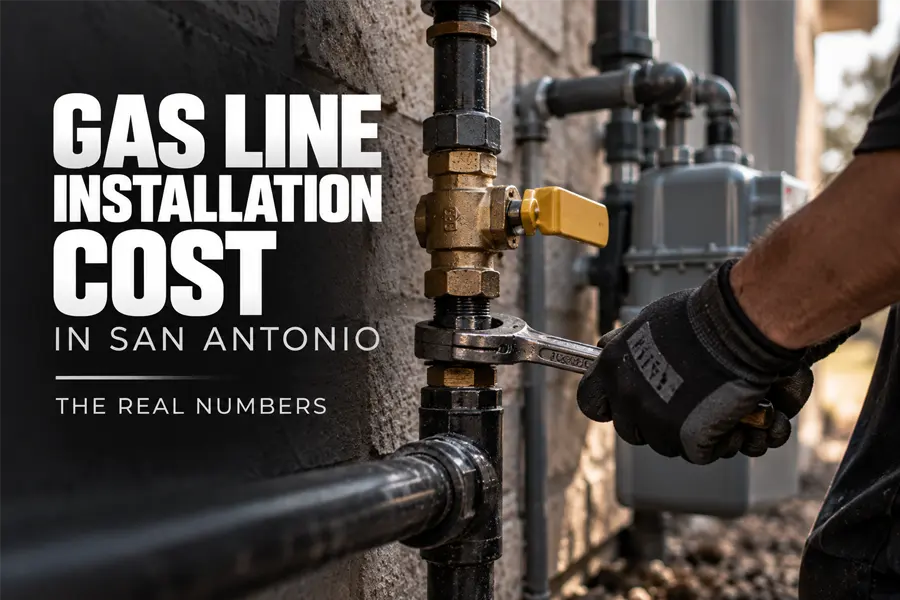
Gas line installation cost in San Antonio runs $15 to $25 per foot for a straightforward run and $35 to $50 or more where it gets complicated. Most single-appliance jobs land between $400 and $1,500 installed. The number that blows up a budget is not the pipe — it is whether your meter can carry the extra load.
- A straightforward run costs $15 to $25 per foot; complicated routing runs $35 to $50 or more. Most single-appliance jobs land between $400 and $1,500 installed.
- Routing is what moves a quote into the high bracket, not material — fishing through walls, slab work, a tight attic, many direction changes.
- The number that actually blows up a budget is not the pipe. It is whether your meter can carry the extra load.
Gas line installation cost confuses people more than almost any other plumbing job, because the thing being priced is mostly invisible. With a water heater you can see the appliance and guess at the labor. With a gas line you are quoting a route: where the pipe starts, what it goes around, what it goes under, and what the house can supply once it gets there.
Almost every time a gas line installation cost lands higher than expected, it is one of three things — the meter cannot carry the new load, the route has to cross something expensive, or the permit and inspections were never in the estimate. All three are below, with market-typical 2026 ranges for San Antonio and the Hill Country. None of it is a Silverback rate card, because we do not publish one, but you should be able to read your own quote against these figures and tell whether it needs explaining.
What Drives Gas Line Installation Cost Per Foot
The per-foot figure is the one everybody wants, and it is useful once you know what moves a run to the top of the range. A simple run stays accessible: a garage wall, an open attic, a straight trench through soft ground. A complex run is fished through finished walls, cut into a slab, or buried under something you cannot damage. That distinction accounts for most of the spread in gas line installation cost.
| Line item | Typical range | What pushes it up |
|---|---|---|
| Simple run, per foot | $15–$25 | Accessible route, few fittings, no finished surfaces disturbed. |
| Complex run, per foot | $35–$50+ | Fishing through walls, slab work, tight attic, many direction changes. |
| Open trenching, per foot | $5–$15 | Rock, roots, irrigation lines and restoring what you dug through. |
| Directional boring, per foot | $10–$30 | Going under a driveway, patio or mature tree instead of through it. |
| Standard pressure test | $75–$150 | Extended tests on a larger or suspect system run higher. |
| Capping an abandoned line | $75–$150 | Access. A cap behind drywall is not a cap in a garage. |
| After-hours surcharge | $200–$300 | Applies to leak response, not to planned installation work. |
Market-typical ranges for 2026, not a Silverback rate card. Pipe material, meter capacity and permit costs are separate line items covered below. See our pricing page for how we build a written quote.
Material moves the number too, though less than people expect. Black iron is the priciest per foot and the most durable, corrugated stainless tubing is cheaper and faster, and polyethylene goes in the ground. Labor usually matters more to gas line installation cost than material. San Antonio also restricts where flexible tubing may be used, which we cover in the permit and code guide.
The Three Projects This City Asks For
Almost every residential call we take is one of three jobs, and the gas line installation cost logic is different for each. It is worth knowing which one you are buying before you compare quotes.
| Project | Typical installed range | What usually decides the number |
|---|---|---|
| Grill or outdoor kitchen | $600–$1,300 | Distance from the meter and whether the run crosses a patio. |
| Pool or spa heater | $500–$1,500+ | Heater size in BTU and how far the equipment pad sits from the house. |
| Standby generator | $400–$1,500+ | Whether the existing meter and service can carry the load at all. |
| Range or cooktop | $500–$1,200 | Getting pipe to a kitchen wall that has never had gas in it. |
| Gas dryer | $400–$900 | Usually the shortest run in the house, often the cheapest job. |
| Fire pit or patio heater | $500–$1,000+ | Buried run, and whether it terminates in a manual or keyed valve. |
Pool heaters are rarely quoted on their own. A full installation here runs $2,500 to $7,500, and the gas line extension is typically $500 to $2,000 of that. Heater sizing drives that share of the gas line installation cost: a small pool takes a 150,000 BTU unit, a large one 400,000 BTU or more, and that changes pipe diameter for the whole run. Our gas line installation service quotes pipe and appliance connection together.
Generators are the category that has changed most here. After the 2021 freeze, standby units stopped being a luxury and became something people budget for alongside a roof. We see them constantly on the larger lots out in Helotes and north of 1604, where the run from meter to generator pad is long enough that pipe stops being a trivial share of the gas line installation cost.
Why Your Neighbor’s Generator Quote Was Half of Yours
Two houses on the same street, two identical 22 kW generators, two quotes thousands of dollars apart. Neither plumber is padding. The difference is what the existing gas service can physically deliver.
Start with the load. A 22 kW standby unit can draw on the order of 327,000 BTU per hour at full output — frequently more than every other gas appliance combined. It is not one more appliance on the end of the system; it is usually the largest single demand the house has ever had, arriving all at once when the power drops.
Then there is the meter, which is what really explains the price gap. Meter capacity is not one fixed number; it depends on the pressure feeding the meter and the drop you allow across it. The same residential diaphragm meter rated for 250 cubic feet per hour at a one-inch water column drop will pass roughly 600 when fed two-pound gas at a two-inch drop. That is why one neighbor needs nothing and the other needs a service upgrade, and that single difference can double a gas line installation cost.
CPS Energy’s published service standards set the frame your plumber sizes inside. Seven inches of water column — a quarter of a psi, or four ounces — is standard delivery pressure for residential customers on rigid steel or polyethylene. Two psi is standard for residential and light commercial customers using corrugated stainless tubing, which requires the customer to install downstream regulation. The utility also states it will not provide less than four ounces.
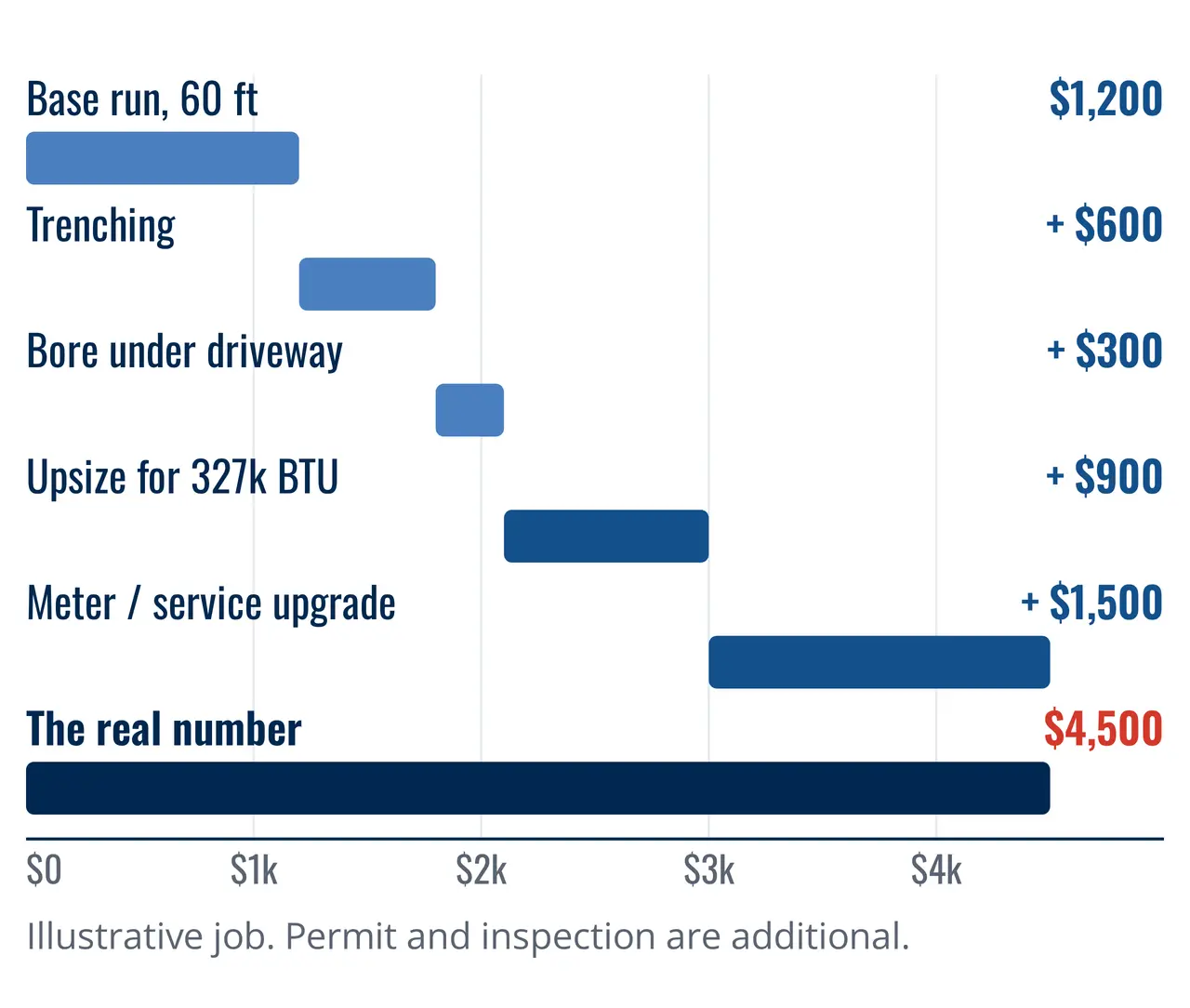
The lesson in that waterfall is not the total but the shape: the pipe was the smallest part of the bill. When a generator quote comes back high, the question to ask is not “why is the pipe so expensive” but “what did you find about my meter and my service pressure.” A plumber who cannot answer that specifically has not sized the gas line installation cost properly.
Get the gas line installation cost priced before the unit is on order, not after. Ask your plumber to total the connected BTU load of every gas appliance plus the generator at full output, and ask CPS Energy what your meter is rated for at your actual delivery pressure. Those two numbers tell you whether this is a $600 job or a $4,500 one — while you can still choose a smaller unit.
Pressure Tests, Caps and Meter Work
Several line items have nothing to do with running new pipe, and homeowners query them most. A pressure test is the big one: every new or altered line must hold a test before service, and San Antonio sets its own pressures, more demanding than the national baseline. At $75 to $150 it is real work, not padding.
Capping an abandoned line is the cheapest item here and the one people skip. Convert a gas range to induction and the stub left behind needs a proper cap, not a hardware store fitting and tape. That is $75 to $150. The reverse — tank to gas tankless — means upsizing, which is why our water heater installation quotes include the gas work.
Meter work is the expensive end of gas line installation cost. A new meter runs $300 to $600; relocating one runs $1,000 to $4,500. CPS Energy’s standards keep meters away from doors and openable windows, out of garages and living spaces, and require clear working room in front, so a patio enclosure that boxes in a meter forces the issue. The same standards make you liable for damage to the utility’s meter or regulator if a pressure test is run against it without isolating it first.
The outdoor kitchen jobs that go badly are the ones where gas was the last thing anybody thought about. The slab is poured, the stone is up, the grill is set into the island, and the only route from the meter runs under fresh concrete. Boring costs several times what a sleeve would have before the pour. Settle the route while the ground is open and the gas line installation cost stays ordinary.
Before Anyone Puts a Shovel in the Ground
Any buried run means excavation, and in Texas excavation means 811. Calling is free, required by state law, and needs two business days of notice excluding weekends and holidays. Utilities then mark their underground facilities, yellow for gas and petroleum. Each excavator files their own request, so you cannot rely on the ticket your fence contractor pulled last month.
The Railroad Commission of Texas, which regulates intrastate gas distribution, sets the trigger at any earth movement deeper than sixteen inches and recommends calling regardless of depth. Penalties under the damage prevention rules begin at $1,000 per violation — considerably more than whatever you were saving.
One gap is worth knowing: 811 locates utility-owned facilities. A line a previous owner ran to a grill, a pool heater or a detached garage is private property, and you should not assume it will be marked. Ask your plumber to locate private lines first — far cheaper than adding a repair to your gas line installation cost because you put a post through something.
Reading a Gas Line Quote Properly
Once you have two or three gas line installation cost quotes in front of you, the useful comparison is not the bottom line but whether each covers the same scope. The cheap one is very often cheap by omission rather than by efficiency.
- Does it include the permit and the inspections?San Antonio requires a permit for gas work and inspects it twice. Missing from a quote, it either appears later or never happens, and the second outcome is worse.
- Has anyone checked the meter capacity?For a generator, pool heater or tankless conversion this is the whole ballgame. A gas line installation cost written without it is a guess.
- What pipe material, and where does each type run?San Antonio restricts flexible tubing in places the national code allows it, so ask what goes in the ground versus in the walls.
- Is the pressure test priced, and at what test pressure?A plumber who knows the local requirement off the top of their head has done this here before.
- Who restores the trench, patio or landscaping?Excavation and restoration can run $1,500 to $5,000 on a bad route. Settle whose problem it is before digging starts.
- Is the appliance connection included?A line that stops three feet short of the grill is not a finished job.
The licensing check takes under a minute and we walk through it in why hiring a licensed plumber matters. If what you are pricing is a fireplace rather than an appliance line, the numbers differ enough that we gave it its own breakdown. Anything else is probably on our frequently asked questions page.
Frequently Asked Questions
How much does it cost to run a gas line to an outdoor grill?
Gas line installation cost for a grill or outdoor kitchen typically lands between $600 and $1,300 installed. What moves it is distance from the meter and what the run has to cross. A straight trench through open lawn sits at the bottom of that range; boring under a finished patio or driveway adds $10 to $30 per foot.
Do I need a bigger gas meter for a standby generator?
Often, but not always, and nobody can tell you over the phone. A 22 kW unit can draw around 327,000 BTU per hour, frequently more than the rest of the house combined. Whether your meter carries that depends on its rating at your actual delivery pressure. Have the connected load calculated before you order the generator.
Is black iron or flexible tubing cheaper for a gas line?
Corrugated stainless tubing costs less per foot and installs faster, so on a long run through finished space it usually lowers gas line installation cost. Black iron costs more and takes longer but is preferred where pipe is exposed. In San Antonio local amendments restrict where flexible tubing may be used, so it is not purely a cost choice.
Why does my gas line quote include trenching and restoration separately?
Because they are different work with different risk. Running pipe is predictable. Digging through caliche, tree roots, irrigation lines and an existing patio is not, and putting the yard back can cost more than the pipe did. Separating them shows what you are paying for rather than burying a $2,000 excavation inside a per-foot figure.
Can I get a rebate from CPS Energy for adding a gas appliance?
Not that we can find. CPS Energy ran a natural gas appliance rebate several years ago, but it is not among the current residential programs, which cover attic insulation, cool roofs and pool pumps. If a salesperson says a rebate will offset your gas line installation cost, ask to see the live program page before signing.
Want San Antonio plumbing answers from a local licensed plumber at the top of your results? Add Silverback as a preferred source.
Get the Gas Side Priced Before You Buy the Appliance
We calculate the load, check what your meter can carry, and quote the route before anyone orders equipment, so the gas line installation cost is settled up front. If your existing service already handles it, that is good news you should hear early rather than on install day.
Serving San Antonio, Helotes, Boerne, Bulverde, Schertz, Somerset and Stone Oak. Open 24/7.Sources
- CPS Energy Gas Service Standards (PDF) — delivery pressures of seven inches water column and two psi, the four-ounce minimum, meter clearance rules and liability for pressure testing against the meter.
- Texas811 — Homeowner Guide — the free locate service and two-business-day notice before digging.
- Railroad Commission of Texas — Pipeline Damage Prevention — the sixteen-inch depth trigger and penalties from $1,000 per violation under 16 TAC Chapter 18.
- CPS Energy — Call 811 Before You Dig — yellow as the marking color for gas, and each excavator filing their own locate request.
- City of San Antonio Plumbing, Gas & Sewer Permit Application (PDF) — gas permit scope: line extensions, replacements, meter splits and relocations.
- CPS Energy — Home Energy Rebates — the current residential rebate list, which excludes natural gas appliances.