

Tunneling is how a plumber reaches a failed drain line beneath a concrete foundation without cutting through the floor above it. A shaft is opened outside the building and worked horizontally under the slab to the repair, the pipework is replaced in place, and the tunnel is backfilled and compacted so the ground carries the foundation exactly as it did before. In San Antonio, where slab-on-grade building is close to universal and under-slab cast iron is reaching the end of its service life, tunneling is frequently the difference between a plumbing repair and a renovation.
Finished flooring, cabinetry and tile are the expensive part of an under-slab repair. Tunneling leaves all of it untouched, which is why the larger-looking number is often the cheaper job.
What tunneling involves, step by step
-
An access pit outside
A shaft is opened at the exterior wall nearest the fault, deep enough to reach the level the pipework runs at beneath the slab.
-
A hand-dug bore under the footing
The tunnel is worked horizontally beneath the foundation, sized for a person to work in, following the line towards the marked repair.
-
The repair itself
The failed section is cut out and replaced with new pipe at correct fall, then tested before anything is closed up.
-
Engineered backfill
The tunnel is refilled in layers and compacted to specification. This is the part that protects the foundation and the part cheap operators skip.
-
Surface restoration
The access pit is closed and the ground reinstated. Whatever was above it is discussed and priced before we start, not after.
-
A retest
A hydrostatic test after the repair proves the system holds again, and the result goes to you in writing.

Tunneling against opening the floor
Both routes reach the same pipe. They differ in what they cost you beyond the plumbing, and that is usually the deciding factor rather than the plumbing itself.
| Tunneling from outside | Cutting through the slab | |
|---|---|---|
| Your floor | Untouched. Nothing comes up | Flooring lifted, concrete cut, both reinstated afterwards |
| Living in the house | Normal. The work happens outside and underneath | Disruptive. Dust, noise and a room out of use |
| Plumbing cost | Higher | Lower |
| Total cost with restoration | Often lower once flooring and cabinetry are counted | Rises steeply with tile, stone or fitted units above the fault |
| Best suited to | Drain repairs, longer runs, anything under finished areas | A single shallow fault under an uncovered floor |
The comparison people get wrong is looking at the plumbing quote alone. Tunneling is the larger plumbing number and frequently the smaller total, because the tile, the cabinets and the hardwood never enter the conversation.
Backfill is the part that protects your foundation
This is the single most important thing to understand about tunneling, and it is the thing that separates a competent job from one that causes a problem two years later.
A tunnel removes soil that was carrying part of the load under your slab. Fill it carelessly and that soil settles over the following seasons, taking support away from the footing above it. Foundation movement that appears a year or two after an under-slab repair is, more often than not, a tunnel that was backfilled by shovelling the spoil back in and walking away.
Done properly, backfill goes in as lifts — shallow layers, each compacted mechanically before the next one goes on top — so the density approaches what the ground had before the tunnel existed. On longer runs and on more sensitive structures, an engineer specifies the compaction and it is verified rather than assumed.
We backfill in lifts as standard on every tunnel, and where a structural engineer is already involved in the property we will work to their specification and give them the record. If you are comparing tunneling quotes, this is the question to ask each one, and the answers will differ more than the prices do.

When tunneling is the right answer, and when it is not
It is not automatically the better route. Four conditions make it the sensible one.
- The fault is on a drain line. Gravity waste has to be reached and replaced where it lies, at the right fall, and tunneling gets to it without disturbing the slab.
- The pipe sits under something expensive. Tile, stone, hardwood, a fitted kitchen or a staircase all cost more to reinstate than the tunnel costs to dig.
- The run is long. Several faults along a line, or a full replacement, favours one tunnel over a series of holes cut through the floor.
- The house has to stay occupied. Tunneling keeps the work outside and underneath, so the household carries on.
Against that: a single shallow supply-line fault under a carpeted spare room does not need a tunnel, and we will say so. Neither does a pressurised line that can simply be rerouted overhead, which is frequently the cheapest answer of all and involves no excavation whatsoever.
While the tunnel is open, replace more than the break
The expensive part of tunneling is getting there. Once a crew is underneath the slab with access to the line, additional pipe is comparatively cheap, and that changes what the sensible scope is.
On cast iron of a certain age the fault we were called for is rarely the only weak point. The same run has been corroding at the same rate along its whole length, and repairing eight inches of it means the next failure is a question of when rather than whether — at which point somebody digs a second tunnel and pays for the access all over again.
So on any line where the camera shows general deterioration rather than a single discrete break, we will quote replacing the full run under the slab alongside the spot repair. The difference in price is usually far smaller than the difference in what happens next, and it is your call with both numbers in front of you.
The same logic applies to cleanouts. If the house lacks an accessible one, fitting it while the tunneling is underway costs a fraction of what it costs as a standalone job later, and it makes every future drain problem cheaper to diagnose.
What moves the cost of tunneling
Tunneling is priced by the foot and by the conditions, and the conditions vary more than people expect between two houses on the same street.
| Factor | Why it matters |
|---|---|
| Distance to the fault | Tunneling is priced per linear foot. A fault six feet in is a different job from one thirty feet in |
| Depth | Deeper pipework means a deeper access pit and more spoil to remove and replace |
| Soil condition | Rock slows everything. Loose or saturated ground needs shoring, which adds time and material |
| Where the pit can go | A driveway, a patio or a pool deck over the entry point changes the approach and the restoration |
| Compaction specification | Engineered backfill to a stated density costs more than ordinary lift compaction and is sometimes required |
| How much pipe is being replaced | A single repair and a full under-slab replacement use the same tunnel but very different amounts of everything else |
What the yard looks like while the work runs
People picture more damage than tunneling actually causes, so it is worth describing plainly.
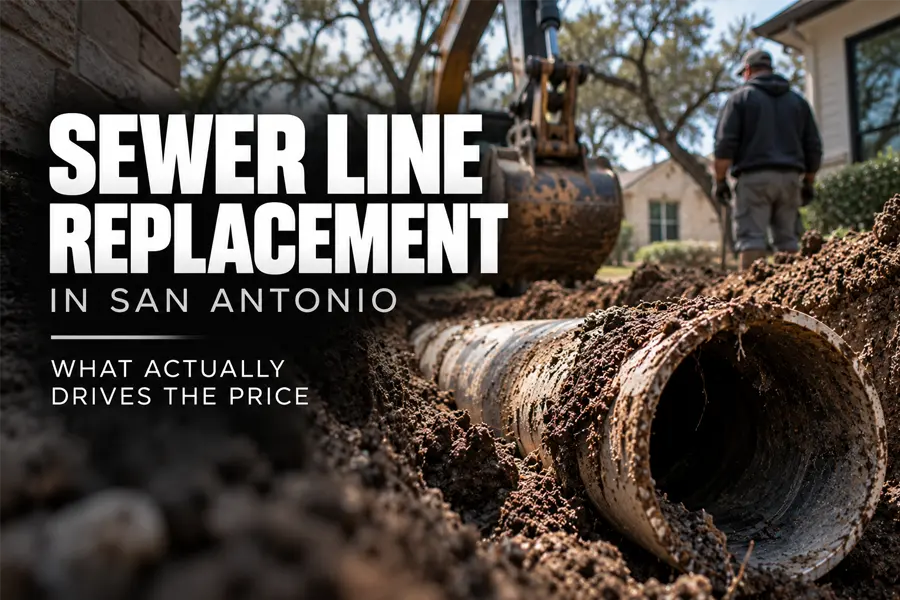
What you see is an excavation at one point along an exterior wall, spoil stacked on boards nearby, and safety fencing around it. The tunnel itself is invisible — it runs underground from that pit, so the lawn between the pit and the repair is untouched. On most jobs the disturbed area is a few square metres rather than a trench across the garden.
Irrigation lines and low-voltage cable in the path of the pit get located first and either moved or worked around. Mature planting close to the wall is the genuine constraint: a tree with roots under the entry point may mean moving the pit or accepting the loss, and that is a conversation before the machine arrives rather than after.
Turf goes back over the closed pit and it settles into place across a season. Hard surfaces — a path, a patio, a driveway apron — are priced as restoration and quoted separately so you can decide who does that part.
Tunneling alongside foundation repair
These two trades meet constantly in San Antonio and the order matters.
If a drain under the slab is leaking, it is washing soil out and contributing to the movement a foundation contractor has been called about. Lifting the slab first leaves the cause running underneath the correction. Plumbing gets proved with a hydrostatic test and repaired first; the structural work follows.
The exception is access. Sometimes piers need to go in where the tunnel wants to run, and the two crews have to sequence around each other. That is a scheduling conversation between us and them, and it is much easier to have before either of us starts. We are used to working to an engineer’s drawing and we will coordinate directly with the foundation contractor rather than through you.
Afterwards, another hydrostatic test. Lifting a slab can break lines that were sound, and a tunnel that was dug and closed before the piers went in deserves a check once the structure has moved.
Where insurance sits on this
Texas policies commonly cover the damage that water causes and exclude the pipe that failed. For an under-slab drain break the practical reading is that tunneling and the plumbing repair are usually the homeowner’s, while damaged flooring, drying and any affected contents may be claimable.
Some policies include access cover, which pays for reaching a covered failure — that is the clause worth looking for, because it is precisely what tunneling is. Whether it applies depends on your policy wording and your insurer, and we do not pretend to make that call.
What we can do is document it properly: the hydrostatic test result, the located fault with depth, photographs of the failed pipe once it is out, and dated records of the work. Adjusters act on evidence, and the evidence has to be collected while the tunnel is open rather than reconstructed afterwards.
Five questions to put to any tunneling quote
Prices for this work vary widely and the cheap ones are usually cheap for a reason that shows up later. These five questions separate them faster than comparing totals.
- How will the tunnel be backfilled, and will it be compacted in layers?
- Has the fault been located and marked, or is the quote based on symptoms?
- Who pulls the permit, and when does the inspection happen relative to backfilling?
- Is a hydrostatic test after the repair included, and do I get the result?
- What is covered by the warranty, and does it include the backfill as well as the pipe?
Any competent outfit answers all five without hesitating. A tunneling quote that cannot say how the ground goes back is quoting for the hole, not for the job.
Tunneling across San Antonio and the Hill Country
We tunnel across San Antonio, Helotes, Boerne, Bulverde, Schertz, Converse, Stone Oak, Alamo Ranch and Somerset. Ground conditions change noticeably across that area — the limestone shelf out towards Boerne is a different proposition from the deep clay south of town — and both affect how a tunnel is dug and what it costs.
Nothing gets quoted until the fault is located. If you have a failed test or a suspected under-slab break, slab leak detection comes first and the tunneling estimate follows from what it finds.
Work is carried out by licensed plumbers under our Responsible Master Plumber, license RMP-43333, issued by the Texas State Board of Plumbing Examiners. You can verify that license yourself.
What San Antonio homeowners say
Reviews pulled live from our Google Business Profile, not retyped here.


Frequently asked questions
Is tunneling safe for my foundation?
Yes, when the backfill is done properly. The risk in any tunnel is settlement afterwards, and that comes from spoil being pushed back in loose. Compacting in layers restores the ground’s support, which is why we treat backfill as part of the job rather than as clearing up.
How long does a tunnel take to dig?
Typically one to three days to reach the repair, depending on distance, depth and ground. The repair itself and the backfill add to that, and you get a realistic window once the fault has been located rather than a guess beforehand.
Will I be able to live in the house?
In nearly every case, yes. That is one of the main reasons tunneling gets chosen. Water may be off for part of a day while the pipework is cut in, and we tell you when that will be.
Is tunneling more expensive than cutting the floor?
The plumbing portion usually is. The total often is not, because opening a slab means lifting and reinstating whatever is above it. We price both routes so you can compare the real numbers rather than the plumbing ones.
Does it need a permit?
Under-slab drain replacement is permitted work in San Antonio and the permit is pulled by the licensed plumber. The work is inspected before the tunnel is backfilled, which is another reason the sequence matters.
What happens to my grass and landscaping?
The disturbed area is around the access pit, not along the tunnel. Turf goes back and settles over a season. Anything hard or planted over the pit is discussed and priced before we begin.
Can you tunnel under a pool or a driveway?
Under, yes — that is often the reason tunneling is chosen. Starting the pit beneath one is a different question, and where the only viable entry point is under a driveway or a pool deck we will say so and price the restoration honestly.
What if there is rock?
It slows the dig and it raises the cost, and it is common enough in parts of the Hill Country that we allow for it. Where we hit unexpected rock mid-job we stop and requote rather than run up an open-ended bill.
How do I know the repair worked?
A hydrostatic test after the repair and before the tunnel is closed. That is the proof, it comes to you in writing, and it is included rather than charged separately.
Is there a warranty?
Yes. Our workmanship carries a five-year warranty, and that covers the backfill and compaction as well as the pipework, which is the part that matters most over time.
Can a tunnel be used for supply lines too?
It can, but usually there is no need. A failed pressurised line is more often rerouted overhead through walls and attic, which avoids excavation entirely. Tunneling is mostly a drain-side solution.
Who should I get a second opinion from?
Any licensed plumber, using our location report and camera footage — both of which are yours. If a quote for tunneling arrives without a located fault behind it, that is the thing to question, whoever wrote it.
Reach the pipe without taking up your floor.
We locate the fault, price the tunnel against opening the slab, and compact the backfill in layers so the ground carries the house as it did before.