

A repipe replaces the water supply pipework through a house rather than patching it one failure at a time. It is the job that ends recurring pinhole leaks, brown water at the taps and pressure that has dropped at every fixture at once. In San Antonio the usual triggers are galvanised steel that has rusted closed from the inside, polybutylene that was never going to last, and copper that hard water and clay soil have worked on from both sides for forty years.
One pinhole is a repair. A third one in two years is the pipe telling you it has reached the end, and at that point each individual repair is money spent on a system that is already finished.
When a house is asking for a repipe
-
Leaks that keep coming back
Not the same joint twice — different points along the same system. That pattern means the material is failing generally rather than at one weak spot.
-
Rust or brown water
Discoloured water at first draw, especially on the hot side, is galvanised pipe shedding its interior. It gets worse, never better.
-
Pressure down at every fixture
One slow tap is an aerator. Every tap in the house losing pressure together is a supply system narrowing from the inside.
-
Polybutylene anywhere in the house
Grey plastic pipe with crimped fittings, common in late-1970s to mid-1990s builds. It fails without warning and insurers ask about it.
-
More than one slab leak
Under-slab copper that has leaked twice is going to leak again. A repipe routed overhead takes the whole run out of the concrete.
-
A remodel that opens the walls
If drywall is coming down anyway, the access a repipe needs is already paid for. This is the cheapest it will ever be.
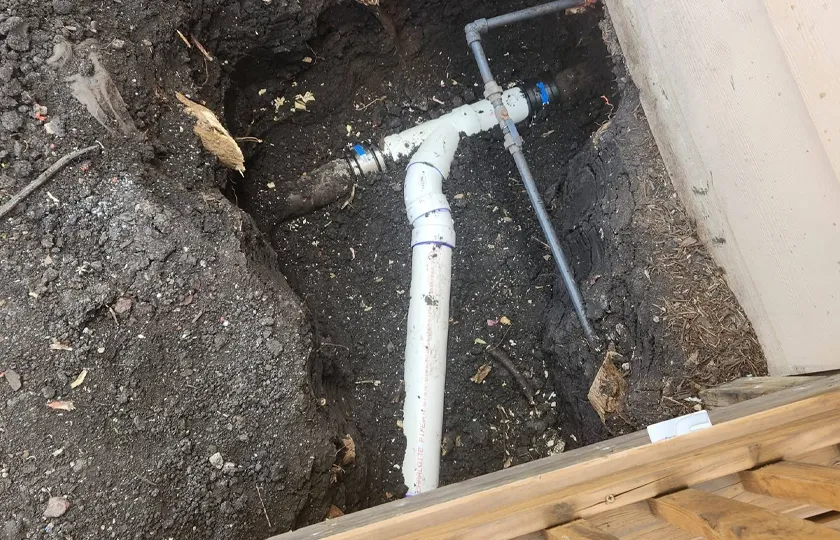
What is in your walls right now
Build era narrows it to one or two materials, and the material decides how urgent a repipe is.
| Material | Typical era | How it fails |
|---|---|---|
| Galvanised steel | Pre-1960 | Rusts from the inside until the bore closes. Brown water, then no pressure. A repipe is the only cure |
| Copper | 1960s to today | Pinholes from pitting, accelerated by hard water inside and soil chemistry outside |
| Polybutylene | Late 1970s to mid 1990s | Degrades from within and splits without warning. Insurers treat it as a known risk |
| CPVC | 1980s onward | Becomes brittle with age and heat; cracks at fittings rather than along the run |
| PEX | 2000s onward | Rarely. Failures are at fittings or from rodent damage, not from the tubing itself |
If you do not know which you have, the fastest check is the pipe entering the water heater and the shut-off under a basin. We can also tell you in thirty seconds on a call if you describe what you can see.
PEX or copper for the new pipe
Both are correct answers and we fit both. The choice is about your house rather than about which is better in the abstract.
| PEX | Copper | |
|---|---|---|
| Cost of the repipe | Lower, and noticeably faster to install | Higher in both material and labour |
| Hard water | Unaffected. Nothing to pit or scale onto | Scales internally and pits over decades in our water |
| Freeze behaviour | Expands somewhat before splitting, which buys margin in a hard freeze | Splits |
| Drywall opened | Less. Flexible runs pull through cavities with fewer openings | More, because rigid pipe needs access at every joint |
| Lifespan | Projected 40 to 50 years, less field history than copper | 50 years plus in soft water; much less in water like ours |
For most San Antonio houses we recommend PEX, and the deciding reason is the water rather than the price: a copper repipe installed into 15 to 20 grain water starts the same pitting clock that ended the last system. Where a homeowner prefers copper we fit it properly and say plainly what to expect from it.

What a repipe looks like day by day
Most whole-house work runs two to four days on site. Here is the shape of it so nothing arrives as a surprise.
- We walk the house with you, agree where the new runs will go, and mark every place drywall will be opened. You see that list before anybody cuts anything.
- Access is opened — small, deliberate openings at the marked points rather than whole walls, and protection goes down over floors and furniture.
- New pipe is run to every fixture, usually through attic and interior walls, with the old system left in place and abandoned rather than torn out.
- Fixtures are tied over to the new system a zone at a time, so the house keeps water overnight through the middle of the repipe.
- The system is pressure tested and the inspector attends before anything is closed up. That timing is the point of the permit.
- Openings are patched, taped and floated ready for texture and paint, and the site is cleaned properly rather than swept.
Water is off for parts of each working day and back on every night. If that is not workable for your household, say so when we quote and we will sequence the repipe around it.
Overhead, or back under the slab?
On a slab-on-grade house the new supply can go overhead through the attic and down interior walls, or it can go back into the concrete. We route overhead in almost every case and it is worth explaining why.
Pipe in a slab cannot be inspected, cannot be repaired without opening the floor, and sits in the same conditions that finished the last system. Pipe in an attic can be looked at, reached and repaired in an afternoon. The trade-off is freeze exposure, which we handle with insulation and by keeping runs out of the coldest parts of the roof space.
The exception is a house where attic access genuinely does not exist over part of the footprint — some additions and some flat-roofed sections. There we will run what has to be run under the slab and tell you exactly which section it is, so a future owner is not guessing.
If the reason you are here is repeated slab leaks, an overhead repipe is the permanent answer to that specific problem rather than a partial one.
What happens to the old pipe
It stays where it is, capped and abandoned, and that surprises people until the reasoning lands.
Pulling dead pipe out of walls, ceilings and a slab means opening far more of the house than the repipe itself needs, for no functional gain — the abandoned line carries nothing and does no harm sitting there. Every additional opening is more drywall, more texture matching and more cost, so removal is disruption you would be paying for twice.
Two exceptions. Accessible runs in the attic or a crawl space come out, because they are easy to reach and in the way of future work. And where the old material is polybutylene, we will discuss removing what is reachable, because a future buyer’s inspector will find it and ask about it even when it has been dead for years — which is a paperwork problem rather than a plumbing one, but a real one.

Drywall, texture and who does what
The part homeowners ask about last and worry about most. We will be straight about where our work stops.
We open the wall, we run the pipe, and we close the opening back to a patched, taped and floated finish ready for texture. Matching your existing texture and paint is a finishing trade, and a good one gets an invisible result where a plumber gets an obvious patch. We can bring somebody in or you can use your own; either way it is priced separately and said out loud in the quote rather than discovered afterwards.
How many openings a repipe needs depends on the material and the layout. A PEX repipe in a single-storey house with attic access might need a dozen small openings. A two-storey house with a copper specification needs considerably more. We count them at the quote stage and show you where they are.
What sets the price of a repipe
Nobody can quote this from a phone call, and anyone who does is guessing. These are the things we look at on the walk-through.
| Factor | Why it matters |
|---|---|
| Number of fixtures | Every sink, shower, toilet, hose bib and appliance is a run and a termination |
| One storey or two | A second storey means vertical runs and far more drywall opened to reach them |
| Attic access | Good access makes a repipe fast. A shallow or obstructed roof space changes the routing and the hours |
| PEX or copper | Material cost and labour both differ substantially between the two |
| Whole house or partial | A partial repipe is cheaper today and leaves the oldest pipe still in service |
| What gets replaced alongside | Angle stops, supply lines, the pressure regulator and hose bibs are cheap while the system is open and expensive later |
Whole house, or just the bad section?
A partial repipe is a legitimate option and sometimes the right one. It is also the decision most likely to be regretted, so it is worth thinking about properly.
It makes sense where the house has genuinely different systems in it — an addition plumbed in PEX twenty years ago attached to an original galvanised core, say. Replacing the old half is a complete answer for that half, and the new half was never the problem.
It makes much less sense where the whole house is one system of one age. Replacing the runs that have already leaked leaves identical pipe of identical age everywhere else, and the failures simply continue somewhere new. You also pay the mobilisation, the drywall and the permit twice.
We quote both, with the partial priced honestly rather than as a loss-leader, and we tell you which we would choose in your house and why.
Selling, or just bought? The timing matters
A repipe lands differently depending on which side of a sale you are on.
Selling with galvanised steel or polybutylene in the walls means a buyer’s inspector will find it and the price will move accordingly, usually by more than the work costs. Doing it first, with the permit and inspection on record, converts a negotiating weakness into a selling point and removes the financing questions some lenders raise about polybutylene.
Buying is the better position to be in. If the inspection has turned up the original supply system in a house of a certain age, a repipe quote in hand during the option period is a number to negotiate with. We will do the walk-through and give you a written figure inside that window, and we will tell you honestly if we think the pipe has years left rather than finding you a reason to spend.
The one case to avoid is discovering it three months after closing, when the same work is entirely yours and there is nobody to share it with.

Permit, inspection and what it is worth to you
A repipe is permitted work in San Antonio and the permit is pulled by the licensed plumber, not by the homeowner. The system is inspected under pressure before any wall is closed.
That matters beyond compliance. Once the drywall goes back nobody can see what was installed, and the inspection is the only independent record that it was done to code. At resale it is also the document that answers the buyer’s question about whether the polybutylene really was dealt with properly.
Unpermitted repipe work is cheaper on the day and it is the kind of saving that reappears during a sale, an insurance claim or the next owner’s inspection. We do not offer it.
Repiping across San Antonio and the Hill Country
We repipe houses in San Antonio, Helotes, Boerne, Bulverde, Schertz, Converse, Stone Oak, Alamo Ranch and Somerset. Older neighbourhoods inside Loop 410 bring galvanised steel; late-1980s subdivisions bring polybutylene; anything from the 1990s onward is usually copper that hard water is now working on.
If hardness is what ended the last system, it is worth pairing the repipe with a water softener. New pipe in untreated 15 to 20 grain water starts the same clock over again.
Work is carried out by licensed plumbers under our Responsible Master Plumber, license RMP-43333, issued by the Texas State Board of Plumbing Examiners. You can verify that license yourself.
What San Antonio homeowners say
Reviews pulled live from our Google Business Profile, not retyped here.


Frequently asked questions
How long does a whole-house repipe take?
Two to four days on site for most single-family homes, plus the inspection. You keep water overnight throughout — it is only off for parts of each working day while fixtures are tied over.
Do I have to move out?
Almost never. The house stays liveable, with water restored each evening. If somebody in the household genuinely cannot be without water during the day, tell us at the quote and we will sequence the repipe around it.
PEX or copper — which should I choose?
For most houses here, PEX. Our water pits copper from the inside, so a copper repipe restarts the clock that ended the old system. Copper is still a good product and we fit it when a homeowner wants it, with an honest explanation of what to expect.
Is polybutylene really that bad?
It fails without warning, from the inside, and there is no way to inspect it. Insurers ask about it and some price accordingly. If you have it, a repipe is a question of scheduling rather than whether.
Will you patch the drywall?
We close every opening back to a taped and floated finish ready for texture. Texture matching and paint are a finishing trade, quoted separately, and we will bring somebody or work with yours.
Can you repipe just one bathroom?
Yes, and sometimes that is right. But if the rest of the house is the same pipe of the same age, a partial repipe usually postpones the problem rather than solving it. We will quote both and say which we would take.
Does a repipe need a permit?
Yes, and we pull it. The system is inspected under pressure before the walls close. It is the only independent record of what went in, and it matters at resale.
Will the new pipe run through the attic?
On a slab-on-grade house, usually yes. Overhead pipe can be inspected and repaired; pipe cast back into a slab cannot. Runs are insulated and kept out of the coldest parts of the roof space.
What else should be replaced at the same time?
Angle stops, supply lines, hose bibs and the pressure regulator. All of them are inexpensive while the system is open and a separate call-out afterwards.
Will a repipe fix my water pressure?
If the cause is galvanised pipe that has rusted closed, yes, dramatically. If the cause is a failed regulator or a leak elsewhere, a repipe is the wrong fix and we will tell you that before you spend the money.
How much does a repipe cost?
It depends on fixtures, storeys, attic access and material, so we walk the house rather than quote from a phone call. You get a fixed written price with the drywall openings marked on it.
Is there a warranty?
Yes. Our workmanship carries a five-year warranty and the pipe manufacturers warrant their material separately. The permit and inspection record stays with the property.
Stop paying for the same leak in a different wall.
We walk the house, mark every opening before we cut, and give you a fixed price for the repipe with the drywall work spelled out.