
A salt free water softener does not soften water. It conditions it so scale will not stick, and it delivers no lather, no spot reduction and no hardness removal. Only ion exchange takes the minerals out. At San Antonio’s 15 to 20 grains, expect roughly 390 to 525 lb of salt a year for a family of four, about ten to thirteen bags.
- A salt-free system does not soften water. It conditions it so scale will not stick — no lather, no spot reduction, no hardness removal.
- Only ion exchange actually takes the minerals out. If soft water is what you want, that is the one category that delivers it.
- At San Antonio’s 15 to 20 grains, a family of four should expect roughly 390 to 525 lb of salt a year. That is the honest running cost of the trade-off.
Almost nobody asking this is really asking about chemistry. They want to know whether they can avoid carrying forty pound bags into the garage every few weeks for fifteen years. That is reasonable, and it deserves a straight answer rather than a brochure.
The straight answer is that a salt free water softener is a real product doing a real thing, but that thing is not softening. At San Antonio’s hardness the gap between the two technologies is wider than the marketing suggests. Below: what each does, what the salt costs, and where a salt free water softener genuinely belongs.
The Difference Nobody Explains Clearly
A conventional softener uses ion exchange. Water passes through resin beads, calcium and magnesium swap places with sodium held on the resin, and what leaves the tank has the hardness minerals genuinely removed. That is why soft water lathers, spots stop forming and scale stops building. The bed is periodically flushed with brine to reload it, which is what the salt is for.
A salt free water softener, usually template assisted crystallisation or TAC, does something different. The minerals stay in the water. The media converts them from their dissolved ionic form into tiny stable crystals much less inclined to stick to hot metal and pipe walls. Scale is substantially reduced. The water is, by every measurement that matters, still hard.
That has consequences you are not usually told at the point of sale. A salt free water softener will not improve lather. Your shower glass will still spot, because the minerals are still there when water evaporates. Laundry will not soften. If scale in the water heater is the complaint, it helps. If the complaint is everything else hardness does, it does not.
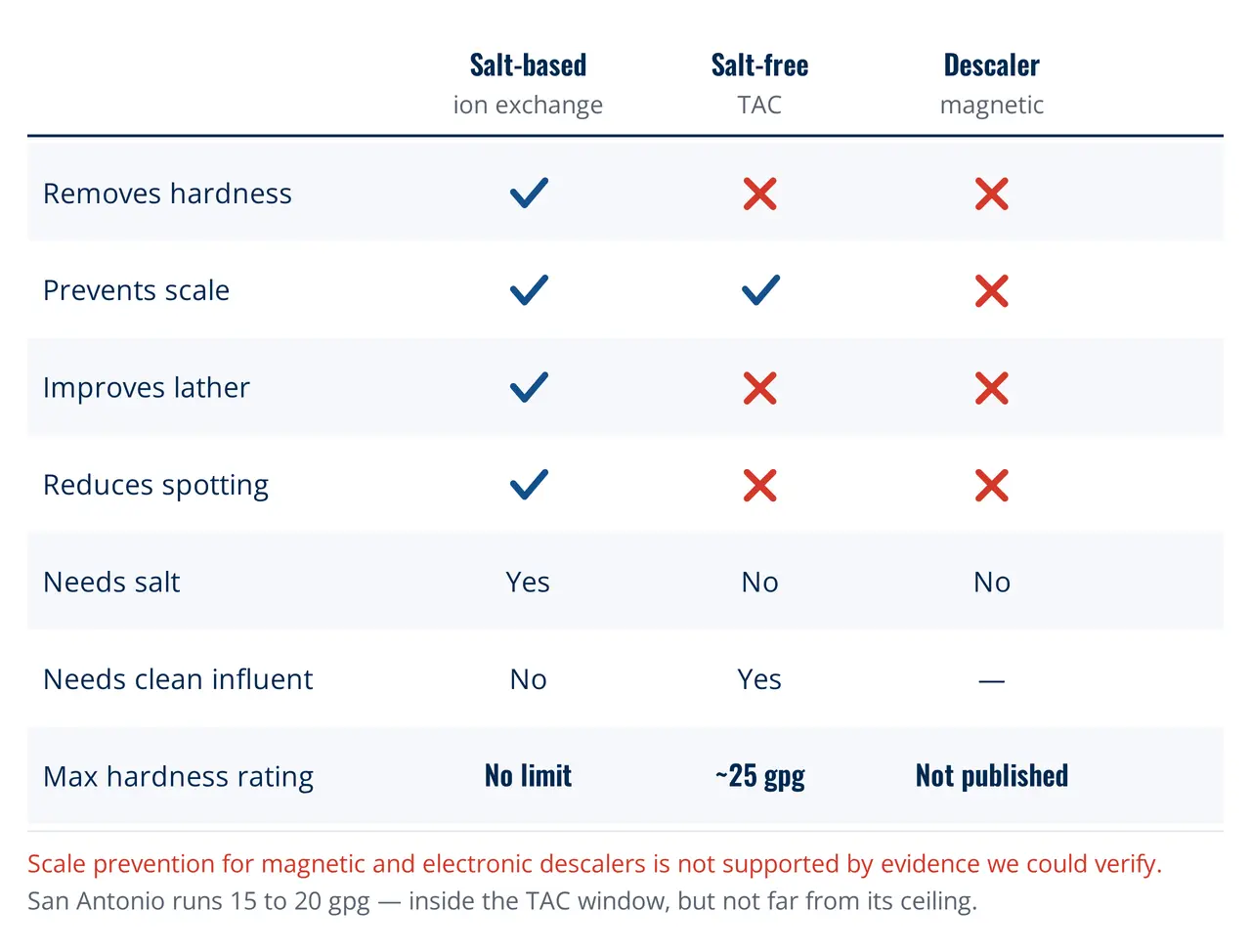
The third column deserves a word. Magnetic and electronic descalers clamp onto the outside of a pipe, and we have never seen credible independent evidence they do anything at 15 to 20 grains. If one is offered as an alternative to a salt free water softener or an ion exchange unit, ask for test data.
What the Salt Actually Costs, With the Working Shown
Since labour is the real question, here is the arithmetic rather than vague reassurance. A household of four using sixty gallons per person per day at 20 grains asks the softener to remove roughly 1.75 million grains a year.
How much salt that takes depends on the unit’s efficiency. NSF/ANSI 44 sets a voluntary minimum of 3,350 grains of hardness removed per pound of salt. California’s statutory minimum, which EPA WaterSense also proposed, is 4,000 grains per pound. Divide the annual load by those and you get the number.
| Hardness | Grains removed per year | Salt at 3,350 gr/lb | Salt at 4,000 gr/lb |
|---|---|---|---|
| 15 gpg | 1,314,000 | 392 lb — 9.8 bags | 328 lb — 8.2 bags |
| 17.5 gpg | 1,533,000 | 458 lb — 11.4 bags | 383 lb — 9.6 bags |
| 20 gpg | 1,752,000 | 523 lb — 13.1 bags | 438 lb — 10.9 bags |
Calculated, not a published local figure. Assumes four people at 60 gallons each per day and 40 lb bags, using NSF/ANSI 44 and EPA WaterSense salt-efficiency standards.
In practical terms that is a bag every four to eight weeks, somewhere around $60 to $155 a year at typical bag prices. It is a smaller number than most people expect. The cost is real but modest; the inconvenience is the lifting, not the bill.
Two things move that number. An efficient demand-initiated unit that regenerates on actual water used, rather than a timer firing on schedule whether you needed it or not, is the biggest lever. Correct sizing is second: a unit set to the wrong hardness burns salt for no benefit.
Where a Salt Free Water Softener Is Genuinely the Right Call
None of the above means a salt free water softener is a bad product. It means it solves a narrower problem. There are households where it is clearly the better choice, and I would rather say so than pretend otherwise.
A salt free water softener fits when nobody in the house can handle salt bags and there is no one to do it for them. It fits when the complaint is scale in a tankless heater or boiler rather than laundry, skin or spotting. It fits where no drain is within reach, since there is no regeneration and no discharge. And it fits anyone on restricted sodium who does not want ion exchange whole-house.
There is one San Antonio caveat worth knowing before you commit. The media in a standard residential salt free water softener is rated to about 25 grains per gallon. Our 15 to 20 sits inside that window but not far from the ceiling, so sizing and media volume matter more here than in a 10 grain city.
The media also does nothing about chlorine, and since SAWS disinfects with free chlorine it lasts noticeably longer with a carbon filter ahead of it. That is worth pricing in rather than discovering later.
You will find pages claiming a salt free water softener prevents a specific percentage of scale, usually between eighty and ninety-something percent. We went looking for the independent study behind those figures and could not verify one — what we found was a manufacturer-commissioned test with no percentages published. So we are not printing a number. Reduced scale, yes. A figure we can stand behind, no.
The Sodium Question, Answered With Actual Arithmetic
This is the objection that stops more softener purchases than any other, usually raised by someone with a family member on a restricted diet. It deserves numbers rather than reassurance.
Ion exchange adds sodium in proportion to the hardness it removes: about 7.86 mg per litre for every grain per gallon taken out. At San Antonio hardness that puts softened water around 118 to 157 mg/L, roughly 28 to 37 mg in an eight ounce glass.
For context, the FDA’s threshold for a “low sodium” serving is 140 mg. A glass of softened San Antonio water sits well under a quarter of that. Two litres a day contributes around 236 to 314 mg, roughly ten to fourteen percent of a 2,300 mg daily limit. For most households this is not a meaningful consideration.
For a genuinely sodium-restricted household it can matter, and that is where reverse osmosis at the kitchen sink earns its place, stripping sodium from the water you drink and cook with while the softener protects the house. A salt free water softener is the other route, since it adds no sodium at all. What is an upsell is RO sold to a household with no restriction on the grounds that softened water is unsafe. It is not.
Water Use, and Whether Any of This Matters in a Drought
San Antonio thinks about water more than most cities, so people reasonably ask whether a regenerating softener is responsible to own. It depends entirely on which unit you buy.
EPA WaterSense puts the average softener at 25 gallons or more per day during regeneration, or 7,800 to 10,400 gallons a year. NSF/ANSI 44 allows 5.0 gallons per 1,000 grains removed; WaterSense proposed 1.5 to 4.0, and the best units achieve 1.5.
Run our local numbers through that and the gap is substantial. At 20 grains with a family of four, an efficient demand-initiated unit uses roughly 2,600 gallons a year for regeneration; one at the NSF baseline uses about 8,800. Around 6,000 gallons a year separates a good unit from an indifferent one — an argument for buying carefully, not for buying nothing. A salt free water softener uses none, its clearest advantage here. SAWS drought stages govern irrigation, not indoor use.
The most common thing I find on a service call is not a failed softener. It is a working one set to the wrong hardness number since the day it went in, usually a factory default, quietly burning salt and regenerating more than it needs to. Checking that against a test of the incoming water takes minutes and is often the entire fix. I see the same on a salt free water softener sized off a guess rather than a reading.
Well Water Around Helotes, Boerne and Bulverde: Get the Order Right
Everything above assumes city water. If you are on a private well in the Hill Country, the picture changes and the sequence of equipment matters more than the choice of technology.
Trinity aquifer well water is typically hard and frequently carries iron, manganese or hydrogen sulphide. EPA secondary guidance puts iron at 0.3 mg/L and manganese at 0.05 mg/L before staining and taste show, and hydrogen sulphide is detectable by smell so low the rotten-egg complaint beats any test. Bacteria and nitrate are the health questions, and Texas A&M recommends testing a private well for bacteria annually.
The rule that matters is the order. Sediment filtration first. Iron, manganese and hydrogen sulphide next, by oxidation or a dedicated filter. Only then the softener. Disinfection, usually UV or chlorination, last. A softener ahead of untreated iron will foul and destroy the resin bed, the most expensive mistake made on well installations. A salt free water softener is even less forgiving, since the media needs essentially clean influent.
That is why a well job starts with a laboratory test, not a strip, and why the equipment list cannot be written until results come back. If you are in Boerne or Bulverde and someone quoted you a softener or a salt free water softener without asking for an analysis, that quote is a guess.
Know your hardness number first — our breakdown of how hard San Antonio water really is has the published figures. Then find out whether your house has a softener loop, since that sets both the price and the permit route, covered in the San Antonio softener permit rules. With those two facts, quotes become comparable.
If the underlying question is still whether to treat the water at all, do you need a water softener system works through the case on both sides, and how hard water wears out a San Antonio home covers what you are actually protecting.
The clearest single financial argument is in what sediment does to a water heater, usually the appliance that pays for the system. If yours is already scaled up, water heater repair or replacement and treatment are worth quoting together.
When you are ready to talk specifics, our page on softening and conditioning equipment for local homes explains what a visit involves, and how we build a quote is set out separately. Whether you end up with ion exchange or a salt free water softener, decide with a test result in hand.
Frequently Asked Questions
Does a salt free water softener actually work?
It works at what it is designed to do, which is reducing scale adhesion, but it does not soften water. The hardness minerals remain in it. You will get no improvement in lather, no reduction in spotting on glass, and no change in how laundry feels. If scale in a heater is your only complaint, a conditioner helps. If anything else is, it will not.
How much salt will I go through in San Antonio?
Our calculation for a family of four at 15 to 20 grains lands between roughly 390 and 525 lb a year, which is about ten to thirteen 40 lb bags, or one bag every four to eight weeks. That works out somewhere around $60 to $155 annually. An efficient demand-initiated unit sits at the lower end, a timer-based one at the higher.
Is softened water bad for you because of the sodium?
For most households, no. Ion exchange adds about 7.86 mg/L of sodium per grain of hardness removed, so San Antonio softened water lands near 118 to 157 mg/L, or roughly 28 to 37 mg in an eight ounce glass. The FDA calls a serving low sodium below 140 mg. If someone in the house is genuinely sodium-restricted, add reverse osmosis at the kitchen tap.
Will a salt free water softener work at 20 grains per gallon?
It is within the rating, but not by a wide margin. The media in a salt free water softener is typically rated to about 25 grains per gallon, so San Antonio at 15 to 20 sits inside the window with limited headroom. Sizing matters more here than in a softer market, and a carbon filter ahead of it extends media life given our free chlorine.
Do I need reverse osmosis as well as a softener?
Only for drinking water specifically. A softener handles scale, lather and spotting throughout the house but does not purify, and neither does a salt free water softener. Reverse osmosis at one tap makes sense for a sodium-restricted household, for taste, or if you buy bottled water anyway. Sold as a safety necessity, it is an upsell.
Can I put a softener on my well without testing first?
You can, and it is how resin beds get ruined. Hill Country well water often carries iron, manganese or hydrogen sulphide alongside hardness, and those must be removed before water reaches the softener, or a salt free water softener, which is even less tolerant. The order is sediment, then iron and sulphide, then softening, then UV. That needs a laboratory analysis.
Want San Antonio plumbing answers from a local licensed plumber at the top of your results? Add Silverback as a preferred source.
Get the Right System, Not the Biggest One
We test your water, tell you the hardness reading, and size to it. If a salt free water softener genuinely suits your household better, that is what we will say — and if your existing unit just needs resetting, we will tell you that too.
Serving San Antonio, Helotes, Boerne, Bulverde, Schertz, Somerset and Stone Oak. Open 24/7.Sources
- EPA WaterSense water softener notice of intent (PDF) — salt efficiency standards of 3,350 and 4,000 grains per pound, and regeneration water use figures.
- SAWS Water Quality FAQs — the 15 to 20 grains per gallon hardness range used in every calculation here.
- EPA Secondary Drinking Water Standards — the 0.3 mg/L iron and 0.05 mg/L manganese guidance levels for well water.
- Texas Well Owner Network guide to water supply (PDF) — iron, manganese, hydrogen sulphide and nitrate guidance for private wells.
- Texas Water Resources Institute, Texas A&M — the recommendation to test private wells for bacteria annually.
- SAWS residential programmes and rebates — evidence that no SAWS rebate applies to softeners or water treatment.