
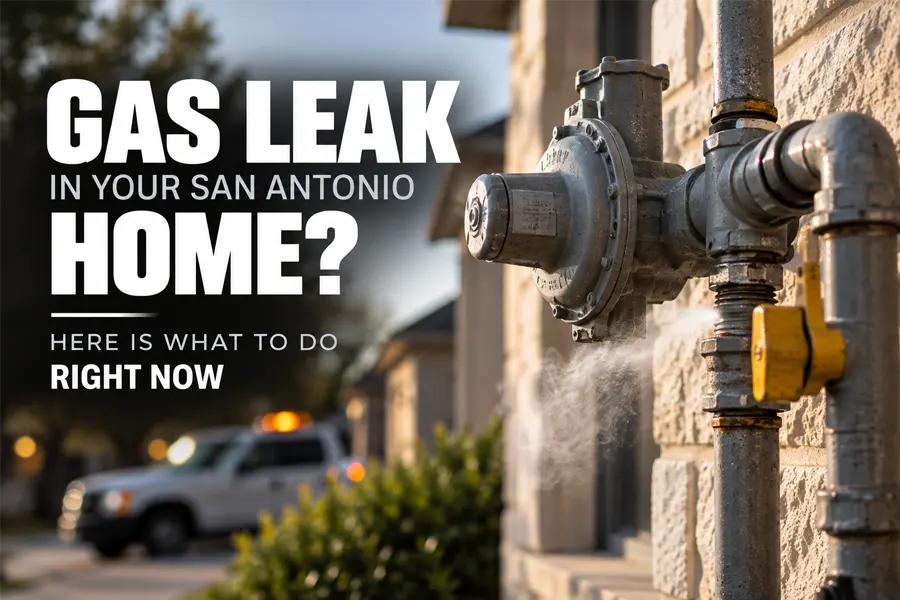
If you suspect a gas leak, get everyone out of the house, leave the door open behind you, and do not touch a single switch on the way. From a neighbor’s porch or the sidewalk, call 911 and CPS Energy at 210-353-HELP (4357), which is staffed around the clock. Then stay out until someone official tells you the house is safe to enter.
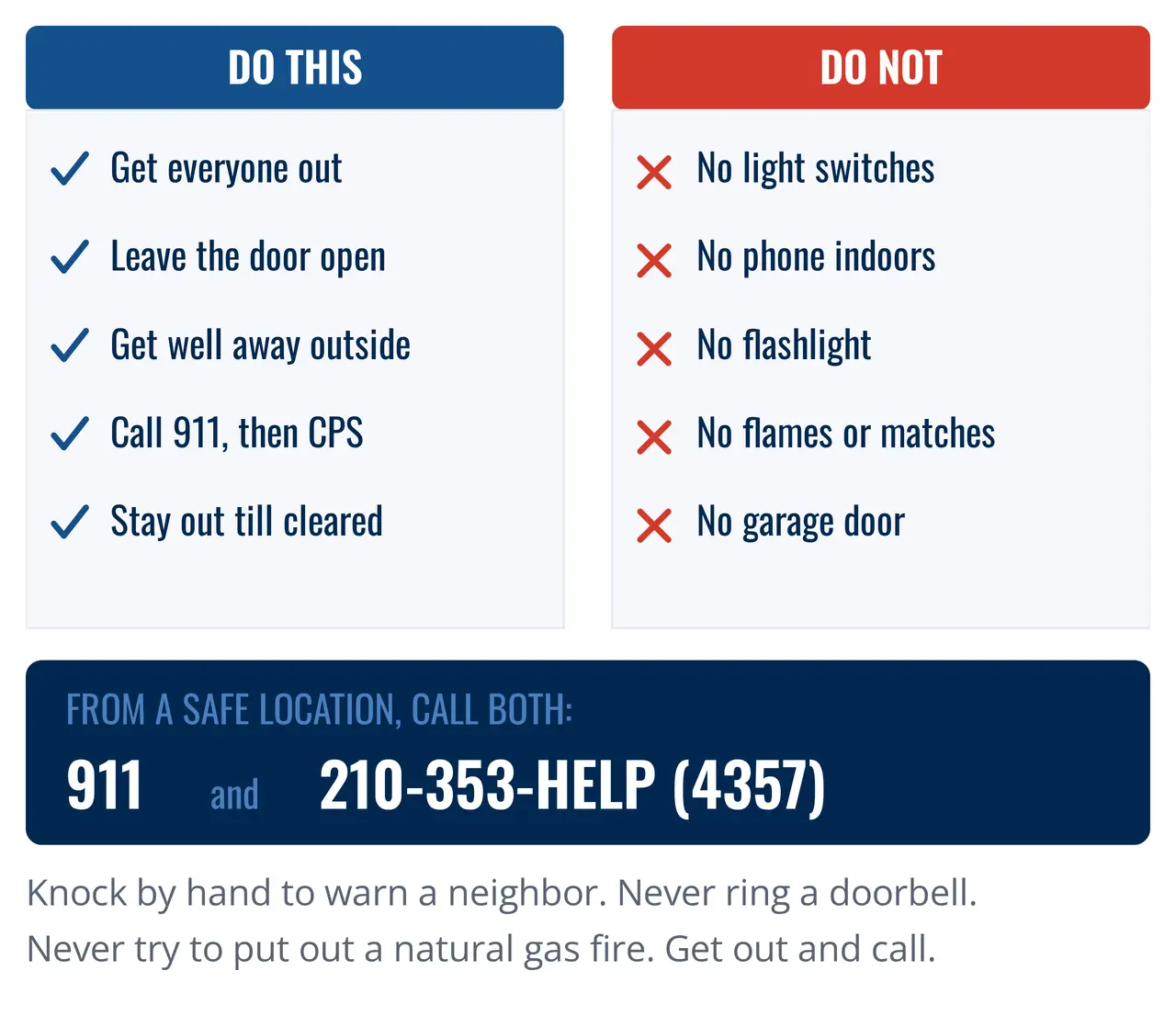
- Get everyone out first. Leave the door open behind you and do not touch a single switch on the way out.
- Call from outside — a neighbor’s porch or the sidewalk. 911 and CPS Energy at 210-353-HELP (4357), which is staffed around the clock.
- Stay out until someone official tells you it is safe. Not when the smell fades, and not when you think you have found the source.
- Get every person and pet out.Do not stop for shoes, a phone charger, the laptop or the dog’s leash. Walk out the door you are closest to. Natural gas needs only a spark and the right concentration, and you have no way to measure either one from inside.
- Leave the door open behind you.An open door vents the house while you are gone. Closing it up traps the gas and raises the concentration inside, which is exactly the wrong direction.
- Touch nothing electrical on the way out.No light switches on or off, no thermostat, no appliance, no garage door button, and no phone until you are outside. Every one of those makes a small arc, and an arc is all it is waiting for.
- Get well away — down the street, not the driveway.Standing at the end of your own drive is still standing next to the house. Put real distance and preferably a couple of other structures between you and the building, and move upwind if you can tell which way the wind is going.
- Knock, do not ring, if you are warning neighbors.A doorbell is a switch like any other. Federal pipeline guidance is specific about this: knock with your hand rather than pressing a button anywhere near a suspected leak.
- From there, call 911 and CPS Energy at 210-353-HELP (4357).Both, not one or the other. The fire department secures the area and the utility handles the gas system. CPS Energy runs that line 24 hours a day and specifically tells customers not to report a leak by email.
- Stay out until you are cleared to go back in.Not when the smell fades, not when you feel silly standing outside. When the fire department or the utility says the house is safe, and not before.
Why the Do-Not List Matters as Much as the Do List
Most people understand the instruction to leave. What catches them out is everything they do on the way, because all of it is harmless habit: the light switch in a dark hallway, the garage door button, the phone pulled out while you are still in the kitchen. A switch, a thermostat, a doorbell, a garage door opener and a phone all make a small electrical arc when they operate. In ordinary air that arc is nothing. In a room a gas leak has been filling, it is the spark the situation was waiting for.
The same logic rules out a flashlight, and it rules out striking a match to check a pilot. Two further instructions come from the federal pipeline regulator. Knock with your hand rather than ringing a neighbor’s doorbell, because the bell is a switch like any other. And if a gas leak has already ignited, do not try to put it out — a burning gas leak is at least predictable, while one that is extinguished but still flowing fills the space with fuel and waits for the next spark. Get clear and let the fire department decide.
Everything below is for a faint or intermittent odor you have time to think about. A strong, unmistakable smell, a hissing you can hear, or anyone feeling dizzy or nauseated is a confirmed gas leak until proven otherwise — run the sequence at the top of this page immediately. Curiosity is what puts people back inside a house they had already safely left.
How to Recognize a Gas Leak, Indoors and Out
Natural gas has no smell of its own. Utilities add mercaptan so that a gas leak announces itself, and what people notice is almost always rotten eggs or sulfur. Smell is not the only signal, though. The federal pipeline regulator groups the signs of a gas leak as sight, sound and smell, and outdoors the first two usually arrive first, because the odor disperses in open air.
| Sense | What you would notice | Where it usually shows up |
|---|---|---|
| Smell | Rotten eggs or sulfur — the added mercaptan, not the gas itself. | Inside, near appliances, or in a closed garage or utility closet. |
| Sound | Hissing, whistling or, on a larger line, a roar. | At a connection, a valve, or along a buried run under pressure. |
| Sight | Dirt or dust blowing up with no wind; bubbling in a puddle or pool. | Over a buried yard line, especially after rain. |
| Sight | Grass or shrubs dead or browning in a line or a patch. | Along the path of an underground line, often the only clue for months. |
| Physical | Headache, dizziness, nausea or fatigue that eases when you go outside. | Anywhere in the house. Treat this as the alarm, not as a symptom. |
That last row matters most. A cold, allergies, age or smoking can blunt your sense of smell, and prolonged low-level exposure dulls the nose even in people who would normally catch mercaptan instantly. If everyone feels better outside and worse indoors, believe the pattern rather than your nose: treat it as a gas leak until someone qualified says otherwise.
The Fear That Stops People Calling
Here is the honest reason San Antonio homeowners sit on a faint smell for a week rather than treat it as a possible gas leak: they assume calling the utility starts a meter running, and would rather wait than be billed for a false alarm. It is an understandable instinct and the most dangerous one in this article.
CPS Energy staffs its emergency line around the clock and asks customers to call rather than email about a gas odor. We will not tell you the response is free, because we have not found CPS publishing a fee schedule for emergency leak response and we are not going to invent one. If cost is what is stopping you, call and ask them directly — but call. A suspected gas leak is not the thing to be frugal about, and we would much rather drive out to a forgotten burner.
The pattern we see is not a dramatic gas leak. It is a homeowner who caught a whiff near the water heater in April, decided it was nothing, and called in July when it came back stronger. By then it is usually a fitting that has been weeping the whole time. The July repair is identical to the April one. Only the months of worry in between were optional.
What Happens After a Gas Leak Is Confirmed
Assume the worst realistic outcome: the utility confirms a gas leak on the house side of the meter. The gas is shut off and secured so it cannot simply be turned back on, and the problem is now formally yours. The utility’s job was to make the situation safe, not to repair your piping.
Getting it back on is a sequence, not a phone call. The failed section has to be repaired or replaced by a licensed plumber, and where the city requires a permit, it has to be inspected. CPS Energy is explicit: where gas permit inspections are required and have not been received, it cannot set your gas meter. On a renovation it installs the meter in a locked position until the paperwork catches up. We walk through that in our guide to gas line permits and inspections.
A confirmed gas leak is one of the few situations where calling an after-hours plumber saves money rather than costing it, because every day the meter stays secured is another day without cooking or hot water. If you have been cold-showering for more than a day, our water heater team can usually restore that appliance the same day the gas repair passes.
Where CPS Energy’s Pipe Ends and Yours Begins
This is the part that costs people money, and almost nobody knows it until the day they need to. The dividing line is the meter, and it is not where most homeowners assume.
CPS Energy’s published gas service standards are plain. The utility owns the service line from the main in the street to the meter, and the meter set itself. Everything downstream of the meter outlet is yours — the standards call it the house line and the yard line — and the customer will design, own, install, operate and maintain all facilities beyond the point of delivery.
The yard line is the expensive surprise. If your meter sits at the property line and the house is sixty feet back, or someone ran a buried line to a pool heater, every foot is yours. A gas leak out there is not a utility repair: it is excavation, a new run, a pressure test and an inspection. If you are pricing that, we broke the numbers down in what it costs to run a gas line here, and our gas line repair and installation service covers the yard side and the house side.
Before anyone digs — a fence post, a tree, a pool — Texas law requires a free 811 locate request with two business days’ notice, and the utility marks its own facilities in yellow for gas. What 811 will not reliably mark is a private line run to your own grill or pool heater, because those are not utility-owned. Hitting one is a common cause of a sudden gas leak in a quiet yard. Ask your plumber to locate private lines first, and see our guide to what actually counts as a plumbing emergency if you are unsure whether to call tonight.
Who Is Allowed to Work on Gas in Texas
There is a persistent idea that gas work is its own trade in Texas, and that a handyman who is “good with gas” occupies some middle ground. That is not how the law is written. Under the Texas Occupations Code, the statutory definition of plumbing covers piping used to supply or distribute gas, so fuel gas piping legally is plumbing. Repairing a gas leak for pay has to be done by a licensed plumber under a Responsible Master Plumber, exactly like a water line.
There is no separate gas endorsement to hold, and anyone claiming one is describing something that does not exist. The endorsements the state issues cover medical gas piping, water supply protection and residential fire sprinklers — none of which is what someone means when they say they run gas lines.
Checking a company takes under a minute. Master Plumber license numbers issued by the Texas State Board of Plumbing Examiners begin with M; a number starting with A, T or J is a different credential. The Responsible Master Plumber’s license number must appear in a company’s advertising, so if you cannot find one on the truck, the website or the invoice, that absence is your answer. We made the longer case in why it is worth hiring a licensed plumber, and you can see who is behind ours on the owner’s page.
Frequently Asked Questions
Is it safe to sleep in the house if the gas smell is faint?
No. A faint smell is not a small leak, it is a leak you cannot measure. Gas accumulates fastest overnight when doors stay shut and nobody is moving around, and a sleeping household has no early warning. Leave, call from outside, and let someone qualified tell you the house is clear. Sleeping on it is the one option with no safe version.
Can I use my cell phone to call CPS Energy from inside the house?
Not from inside or anywhere near the building. A phone is an electrical device and switching it on or taking a call can produce a small arc, which is exactly what the guidance is trying to avoid. Carry the phone out with you if it is already in your pocket, but do not use it until you are well away from the house.
My carbon monoxide alarm went off. Is that the same as a gas leak?
They are different problems with different causes. A gas leak is unburned fuel escaping from piping or a connection. Carbon monoxide is a byproduct of fuel burning without enough air, so it usually points at an appliance, a blocked flue or bad venting rather than a pipe. Both mean get out and call for help, but the repair afterward is a different job.
CPS Energy shut off and secured my meter. Who can turn the gas back on?
Not you, and not a handyman. The house-side repair has to be made by a licensed plumber, and where the city required a permit the work has to pass inspection before the utility will restore service. CPS Energy states that where required gas permit inspections have not been received, it cannot set your meter. The fastest route back is a licensed plumber and a permit, in that order.
Why do I smell gas outside near the meter but not inside?
That points at the meter set, the riser or a buried line rather than anything in the house, and it still warrants the same call. Outdoor leaks disperse, so an odor you catch outside can be a larger escape than a stronger smell indoors. Whether it turns out to be the utility’s equipment or your yard line changes who pays, not whether you should call.
Want San Antonio plumbing answers from a local licensed plumber at the top of your results? Add Silverback as a preferred source.
Once the House Is Clear, We Handle the Repair
We find the gas leak, repair the line, pressure test it and take it through inspection so the utility can restore service. If the problem turns out to be on the utility’s side of the meter, we will tell you so and it costs you nothing.
Serving San Antonio, Helotes, Boerne, Bulverde, Schertz, Somerset and Stone Oak. Open 24/7.Sources
- CPS Energy — Natural Gas Safety — evacuation sequence, the prohibitions on switches, phones and garage doors, and the 210-353-HELP line.
- PHMSA — Pipeline Leak Recognition and What to Do — recognition by sight, sound and smell, knocking by hand, and not attempting to extinguish a gas fire.
- CPS Energy Gas Service Standards (PDF) — the ownership boundary at the meter outlet and responsibility for the house and yard line.
- CPS Energy — New Home Construction Underground Service — CPS cannot set a gas meter where required permit inspections have not been received.
- Texas Occupations Code Chapter 1301 — the definition of plumbing, which covers piping used to supply or distribute gas.
- Texas State Board of Plumbing Examiners — Consumer Information — verifying a license, the M prefix on Master Plumber numbers, and the complaint line.