
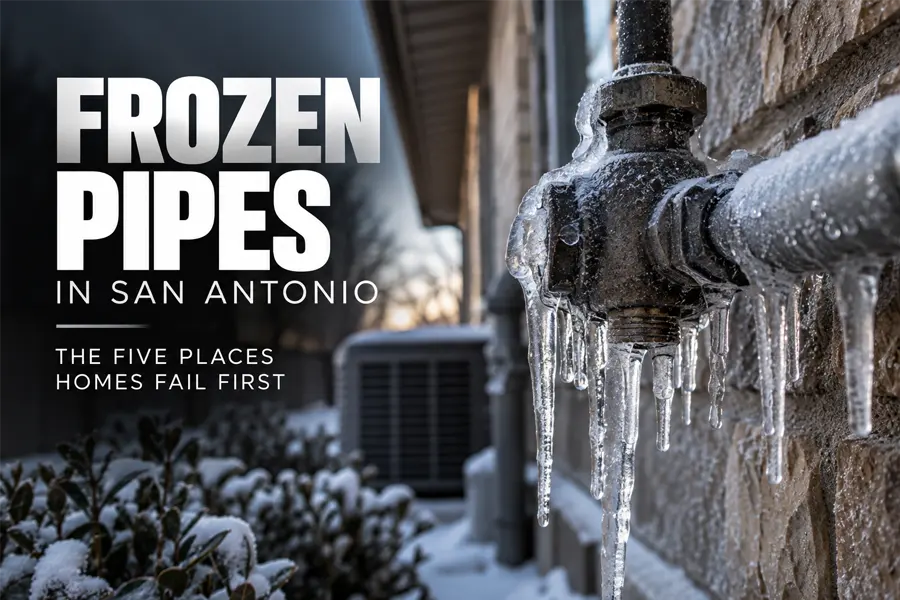
Frozen pipes in San Antonio almost always split in the same five places: attic supply runs, exterior hose bibbs, pipe against uninsulated exterior walls, irrigation lines and pool equipment. The city averages only about fifteen freeze days a winter, which is why homes here carry so little margin. Bexar County filed 44,232 insurance claims after the February 2021 storm.
- Five places split, nearly every time: attic supply runs, exterior hose bibbs, pipe against uninsulated exterior walls, irrigation lines and pool equipment. That is where protection belongs.
- San Antonio averages only about fifteen freeze days a winter — which is exactly why homes here are built with so little margin against one.
- Bexar County filed 44,232 insurance claims after the February 2021 storm. Freeze damage here is rare, and then it happens to everyone at once.
We are putting this up in September on purpose. Every year a freeze watch appears on a Thursday and by Friday afternoon there is not a faucet cover left in the city. The work that prevents frozen pipes takes an afternoon, and it is worth nothing if you start it the night the forecast changes.
What makes San Antonio unusual is not that it gets cold. It gets cold rarely enough that nobody builds for it, then occasionally cold enough to find out. That is how a mild city produced one of the most expensive residential freeze events in American insurance history.
What February 2021 Actually Cost Bexar County
The numbers from Winter Storm Uri are the argument for every twelve-dollar faucet cover here. That event is the reason anyone in this city plans for a freeze at all, and the scale of it in this county alone surprises most homeowners.
| Measure | Bexar County | Texas statewide |
|---|---|---|
| Insurance claims filed | 44,232 | 510,772 |
| Paid losses | $279.8 million | $8.3 billion |
| Case-incurred losses | $355.5 million | — |
| Estimated ultimate insured loss | — | $11.2 billion |
| Residential share of all claims | — | About 85% |
| Average residential property claim | — | $17,600 |
Figures published by the Texas Department of Insurance in its February 2021 winter weather loss report. Case-incurred losses include amounts reserved but not yet paid at the reporting date.
One statistic outside that table makes the point better. In the year before the storm, one of the largest carriers writing in Texas handled 75 frozen and burst pipe claims across the entire state. In the weeks after, the same carrier handled 18,900.
The damage was not evenly spread. SAWS leadership noted that the older parts of the city on pier and beam foundations — the near West, South and East Sides — were where they expected the worst, because a heated house over open air is a different proposition from a slab. In those homes the underfloor runs produce frozen pipes as readily as the attic.
A Mild City Builds Like the Cold Never Comes
San Antonio International Airport averages roughly fifteen freeze days a winter, and the city has never gone a season without one. Fifteen days is enough to matter and nowhere near enough to change how anyone builds.
So supply lines run through vented attics where a northern builder would never put them, hose bibbs go in without frost protection, and water service is buried shallow because there is no frost line to clear. In our experience the mains here sit around eighteen inches down — fine in an ordinary winter, little help in the week that produces frozen pipes.
None of that is a construction scandal, and it is worth saying, because freeze-season sales pitches lean on the idea that your house was built badly. It was built for the climate it sits in.
The problem is that the margin is thin enough that one sustained freeze removes it. What splits a line is hours below freezing rather than the number on the thermometer at dawn, and a still, dry twenty-eight degrees lasting two days does more damage here than a sharp overnight low gone by nine.
The Five Places Frozen Pipes Actually Split
After enough freeze weeks you stop being surprised by where the water comes from. The same five locations account for very nearly all the frozen pipes we are called to, and four of the five are fixable in an afternoon with hardware-store parts.
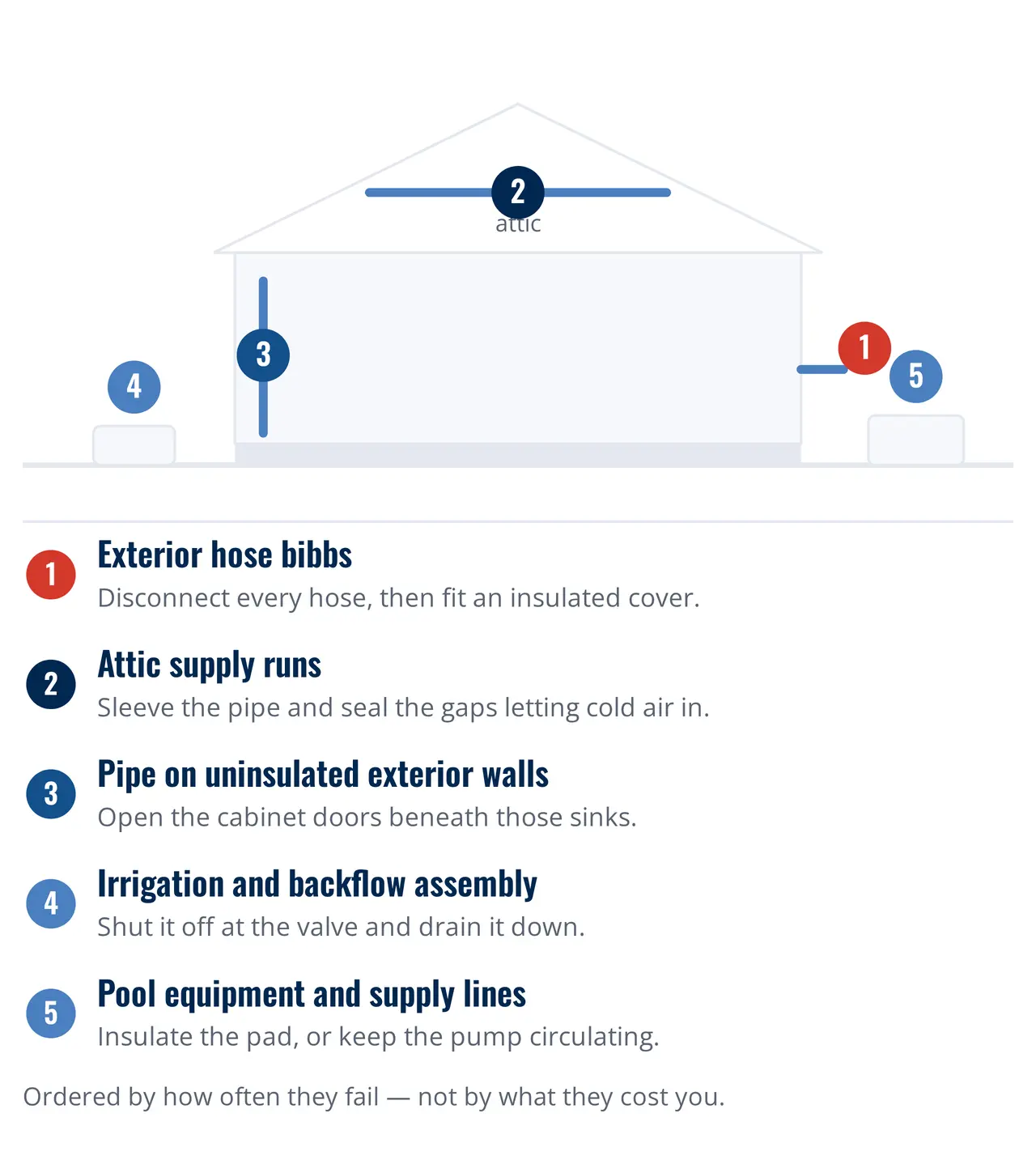
Four of the five you can handle yourself. The attic run is worth a professional eye, because reaching it means walking joists in a vented attic and sealing the air paths that let cold in. That is scheduled work in October and an after-hours emergency call in January.
The hose bibb deserves explanation, because it is the failure people find hardest to believe. A modern frost-proof bibb keeps its valve seat inside the heated wall and drains itself every time you shut it off, which is exactly what stops it freezing.
Leave a hose screwed onto it and that drainage cannot happen. Water sits in the barrel, freezes and splits the pipe inside the wall, where you will not see it until spring. Unscrewing the hose is the highest-value ten seconds against frozen pipes in this entire article.
The attic run is the opposite case: rarer, and far more expensive. Frozen pipes up there do not drip politely into a pan. They empty across the insulation and come through the ceiling below, and because it is out of sight it often runs a while before anyone notices. If a water heater lives up there too, the attic carries two risks at once — see why an attic water heater is the most expensive leak in the house.
| When | What to do | Why the timing matters |
|---|---|---|
| Now, in autumn | Find your main shut-off valve and confirm it turns. Fix it if it does not. | A seized valve is a scheduled repair in September and a catastrophe in January. |
| A week out | Sleeve exposed attic and garage pipe, seal air gaps, buy faucet covers. | Stores are cleared out within hours of a freeze watch appearing. |
| The day before | Disconnect hoses, shut off and drain irrigation, cover every bibb. | These take twenty minutes and prevent the most common failure. |
| The evening of | Open cabinet doors, keep the heat on, close the garage, start the faucet stream. | Warm air needs hours to reach pipe inside a wall cavity. |
| The morning after | Walk every room and look at the ceilings before you leave the house. | Splits usually reveal themselves on the thaw, not during the freeze. |
Insulation and air-sealing guidance follows SAWS winter pipe protection. Watch the National Weather Service Austin/San Antonio office rather than an app notification.
The Drip Advice Everyone Gets Wrong
The instruction to leave a faucet dripping is the most repeated freeze advice in Texas and the most commonly misapplied. Two details decide whether it prevents frozen pipes at all, and almost nobody hears them.
The first is volume. A drip is not enough. What protects the line is water actually moving through it, so run a steady, light stream about the thickness of a pencil lead — enough to see running rather than counting drops.
The second is which faucet. Run the one farthest from where water enters the house, because that pulls flow through the longest and coldest stretch of pipe. Dripping the kitchen tap ten feet from the meter leaves the vulnerable eighty feet untouched, which is how people who followed the advice still get frozen pipes.
The rest of the evening routine matters just as much. SAWS recommends sealing openings where cold air reaches unprotected pipe, sleeving exposed runs, leaving cabinet doors open under kitchen and bathroom sinks, and opening doors to any room without its own heating duct. Keep the garage shut, since garage walls are rarely insulated.
The American Red Cross advises leaving the heat on and set no lower than 55°F if you will be away in cold weather. That is the cheapest insurance against frozen pipes in this article.
Better still, shut the water off at the main before you go and open a faucet to relieve pressure. An unpressurized line cannot flood a house for four days while you are in Colorado. In the Hill Country, a few degrees colder than town, that applies with more force; we cover Boerne and the surrounding area too.
Better still, shut the water off at the main before you go and open a faucet to relieve the pressure. A line that is not pressurized cannot flood a house for four days while you are in Colorado. If you keep a property in the Hill Country, where it runs a few degrees colder than town, that applies with more force; we cover Boerne and the surrounding area as well.
If You Get Frozen Pipes Anyway
Frozen pipes that have not yet split are a warning rather than a disaster, and the next twenty minutes decide which they become. Before you warm anything, shut off the main. Thawing is when a split announces itself, and you want to be standing at the valve already.
The Red Cross is specific about method. Apply heat with an electric heating pad wrapped around the pipe, a hair dryer, a portable space heater kept well clear of anything flammable, or towels soaked in hot water. Open the affected faucet first so meltwater has somewhere to go.
Never use a blowtorch, a kerosene or propane heater, a charcoal stove, or any other open-flame device. House fires during freeze events are overwhelmingly caused by people thawing frozen pipes and heating rooms with things never meant to do either. If you cannot locate or reach the frozen section, stop and call someone.
If you had no water on a freezing morning and it came back on its own, do not assume you got away with it. Walk the house and look at the ceilings, especially under the attic. Frozen pipes reveal themselves as the roof warms, usually mid-morning, hours after the crisis felt over. If you find one, the first response is in what to do in the first ten minutes after a pipe bursts.
Freeze weeks follow a rhythm you could set a watch by. The calls on the cold morning are people with no water and an intact house. The expensive ones come that afternoon, from the same neighborhoods, once the sun has been on the roofs a few hours. The homes that avoid frozen pipes are almost never the ones with the newest plumbing.
The $100 Valve Worth Claiming
Here is a useful local program few homeowners know about, and it fixes the gap we find most often in freeze season: the house with no accessible shut-off valve at all.
SAWS offers a rebate of up to $100, applied as a credit on your water bill, for a newly installed shut-off valve near the meter that shuts off all water to the property.
The conditions matter: it must be a new installation, not a replacement; it must be a ball valve, since gate valves do not qualify; and it must sit in a valve box. Apply within 60 days of purchase with the receipt or plumber’s invoice plus a photo, and allow six to eight weeks for the credit. Limited to 2,000 rebates, one per household. Full terms are on the SAWS rebate page.
Whether or not you claim the rebate, the point stands alone. What decides the cost of frozen pipes is not the age of your plumbing or the insulation. It is how many minutes pass between the pipe opening and the water stopping, which depends entirely on whether somebody knows where the valve is and whether it still turns.
If yours is seized, buried or was never fitted, that is a short scheduled job and a good use of an autumn Saturday — a fraction of the cost of an after-hours call.
Our approach to emergency and freeze-season plumbing starts from the view that most frozen pipes are autumn maintenance that did not happen, and how we quote is on our pricing page. The wider checklist is in our seasonal plumbing guide, and what warrants a two-in-the-morning call is in what counts as a plumbing emergency.
Frequently Asked Questions
At what temperature do pipes freeze in San Antonio?
There is no single number, and anyone who gives you one is simplifying. Frozen pipes are produced by hours below freezing, how exposed the run is, and whether wind moves through the space around it. An uninsulated attic run can freeze in a long night in the high twenties, while the same pipe in a warm wall survives a colder but shorter snap.
Which faucet should I leave running, and how much?
Run the fixture farthest from where water enters the house, so flow is pulled through the longest and coldest stretch of pipe. Set a steady, light stream about the thickness of a pencil lead rather than a slow drip; a true drip moves too little water to help. With more than one long exposed run, run a fixture at each end.
Do I really need covers on my outdoor faucets?
Yes, and more importantly get the hose off. A frost-proof bibb protects itself by draining when you close it, and an attached hose blocks that drain, so water sits in the barrel and freezes inside the wall. Take the hose off first, then fit the cover. Covers cost a few dollars and address the commonest cause of frozen pipes we see.
Should I shut the water off at the meter before a freeze?
Only if you are leaving the house empty. Shutting off and draining down removes the risk of a four-day flood while you are away. If you are staying, leave it on, because you want water circulating. Use the house valve rather than the meter if you have one, and keep the heat running regardless.
Does the SAWS rebate cover replacing my old shut-off valve?
No. The rebate applies only to a newly installed valve; replacing an existing shut-off is specifically excluded. It must also be a ball valve rather than a gate valve, installed near the meter in a valve box so it isolates the whole property. Replacing a seized valve is still worth doing, but it will not qualify.
My house is single story. Do attic pipes still apply to me?
Almost certainly yes, and single-story homes are often worse. Slab-on-grade construction leaves nowhere else to run supply lines, so they go up and over through a vented, unconditioned attic. Frozen pipes there come down through the ceiling of whatever room sits beneath. Check for exposed pipe before assuming you are exempt.
Want San Antonio plumbing answers from a local licensed plumber at the top of your results? Add Silverback as a preferred source.
Get the Freeze Work Done While It Is Still Warm
A shut-off valve that turns, sleeved attic runs and sealed air gaps are an afternoon’s work in autumn, and the cheapest insurance against frozen pipes there is. The same list is impossible to book once a freeze watch appears.
Serving San Antonio, Helotes, Boerne, Bulverde, Schertz, Somerset and Stone Oak. Attic tanks and freeze-damaged units are handled under water heater repair and installation.Sources
- Texas Department of Insurance — February 2021 winter weather insured loss report (PDF) — Bexar County and statewide claim counts, paid and case-incurred losses, and the $17,600 average residential claim.
- SAWS — Winter Pipe Protection — sealing air openings, sleeve insulation and open cabinet doors.
- American Red Cross — Preventing and Thawing Frozen Pipes — safe thawing, the open-flame prohibition and the 55°F away-from-home minimum.
- SAWS shut-off valve rebate — the $100 credit, ball-valve and new-install conditions, and the 60-day window.
- KSAT — San Antonio freeze climatology — about fifteen freeze days per winter at San Antonio International Airport.
- San Antonio Report — insurance claims after the winter storm — the jump from 75 frozen-pipe claims to 18,900 at one major Texas carrier.
More about Mark Vargas, who wrote and reviewed this page, and our wider FAQ page.