
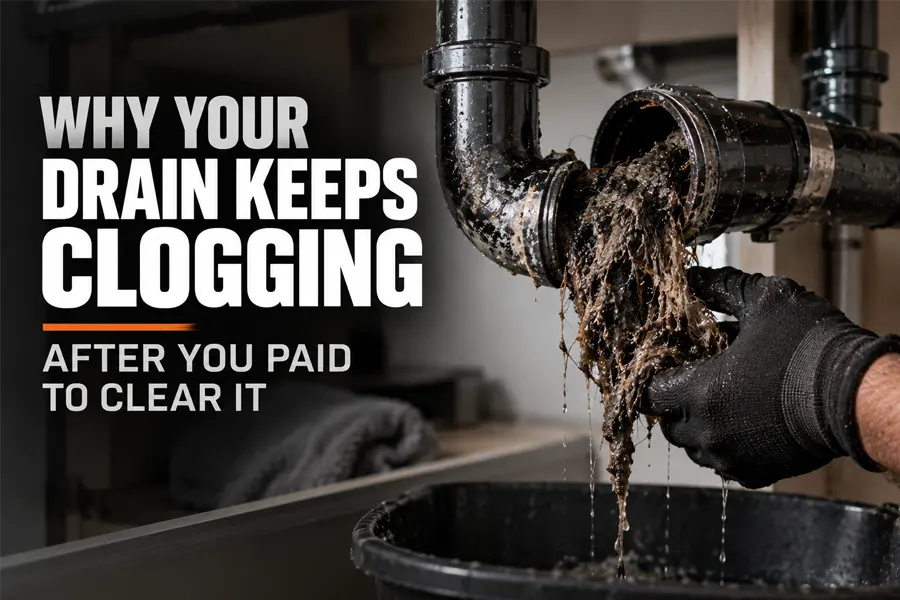
When a drain keeps clogging, it almost always means the blockage was cleared but the defect causing it was not — roots through a cracked joint, a sagging belly holding water, or scale narrowing old cast iron. The fastest clue is how many fixtures misbehave together. One fixture is a local problem. Two or more is the main line, and clearing it again will not hold.
- A drain that keeps clogging means the blockage was cleared but the defect was not — roots through a cracked joint, a sagging belly holding water, or scale narrowing old cast iron.
- Count the fixtures. One misbehaving fixture is a local problem. Two or more at once is the main line, and clearing it again will not hold.
- Cleared and fixed are not the same thing. If nobody has put a camera in the line, you are paying to reset the clock rather than to solve the problem.
There is a particular kind of frustration in watching a drain keep clogging for the second time in a season. You paid someone. It worked. Then the tub is filling again while you shower, and you are wondering whether the first plumber did a bad job or something is genuinely wrong with the house.
Usually none of those. When a drain keeps clogging, the explanation is more mundane and far more useful: the clog was removed, and the reason it formed was left exactly where it was. Those are two different jobs, and many drain calls only ever address the first.
When a Drain Keeps Clogging, Cleared and Fixed Are Not the Same
Think about what a cable does when it reaches a blockage. It bores a channel through the obstruction so water can pass. In a house with sound pipe and a one-off blockage that is the entire fix. But if something structural is causing material to collect at that spot, the channel simply refills. That is why a drain keeps clogging on what feels like a schedule — the interval is set by how fast your household puts material down the line.
Three defects account for nearly every case where a drain keeps clogging in this city. The first is root intrusion, where a crack or a separated joint lets in fine roots that act like a net, catching everything that floats past.
The second is a belly, a section that has sagged so the line no longer runs downhill; water stands in the low spot and solids settle out of it, and no amount of cleaning touches the sag. The third is scale, the mineral and grease layer that narrows an old pipe until it cannot pass what a modern household sends down it.
What all three have in common is that a camera shows them in minutes and a cable shows them not at all. That is the practical argument for insisting on video the second time a drain keeps clogging. The first backup is bad luck; the second is information. That is the starting point for any drain cleaning work we take on in San Antonio where there is a history of repeats.
The Multi-Fixture Tell
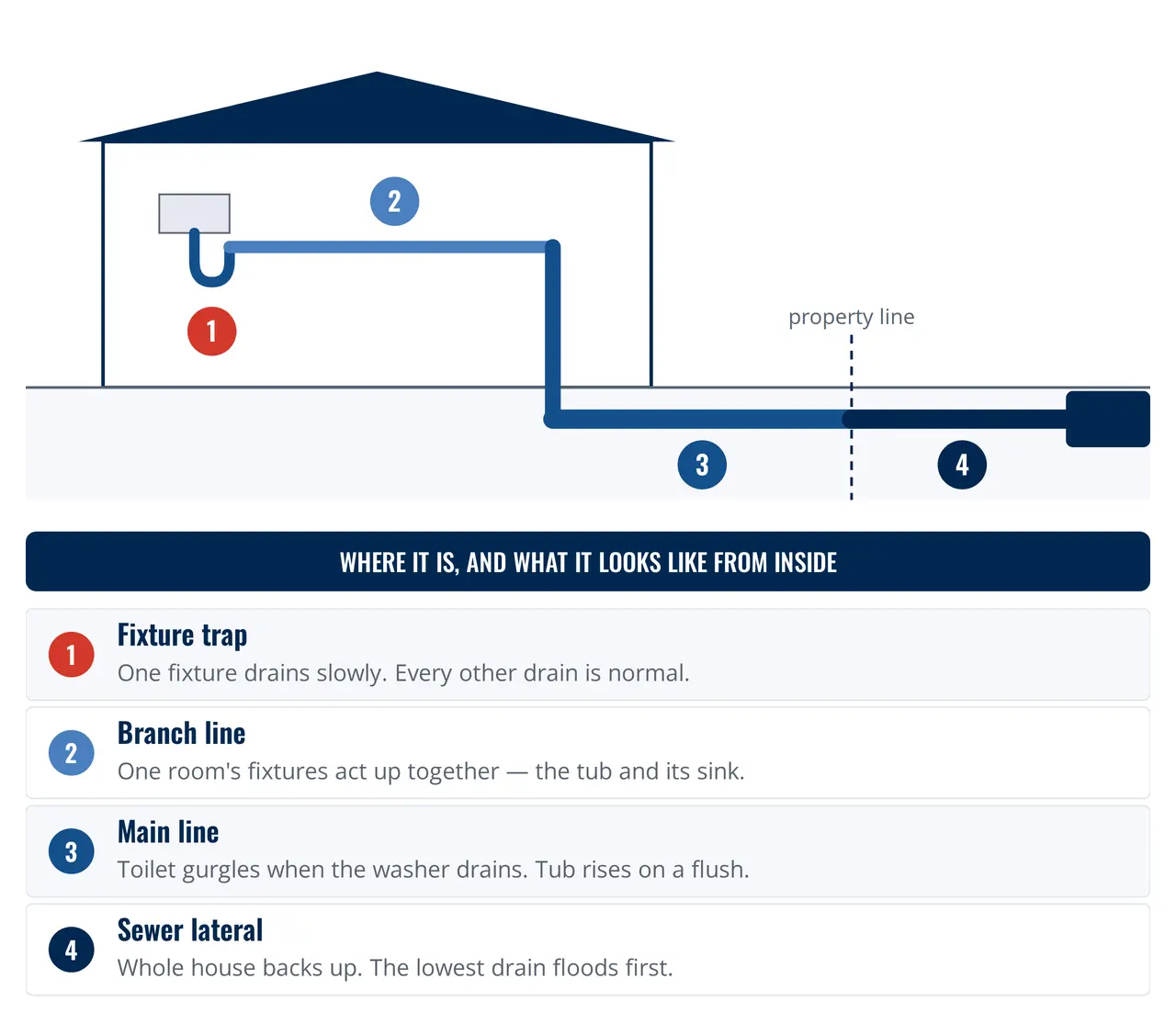
If a drain keeps clogging and you learn one thing from this page, make it this. Drainage in a house is a tree, and every fixture eventually feeds the same trunk. The number of fixtures behaving badly tells you how far down that tree the problem sits, and you can work it out standing in your hallway.
A single slow lavatory while everything else runs fine is a local problem, in that fixture’s trap or the short run behind it. But when the toilet bubbles as the washing machine discharges, those fixtures are talking to each other through shared pipe. That gurgle is air pushed back past a partial blockage downstream.
This matters commercially too, because the most expensive mistake here is treating a main-line symptom as a fixture problem. People pull the toilet, snake the tub and repeat for months while a drain keeps clogging from a blockage forty feet away. If two or more fixtures are involved, stop working on fixtures.
If the backup is affecting the whole house, there is a genuine chance it is not your pipe at all. SAWS maintains the lateral from the main up to your property line, and you own the yard piping from there in. Reporting it to SAWS first at 210-704-SAWS (7297) costs nothing. We walk through the procedure, including the green paint marking reimbursement depends on, in who pays for a sewer backup in San Antonio.
What Actually Happens to Grease
Grease deserves its own section because it is the one reason a drain keeps clogging that homeowners fully control, and because the mental model most people have of it is wrong in a way that matters.
When you pour bacon fat or pan drippings down the sink it goes down as a liquid, and that is the whole problem: the evidence of success is immediate and the consequence is invisible. A few feet along, the pipe is cooler than the pan was. The fat gives up heat, thickens, and coats whatever it touches.
It stays, and every pour adds a layer to the one before it, the way wax builds on a candle. Months later the effective diameter of a three-inch pipe is closer to one inch, and then somebody rinses a plate with rice on it and the line finally stops.
SAWS reports that fats, oils and grease account for nearly 70 percent of its sewer blockages and overflows, which tells you how often a drain keeps clogging because of habit rather than bad luck. Their guidance is three words: Scrape, Pour, Wipe. Scrape plates into the bin, pour cooled grease into a disposable container, and wipe greasy pans with a paper towel before they reach the sink. For larger volumes, the City’s Household Hazardous Waste drop-off at 7030 Culebra Road takes cooking oil.
One related point, since it comes up on nearly every kitchen call. A garbage disposal does not solve grease, and it barely solves food — it grinds solids small enough to leave the sink, not small enough to clear sixty feet of pipe. If the sink backs up into the other basin, the disposal itself may be the smaller half of the problem.
Hot Water, Baking Soda and the Chemical Question
Three home remedies come up whenever a drain keeps clogging, and they deserve individual answers rather than a blanket dismissal: one is useless, one is nearly useless, and one can cost you a pipe.
| Remedy | Verdict | What really happens |
|---|---|---|
| Hot water and dish soap after grease | Does not work | It keeps fat liquid for a few feet. SAWS is explicit that it re-congeals when it meets cooler water downstream. |
| Baking soda and vinegar | Mostly theatre | The fizz is spent in the trap. It has no mechanical force and does not touch a grease layer or roots. |
| Caustic or acid drain openers | Risky on old pipe | Generates heat, sits on the blockage, and attacks corroded cast iron and old joints while it waits. |
| Enzyme or bacterial treatments | Maintenance only | Can slow organic buildup over months. Will not open a line that is already blocked. |
| A plunger, used properly | Genuinely useful | Real mechanical force on a soft local clog. Seal the overflow first or you are just moving air. |
The chemical one warrants plain speech. Those products work by generating heat and reacting with whatever they land on, and in a pipe that is already blocked they sit against one spot for hours doing exactly that.
In the aging cast iron under many older San Antonio homes, you are applying an aggressive chemical to metal that has already lost wall thickness, right where debris has collected. A line full of caustic is also a hazard to whoever opens it next.
Say so when you call, and do not add a second product on top of the first. Mixing an acid-based opener with a caustic one, or either with bleach, can produce heat and fumes under your sink. Leave the standing water and mention it on arrival.
Why a Drain Keeps Clogging in Older Cast Iron
If your house is in Monte Vista, Alamo Heights, Olmos Park, Terrell Hills, Southtown or Dellview, the drains under it may well be the original cast iron, and that is a common reason a drain keeps clogging here. Cast iron corrodes from the inside out, and the surface that was smooth when installed becomes rough. Rough pipe catches what smooth pipe carries away.
Two local factors accelerate it. San Antonio’s water is hard — SAWS puts typical household hardness at 15 to 20 grains per gallon — which feeds the mineral part of that buildup. The expansive clay soil also works at buried joints over decades, opening the gaps roots exploit. For the broader picture, see how hard water affects your plumbing.
The honest implication is uncomfortable but useful: on a line in that condition, cleaning is maintenance, not repair. That is rational to pay for if you know what you are buying. It stops being rational when nobody has told you, and a drain keeps clogging every year while you believe each clearing is the last.
A pattern we see often on older properties is a kitchen line that fails every autumn, right when the household starts cooking more. The owner assumes the previous clearing failed. In fact the pipe never had its diameter back — it was cabled open through a grease layer left in place — so a cooking season reaches the limit sooner.
Breaking the Cycle
Getting out of a pattern where a drain keeps clogging is mostly a matter of changing the question you ask. Instead of asking a plumber to clear the drain, ask what is causing it to block. It is a short sentence and it reliably changes the visit.
- Get video, and keep a copy.You want the pipe material, the condition of the wall and any standing water. Ask for the footage to be sent to you; it becomes your baseline for every future conversation.
- Have the defect named, not just the clog.Roots at a specific joint, a belly at a measured distance, or scale along a run are three different problems with three different price tags.
- Clean it properly once rather than opening it repeatedly.Where the pipe can safely take it, restoring full diameter lasts far longer than boring a channel. What that means by pipe material is set out in hydro jetting versus snaking.
- Fix the opening if roots are getting in.Cutting roots is temporary by definition. Lining or replacing the affected section is what ends it, and that is where a sewer line repair stops being an upsell and becomes the cheaper path.
- Change the two habits that matter.Grease into the bin, nothing fibrous down the disposal. Both are free and both extend the interval on any line.
For what these visits typically run, our San Antonio drain cleaning cost guide lays out the ranges and our pricing page explains how a quote gets built. If the house is backing up right now, that is an after-hours call, and general questions are collected on our FAQ page.
Frequently Asked Questions
My drain keeps clogging every few months. Why?
Because the blockage was removed but whatever caused it was not. A drain keeps clogging when the defect survives the clearing. Roots at a cracked joint, a sagging belly that holds water, or a scale layer narrowing the pipe will all refill a cleared channel on a predictable cycle. A camera inspection is what distinguishes these, and it is worth doing on the second backup rather than the fifth.
My toilet gurgles when the washing machine drains. What does that mean?
That is a main line signature, not a toilet problem, and it is the clearest sign a drain keeps clogging because of shared pipe. The gurgle is air forced back past a partial blockage downstream of where both fixtures join the same pipe. Snaking the toilet or replacing parts will not help. The blockage is in shared pipe, and on a whole-house symptom it is worth checking whether it sits past your property line.
Does pouring grease down with hot water and soap work?
No. Hot water keeps fat liquid for a short distance only, and SAWS states plainly that it re-congeals when it reaches the cooler water further along the system. All the mixture does is move the deposit further from the fixture, where it is harder to reach. Cooled grease belongs in a container in the bin.
Will baking soda and vinegar clear a clogged drain?
Not a real clog. The reaction is brief, it is spent within the trap, and it produces no mechanical force to move a blockage. It can help with odour in an otherwise clear line. It will not cut roots, strip a grease layer or shift anything settled in a belly, which are the three reasons a drain keeps clogging.
Is liquid drain cleaner safe for old cast iron pipes?
We would avoid it. Those products generate heat and sit against the blockage for hours, and in corroded cast iron that already has wall loss, that is the worst place to concentrate an aggressive chemical. There is also a safety issue for whoever opens the line afterward. If you have used one, say so when you call.
If a drain keeps clogging, do I need cleaning or a repair?
Frequency answers it. A line that blocks once and then behaves for years needed cleaning. A line that blocks on an annual rhythm has a defect, and each cleaning is rent rather than a fix. Once you are on a yearly cycle, compare the running cost of clearing against lining or replacing the bad section.
Want San Antonio plumbing answers from a local licensed plumber at the top of your results? Add Silverback as a preferred source.
Find Out Why It Keeps Coming Back
If this is the second or third time the drain keeps clogging, the useful spend is a camera, not another clearing. We will show you the footage, name the defect and tell you whether cleaning or repair is the cheaper road.
Serving San Antonio, Helotes, Boerne, Bulverde, Schertz, Somerset and Stone Oak. Open 24/7.Sources
- SAWS — Grease FAQs — the share of local sewer blockages attributed to fats, oils and grease, the re-congealing of grease in cooler water, and the Household Hazardous Waste drop-off at 7030 Culebra Road.
- SAWS — Grease — the Scrape, Pour, Wipe disposal guidance for households.
- U.S. EPA — Sanitary Sewer Overflow Frequent Questions — roots entering through defects or openings, and FOG among the standard causes of blockages.
- SAWS — Plumbing Backed Up? — the 210-704-SAWS reporting line and the property-line responsibility split.
- SAWS Water Quality FAQs — typical household hardness of 15 to 20 grains per gallon.