

Yes, and the water softener permit rule here is unusual. Swapping an existing unit or installing into a home that is already pre-plumbed qualifies for a Limited Service and Repair permit, obtained within three working days after the work is done. New piping, a relocation, new construction, or a job over $2,000 requires a standard plumbing permit instead.
- San Antonio does require a permit, and the rule is unusual. A like-for-like swap, or an install into a home already pre-plumbed for a softener, qualifies for a Limited Service and Repair permit.
- That permit is obtained within three working days after the work is done — not before it starts.
- New piping, a relocation, new construction, or any job over $2,000 falls outside that and needs a standard plumbing permit instead.
People type one question into Google more than any other here, so it deserves a direct answer first: why are water softeners banned in Texas? They are not. There is no statewide ban, no San Antonio ban, and nothing in the adopted code stopping a homeowner installing one. The belief exists because a handful of California and Arizona communities restricted softeners over brine discharge, and equipment vendors have repeated a vague version of it with Texas attached.
What San Antonio does have is a water softener permit requirement, and it works in a way that catches out both homeowners and out-of-town contractors. Understanding it is genuinely useful, because it decides whether your installer can start this afternoon or has to file paperwork and wait first. That distinction shows up directly in what you are quoted.
Starting With the Myth, Because It Is the Loudest Thing Out There
Softeners are legal in Texas and legal in San Antonio. The city’s own adopted plumbing code does something stronger than merely permitting them. It explicitly names water softener companies as a category of business authorised to pull a water softener permit, which is not language you write for equipment you are trying to discourage.
Brine discharge is a legitimate environmental topic, and some water-scarce municipalities elsewhere have acted on it. Salt from regeneration does pass through a wastewater plant largely untreated, which matters where treated effluent is reused for irrigation under tight chloride limits. It has simply not produced a San Antonio rule.
What I Could and Could Not Find on Brine Discharge
I want to be careful here, because this is exactly the kind of claim that gets repeated until it becomes received wisdom. I went looking specifically for a SAWS regulation or a City of San Antonio ordinance restricting residential softener brine discharge to the sanitary sewer. I checked the adopted building and plumbing codes, the municipal code’s prohibited-discharge provisions, and SAWS’s own compliance material.
I did not find one. No SAWS rule, no city ordinance, and nothing in the state code restricting a residential softener from draining to the sewer the way the manufacturer intends. At least one equipment vendor’s website states that San Antonio has “established similar regulations” to restricted California cities, while contradicting itself elsewhere on the same page by noting Texas has no such ban. Treat that claim as unsupported.
The honest framing is this. No primary source shows such a restriction, and if one is ever adopted it will appear in the city’s code or SAWS’s service regulations, not on a manufacturer’s marketing page. Standard practice here is an indirect waste connection with an air gap, per the plumbing code.
The first is that softeners are restricted here and you need a special exemption. They are not, and you do not. The second is that a rebate will offset the cost. SAWS residential rebate programmes are all outdoor and irrigation related — landscape, irrigation design, pool and flow sensor. There is no SAWS rebate for a water softener or any other water treatment equipment. If someone tells you otherwise, ask them to open the programme page in front of you.
Which Code San Antonio Is Actually On
This matters because a lot of contractor advice online is running two editions behind. San Antonio adopted the 2024 International Plumbing Code, effective 1 May 2025. That is the document governing the installation, alteration, replacement and relocation of plumbing systems here, including equipment and appliances, which is where a softener sits.
The adopted chapter also sets out who may obtain a plumbing permit, and the softener-specific line is worth quoting because almost nobody locally writes about it. The code authorises water softener companies holding a Class III licence from the Texas Commission on Environmental Quality to pull a water softener permit for the installation or change-out of softeners and associated equipment. That carve-out tells you the city expects this work permitted, with a specific credential behind it.
The Two Water Softener Permit Routes, and Which One You Are On
San Antonio runs a Limited Service and Repair programme for minor replacement work, and water softeners are explicitly on the eligible list. The mechanic genuinely surprises people the first time they hear it, because this kind of water softener permit comes after the work rather than before.
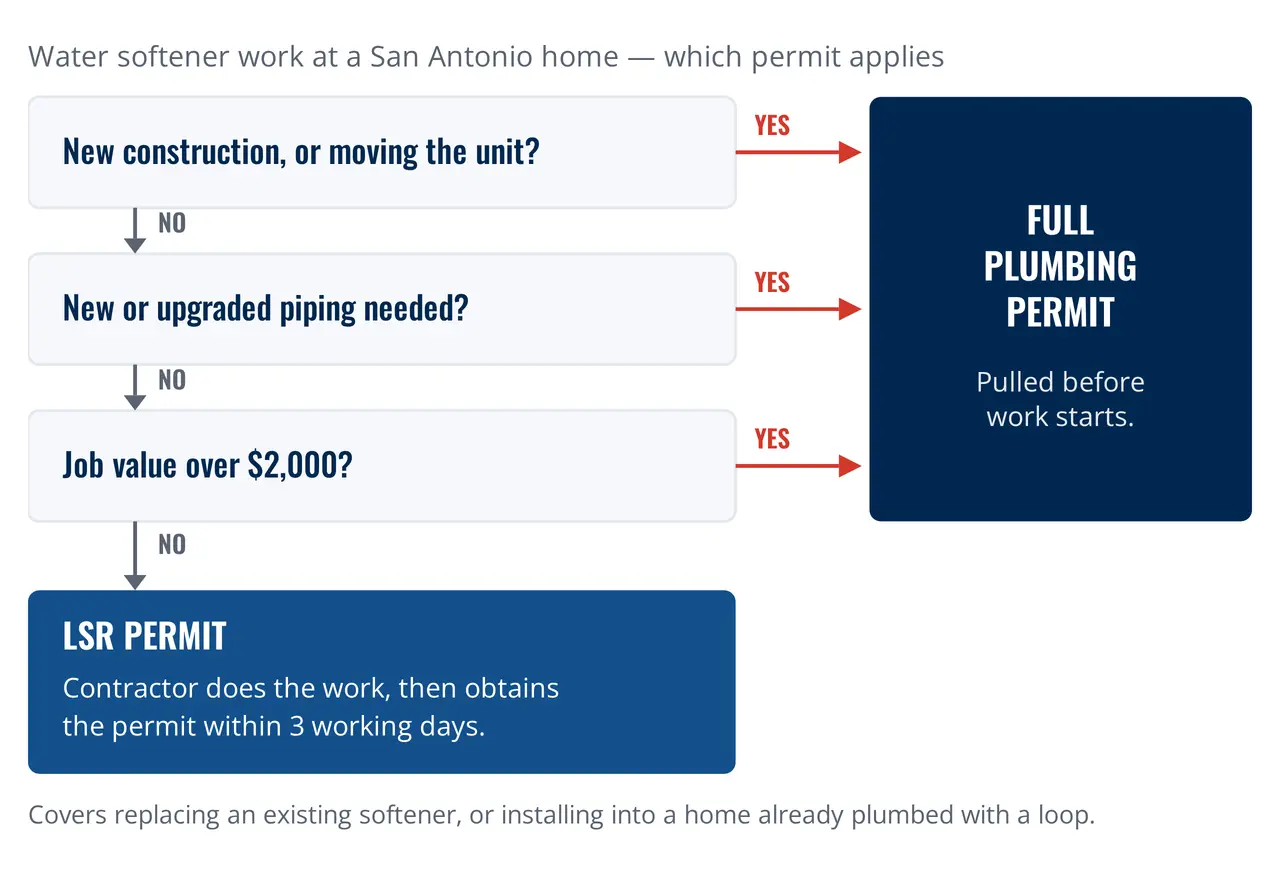
Under the Limited Service and Repair route the contractor performs the eligible work and then obtains the water softener permit within three working days of completing it. Contractor certification stands in place of a routine inspection, although a property owner can request an inspection from Development Services at no additional cost, which is a right worth knowing you have.
| The job | Route | Timing of the water softener permit |
|---|---|---|
| Replacing an existing softener in the same spot | LSR | Within 3 working days after the work. |
| New softener into a home with an existing loop | LSR | Within 3 working days after the work. |
| New softener where a loop must be added | Full permit | Pulled before work begins. |
| Moving the unit to a different location | Full permit | Pulled before work begins. |
| Softener in new construction or an addition | Full permit | Pulled before work begins. |
| Any softener job valued over $2,000 | Full permit | Pulled before work begins. |
Route eligibility is set by the City of San Antonio Development Services LSR bulletin. Dollar threshold and piping exclusions are the city’s, not a company policy.
That last row catches more jobs than people expect, and it is the reason a $2,400 softener installation is a different administrative animal from a $1,900 one even when the physical work looks identical.
Who Is Allowed to Do This Work, and What the Credential Is Called
Here is where a lot of competitor content gets it wrong, and where a homeowner can easily be told something confident and incorrect. In Texas the softener-specific credential is the Water Treatment Specialist licence issued by the Texas Commission on Environmental Quality. It is not a plumbing endorsement.
The TCEQ licence comes in three classes. Class I is entry level and works under supervision, largely limited to exchanging and regenerating portable tanks. Class II can carry out installations, exchanges, servicing and repairs, but not reverse osmosis or deionisation work unsupervised. Class III carries no equipment restriction and covers reverse osmosis and deionisation as well as softeners, which is precisely the class the city’s adopted code names for water softener permits.
The Texas State Board of Plumbing Examiners issues only three endorsements, and none of them is a softener endorsement. They are medical gas piping installation, multipurpose residential fire protection sprinkler specialist, and water supply protection specialist. The last of those sounds like it should cover treatment equipment but does not: it covers plumbing associated with rainwater treatment and distribution, plus customer service inspections for public water systems.
So there are two legitimate paths for getting a softener installed and permitted in San Antonio. A water treatment company holding a TCEQ Class III licence can do it and pull the water softener permit. A licensed plumber working under a Responsible Master Plumber can also do it under a standard plumbing permit, which is the route we take for every softener installed across our San Antonio service area. Either is correct. What is not correct is an unlicensed installer, and you can check any plumbing licence yourself in about thirty seconds through the state board’s lookup.
The call I take most often on this subject is not from someone planning an installation. It is from someone mid-sale whose buyer’s inspector has flagged a softener with no water softener permit record attached to the address. Nothing about the equipment is wrong, the install is usually fine, but there is no paper trail and it becomes a negotiating point at the worst possible moment. Retroactive documentation is far more painful than a water softener permit obtained when the work was done, which is the whole reason the three-day window exists.
Why the Water Softener Permit Fork Is Also the Money Fork
The reason softener quotes in this city vary so widely is not usually the equipment. It is whether your house is already plumbed for one. Many San Antonio homes were built with a softener loop, typically in the garage: a pair of stubs on the incoming cold line with a bypass, waiting for a unit.
If you have a loop, the installation is genuinely straightforward, your water softener permit falls under the Limited Service and Repair route, and the plumbing work is measured in hours.
If you do not have a loop, someone has to cut into the incoming main, run new pipe, fit a bypass, and get a drain and an air gap to the softener’s discharge point. That is new piping, and it moves you to a full plumbing permit pulled before work begins.
The typical San Antonio market range for adding a loop sits somewhere around $300 to $800 or more, depending on where the main enters and how far the drain has to travel. Same softener, same crew, meaningfully different job. It is also the moment worth thinking about your water heater, since the softener usually ends up plumbed upstream of it and the two jobs are cheaper together than apart.
This is why a quote given over the phone without a single question about your garage should make you cautious. A company that has not asked whether you have a loop does not yet know which water softener permit route your job is on, and therefore does not know what it costs. How we assemble a number is set out on our pricing page, and the full picture of what a softener installation in San Antonio involves sits alongside it.
Go into the garage and find where the water line comes in from outside. A softener loop looks like two capped or valved copper or PEX stubs about a foot apart, often with a third valve between them acting as a bypass, and there is usually a drain or a laundry standpipe within a few feet. If you find that, you are on the cheaper side of this decision. If you are not sure what you are looking at, a photograph on your phone is enough for us to tell you over the phone.
Before you decide any of this, it is worth knowing the number you are treating. Our breakdown of how hard San Antonio water actually is covers the published figures, and if you are weighing equipment types, salt versus salt-free at local hardness is the honest comparison. The general case for treatment is in do you need a water softener system, and the argument for using someone licensed at all is in why you should hire a licensed plumber.
Frequently Asked Questions
Are water softeners banned in Texas?
No. There is no statewide ban and no San Antonio ban. The city’s adopted plumbing code goes further and explicitly names water softener companies holding a TCEQ Class III licence among those authorised to pull a water softener permit. The belief comes from a small number of California and Arizona communities that restricted brine discharge, which does not apply here.
Can I install a water softener myself in San Antonio?
Texas exempts a property owner from licensing for plumbing work on the homestead they live in, and the city will issue a homeowner water softener permit on that basis. The exemption is narrow and does not extend to rentals or investment property. The work still has to meet the adopted plumbing code, including a proper indirect waste connection with an air gap on the drain.
What is the difference between an LSR permit and a full plumbing permit?
Timing and scope. A Limited Service and Repair water softener permit covers minor replacement work, including swapping a unit or installing one into a pre-plumbed home, and the contractor obtains it within three working days after finishing. Anything involving new or upgraded piping, a relocation, new construction, or a value over $2,000 needs a standard plumbing permit pulled before work begins.
Does my installer need a plumbing licence or a TCEQ licence?
Either can be correct. A water treatment company holding a TCEQ Class III Water Treatment Specialist licence is authorised under the city’s adopted code to install softeners and pull the permit. A licensed plumber working under a Responsible Master Plumber can do the same under a standard plumbing permit. What matters is that whoever shows up holds one of them.
Will an unpermitted softener cause a problem when I sell my house?
It can. A buyer’s inspector who sees treatment equipment with no water softener permit record often raises it, and it becomes a price negotiation at the point you have the least leverage. The equipment itself is rarely the issue. It is the absence of documentation, which is far easier to create at the time of installation than years afterwards.
Want San Antonio plumbing answers from a local licensed plumber at the top of your results? Add Silverback as a preferred source.
Get It Installed Once, Permitted Properly
We will tell you on the phone whether your house has a loop, which water softener permit route that puts you on, and what the job actually involves before anyone quotes a number. The paperwork is our problem, not yours.
Serving San Antonio, Helotes, Boerne, Bulverde, Schertz, Somerset and Stone Oak. Open 24/7.Sources
- City of San Antonio Chapter 10 Building-Related Codes (PDF) — adoption of the 2024 International Plumbing Code effective 1 May 2025, and the TCEQ Class III water softener permit provision.
- City of San Antonio Information Bulletin 121c (PDF) — Limited Service and Repair eligibility, the three working day window, and the $2,000 threshold.
- TCEQ Water Treatment Specialist licence — Class I, II and III scope, including reverse osmosis and deionisation under Class III.
- Texas State Board of Plumbing Examiners endorsements — confirmation that the three endorsements do not include water softeners.
- Texas State Board of Plumbing Examiners consumer information — licence verification for anyone doing plumbing work for pay in Texas.
- SAWS residential programmes and rebates — evidence that all residential rebates are outdoor and irrigation related.