

Gas fireplace repair in San Antonio usually lands between $75 and $600, while a brand-new direct vent unit runs $7,200 to $16,200 installed. Here is what drives the price in each direction, and the safety checks that matter more than the price tag.
The short answer
Most repairs fall in the $150 to $600 range, and a pilot light or thermocouple fault is the cheapest common fix at $75 to $350. Installation is a different order of magnitude: $2,300 to $8,000 for an insert, $7,200 to $16,200 for direct vent. Any work involving the gas line or venting is licensed work, not a weekend job.
Installation cost depends heavily on type: a gas fireplace insert typically runs $2,300 to $8,000 installed (averaging around $3,700), while a full direct vent fireplace runs $7,200 to $16,200 once gas line access, venting, and finish work are included. These are approximate, market typical figures, not a Silverback quoted price; an in home estimate accounts for your specific setup.
Gas fireplace repair is far cheaper: a thermocouple or pilot light issue usually costs $75 to $350, and most gas fireplace repairs overall fall between $150 and $600.
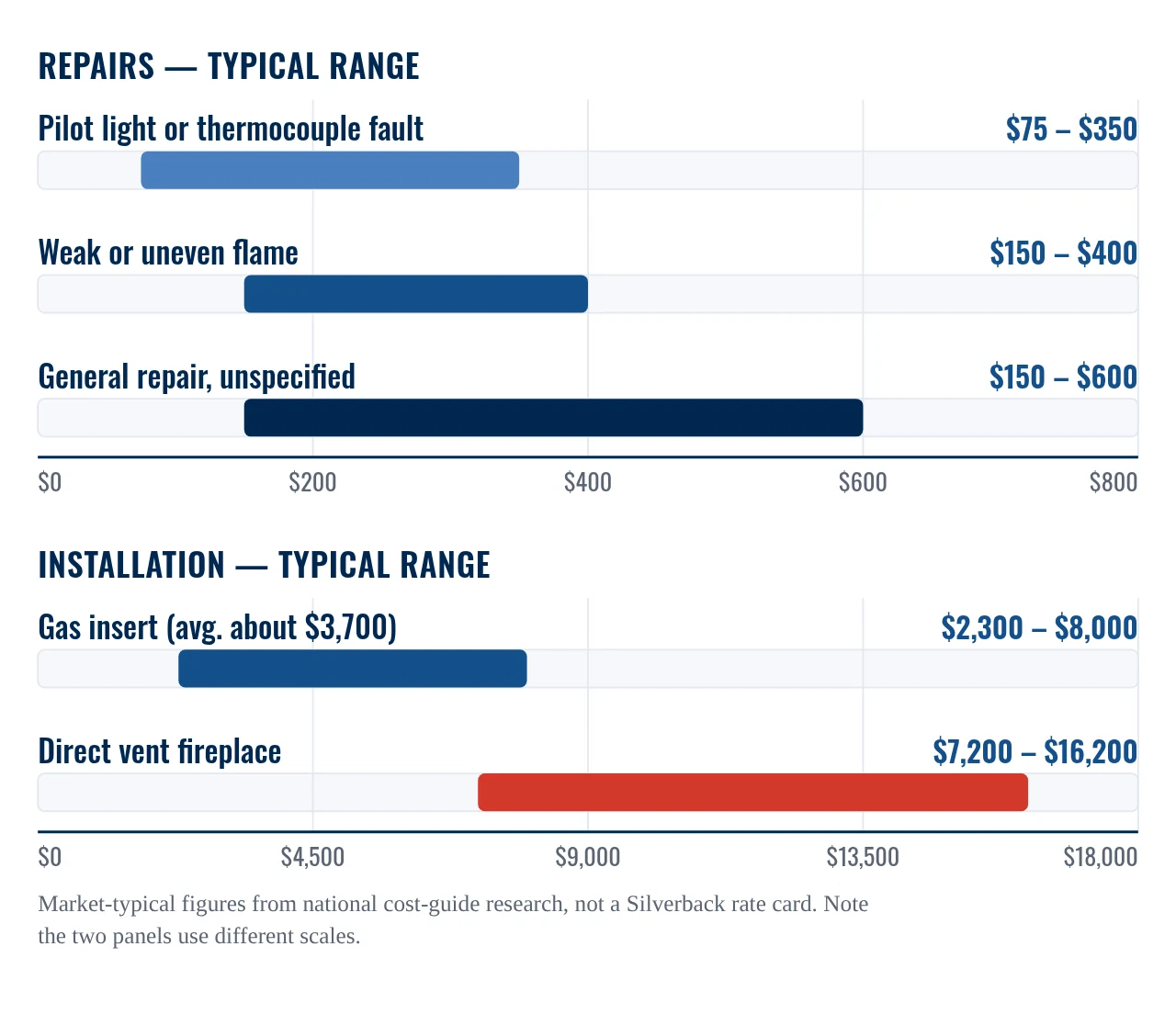
- Most gas fireplace repairs fall in the $150 to $600 range. A pilot light or thermocouple fault is the cheapest common fix at $75 to $350.
- Installation is a different order of magnitude: $2,300 to $8,000 for an insert, $7,200 to $16,200 for direct vent.
- How the unit vents is what decides the price bracket — more than the firebox, the finish or the brand.
- Any work involving the gas line or the venting is licensed work, not a weekend job.
Three Types of Gas Fireplaces, and What Each Costs
Gas fireplaces in San Antonio homes generally fall into three categories, and the installation cost differs significantly between them.
| Type | Best for | Approximate installed cost |
|---|---|---|
| Gas insert | Upgrading an existing wood burning fireplace | $2,300 to $8,000 (avg around $3,700) |
| Direct vent | New installations needing the best heat efficiency and safety | $7,200 to $16,200 |
| Vent free | Homes without existing venting access | Generally lower than direct vent, but requires careful sizing and ventilation precautions |
Pricing note: these figures reflect current national cost guide research rather than a Silverback specific rate card. The exact price for your home depends on existing gas line access, venting requirements, permits, and the finish materials you choose around the unit.
How a Gas Fireplace Vents, and Why That Decides the Price
Almost every difference between two quotes traces back to one question: where do the combustion gases go? Venting determines the unit, the labour, the wall or roof work, and whether the job needs framing. It is also the single biggest driver of what a gas fireplace repair costs later, because each system fails in its own way.
Direct vent
A direct vent fireplace is a sealed box behind glass. A coaxial pipe pulls combustion air in from outside through the outer sleeve and pushes exhaust out through the inner one, so room air is never used for combustion. These units are listed to ANSI Z21.88 or Z21.50 and can terminate horizontally through an exterior wall, which is why they fit homes with no chimney.
That sealed design is the reason direct vent sits at the top of the cost range and the reason it is the safest of the three. It is also the most forgiving to live with: because the firebox is isolated from the room, most direct vent gas fireplace repair work is confined to the ignition system and the burner rather than anything affecting indoor air.
B-vent
A B-vent unit draws room air for combustion and sends exhaust up a vertical flue. The critical rule is that B-vent must terminate vertically — it cannot be run out a side wall the way direct vent can. If your home has no existing chimney chase above the fireplace location, creating one is framing and roofing work, and that lands in the quote long before anyone talks about the appliance.
Vent-free
A vent-free unit has no flue at all and releases combustion byproducts into the room. It is the cheapest to install and by far the most restricted to use, which is where most homeowners get caught out.
The Vent-Free Rules Most Homeowners Never Hear
San Antonio adopted the 2024 International Residential Code effective 1 May 2025, and section R1006 governs this directly. A salesperson describing a vent-free unit as “install it anywhere” is describing something the code does not allow:
- Not in bedrooms or bathrooms. Unvented appliances are prohibited in both, and in any room below the minimum volume for the appliance’s rating.
- An oxygen depletion sensor is mandatory. The ODS shuts the gas off automatically if room oxygen falls to roughly 18 percent.
- 40,000 BTU/hr is the ceiling for an individual vent-free room heater.
- Room volume must be about 50 cubic feet per 1,000 BTU/hr of input.
Run that last number and the practical limit becomes obvious. A 30,000 BTU vent-free unit needs roughly 1,500 cubic feet of room. A 15-by-16-foot living room with 8-foot ceilings gives you about 1,920 cubic feet, so it qualifies; a snug den will not. Sizing a vent-free appliance to a room that cannot carry it is the most common reason we get called for a gas fireplace repair that turns out not to be a fault at all — the ODS is doing its job and shutting the unit down.
Common Gas Fireplace Repair Problems and What They Cost
| Symptom | Likely cause | Approximate repair cost |
|---|---|---|
| Pilot light won’t stay lit | Faulty thermocouple or gas valve | $75 to $350 |
| Weak or uneven flame | Clogged burner ports or low gas pressure | $150 to $400 |
| Unusual odors or soot buildup | Ventilation or combustion issue | Varies; often requires a diagnostic visit first |
| General repair, unspecified | Varies by component | $150 to $600 typical range |
If you smell sulfur or rotten eggs near your fireplace: turn it off, ventilate the area, and call a professional immediately. Our step-by-step guide to a suspected gas leak covers the order those actions belong in rather than attempting any repair yourself. That smell is the standard indicator of a gas leak.
Why This Is Not a DIY Job
Gas fireplace work means working directly with a gas line, the same line our gas line repair team handles elsewhere in your home. A poor connection or venting mistake doesn’t just void a warranty, it creates a real carbon monoxide and fire risk. A licensed technician installs to local code, confirms the gas line and venting are sized correctly, and tests the system before handing it back to you.
In Texas, Gas Fireplace Work Is Plumbing Work
This surprises people, and it matters when you are choosing who to call. Under Texas Occupations Code §1301.002, gas piping falls within the legal definition of plumbing. There is no separate “gas fitter” licence in this state. The person who runs, moves or alters the gas line feeding your fireplace must hold a Texas plumbing licence issued by the Texas State Board of Plumbing Examiners, and you can check any licence yourself at tsbpe.texas.gov.
San Antonio handles the paperwork the same way. Gas work is permitted through the city’s plumbing permit rather than a separate fireplace permit, and the city’s own guidance is blunt about who may do it: licensed trade contractors are required for new plumbing and HVAC work. A handyman quoting a gas fireplace repair that involves the supply line is quoting work they cannot legally pull a permit for. The local permit rules are stricter than the model code in two specific places.
The practical consequence lands later. Unpermitted gas work has a habit of surfacing at the worst moment — during a sale, during an insurance claim after a fire, or when the next plumber refuses to connect to it.
Annual Maintenance That Prevents Gas Fireplace Repair
- Checking the gas line connections for leaks.
- Inspecting the venting system for blockages.
- Examining the burner and ignition system.
- Testing the thermocouple or thermopile for proper function.
- Removing dust, debris, and soot buildup from the burner and logs.
Skipping this for a few years is usually how a $75 thermocouple fix turns into a $400 burner replacement, so annual service tends to pay for itself and keeps gas fireplace repair at the low end of the range.
Safety Signs You Shouldn’t Ignore
- A sulfur or rotten egg smell, which signals a possible gas leak.
- Soot buildup or unusual odors during normal use.
- A pilot light that won’t stay lit, even after relighting.
- Decorations, furniture, or curtains placed too close to the unit, which is a fire risk regardless of the fireplace’s condition.
A working carbon monoxide detector near the fireplace is a good extra precaution even when the unit is installed and maintained correctly.
Repair or Replace: The Decision in Plain Numbers
The arithmetic is usually straightforward once the numbers are side by side. A gas fireplace repair in the $75 to $600 band against an insert at $2,300 to $8,000 means repair wins almost every time on a unit that is otherwise sound.
Replacement starts to make sense when one of these is true:
- The firebox itself is cracked or warped. This is not a serviceable part. A compromised firebox on a B-vent or vent-free unit is a combustion-products-into-the-room problem, and it ends the conversation.
- Parts are no longer made. On units past roughly 20 years, valves and control modules get scarce, and a gas fireplace repair that needs a discontinued part becomes a sourcing exercise with no guaranteed end.
- You are changing vent type anyway. If you are moving from vent-free to direct vent for the safety margin, the appliance cost is arriving regardless, and any new gas line run is priced separately.
- Repeat failures in one season. Three service calls in one winter usually means the underlying issue was never the part that kept being replaced.
What should not drive the decision is a single stuck pilot light. That is the cheapest fault on the board and it is not evidence of a dying unit.
What to Ask Before You Hire Anyone
Five questions separate a real quote from a number invented on a doorstep:
- What is your Texas plumbing licence number? Then verify it at TSBPE rather than taking the card at face value.
- Is the permit included, and who pulls it? If the answer is that no permit is needed for gas work, that is your answer about the contractor.
- What vent type is my unit, and what is its model number? Anyone quoting a gas fireplace repair without having read the rating plate is guessing.
- Is the quote diagnostic-inclusive? Some visits price the diagnosis separately and credit it against the work; some do not.
- What is warranted, parts or labour or both, and for how long?
Carbon Monoxide Detection, and Where the Code Actually Puts It
If you have a gas fireplace, you are required to have carbon monoxide detection. The 2024 IRC states it plainly at R311.2.1: alarms are required in a dwelling unit that contains a fuel-fired appliance, or that has an attached garage communicating with the dwelling.
Worth knowing if you are checking this yourself: carbon monoxide alarms moved from R315 to R311 in the 2024 edition. San Antonio has been on the 2024 codes since 1 May 2025, so a local article or contractor still citing R315 is quoting a superseded edition.
Placement is set by R311.3. Alarms go outside each separate sleeping area, in the immediate vicinity of the bedrooms. There is one clause people miss: where a fuel-burning appliance sits inside a bedroom or its attached bathroom, an alarm is required inside that bedroom, not merely in the hallway outside. Bedroom fireplaces are common enough in older San Antonio homes that this catches people out.
The code sets a floor, not a ceiling. An alarm near the fireplace itself costs very little and tells you about a venting problem long before it reaches the hallway.
Why the Fireplace That Sits Idle Is the One That Fails
San Antonio gives a gas fireplace maybe eight to twelve weeks of real use a year. The rest of the time it sits. In our experience that idle stretch, not the burning, is what generates most of the gas fireplace repair calls that arrive in the first cold snap.
Three things happen to a unit that sits for nine or ten months. Dust and pet hair settle across the burner ports and the pilot assembly, so the flame pattern comes back uneven. Insects — mud daubers and spiders especially — find the pilot orifice and the burner tube an appealing place to build, and a partially blocked orifice reads exactly like a failing thermocouple from the outside. And the thermopile, which generates the small voltage that holds the gas valve open, degrades steadily whether or not the unit is lit.
That last one explains a pattern we see every November: a fireplace that worked perfectly in March will not stay lit in the autumn, and nothing was touched in between. The thermopile simply crossed its threshold while the unit was idle.
The practical takeaway is to test the fireplace in October, not on the first genuinely cold evening. A unit that will not light in October is a scheduled gas fireplace repair at a normal rate. The same fault discovered during a hard freeze, when every plumber in the city is chasing burst pipes and frozen lines, is a very different conversation.
Frequently Asked Questions About Gas Fireplace Repair
How much does it cost to install a gas fireplace in San Antonio?
It depends on the type. A gas insert typically runs $2,300 to $8,000 installed, while a full direct vent fireplace runs $7,200 to $16,200 once gas line access, venting, and finish work are included. These are market typical ranges; an in home estimate will reflect your specific setup.
Why won’t my gas fireplace’s pilot light stay lit?
The most common cause is a faulty thermocouple or gas valve. Replacing a thermocouple typically costs $75 to $350 including parts and labor.
Is a vent free gas fireplace safe?
Vent free fireplaces can be safe when properly sized for the room and installed correctly, but they release combustion byproducts into the home, which makes correct sizing and a working carbon monoxide detector especially important.
How often should a gas fireplace be inspected?
Annually, before the heating season starts. A yearly inspection checks the gas line, venting, burner, ignition system, and thermocouple, which catches small issues before they become bigger repairs.
Can I install a gas fireplace insert myself?
No. Gas fireplace installation involves connecting to a gas line and meeting local venting and safety codes, work that requires a licensed technician to do safely and legally.
Does a gas fireplace still need a chimney or vent inspection?
Yes. NFPA 211, the national standard for chimneys, fireplaces and vents, calls for annual inspection regardless of the fuel. Gas produces no creosote, so the risk is different, but not smaller: what blocks a gas vent is nesting material, debris, corrosion and separated joints. A blocked or disconnected vent on a B-vent unit sends combustion products into the room, which is why the vent check is the part of a gas fireplace repair visit we never skip.
Can I convert my wood-burning fireplace to gas?
Usually, and it is one of the more cost-effective routes. Dropping a gas insert into an existing masonry firebox runs $2,300 to $8,000 installed, averaging around $3,700, because the opening and the chase already exist. The variables are whether a gas line already reaches the hearth and whether the existing flue can be relined to suit the insert. Both are things a licensed plumber confirms on site, not over the phone.
Sources
- International Code Council — 2024 International Residential Code, section R1006 (gas fireplace venting) and section R311 (carbon monoxide alarms). San Antonio adopted the 2024 codes effective 1 May 2025.
- NFPA 211 — Standard for Chimneys, Fireplaces, Vents, and Solid Fuel-Burning Appliances, which sets the annual inspection expectation.
- Texas State Board of Plumbing Examiners — public licence verification. Texas Occupations Code §1301.002 places gas piping within the definition of plumbing.
- City of San Antonio Development Services — residential permit requirements, including the requirement to use licensed trade contractors.
Cost ranges quoted here reflect current national cost-guide research for this market, not a Silverback rate card. The only way to get a real number for a gas fireplace repair at your address is an on-site look at the unit.
Get a Real Gas Fireplace Repair Quote
Installation, gas fireplace repair, or an annual safety inspection, our licensed technicians will give you an honest number for your specific setup.
Call (726) 895 9998