

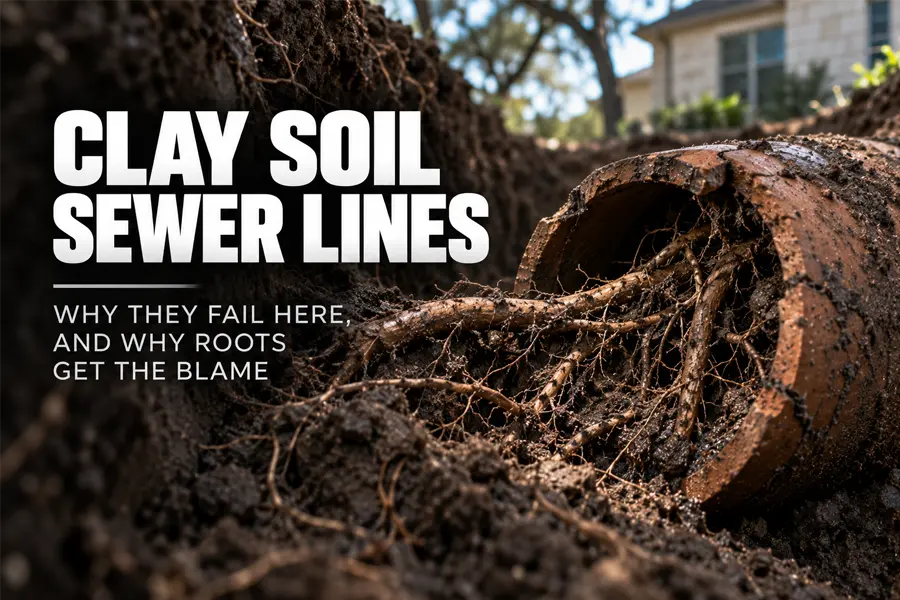
Clay soil sewer lines fail at the joint, not mid-run. The clay under much of San Antonio is a vertisol running 40 to 60 percent clay, and the USDA records it opening cracks 0.5 to 4 inches wide and 12 inches or deeper that stay open 90 to 150 cumulative days in most years. That seasonal movement shears rigid pipe joints. Roots arrive afterward — they cannot crack a sound pipe, only exploit one already open.
- Clay soil sewer lines fail at the joint, not mid-run. The clay under much of San Antonio is a vertisol running 40 to 60 percent clay.
- The USDA records it opening cracks 0.5 to 4 inches wide and 12 inches or deeper that stay open 90 to 150 cumulative days in most years. That seasonal movement shears rigid pipe joints.
- Roots arrive afterward. They cannot crack a sound pipe — they only exploit one that is already open.
Almost every homeowner who calls us about one of San Antonio’s failing clay soil sewer lines has already settled on an explanation, and it is nearly always the tree. The pecan in the back corner, the live oak planted too close to the walk. It is intuitive, it is the story most plumbing companies repeat, and it gets the sequence backwards in a way that costs people money and, occasionally, a healthy tree.
The real answer starts with the ground, because clay soil sewer lines behave in a way that has little to do with landscaping. San Antonio sits on some of the most seasonally active soil in North America, and it does something to buried rigid pipe that careful installation cannot fully prevent. Once you understand what the clay does between August and November, the role of roots becomes clearer and far more useful.
The Ground Clay Soil Sewer Lines Sit In
The dominant soil across mid-county San Antonio is Houston Black, the Texas state soil, an order called vertisols. The name is Latin for turning, because these soils physically invert themselves as they swell and shrink. That is the defining behavior of the material clay soil sewer lines are buried in.
The USDA Natural Resources Conservation Service series description is unusually specific. This soil runs forty to sixty percent clay. When it dries it opens cracks between half an inch and four inches wide, extending twelve inches or more down, and those cracks stay open ninety to a hundred and fifty cumulative days in a typical year. Shrink-swell potential is classified as high. That is the load clay soil sewer lines carry.
| Property | Recorded value | Why it matters to a buried lateral |
|---|---|---|
| Clay content | 40–60% | The whole soil mass moves as one body rather than grain by grain. |
| Crack width when dry | 0.5–4 in | The soil is physically pulling apart around and beneath the pipe. |
| Crack depth | 12 in or more | Movement reaches down toward the pipe zone. |
| Days cracks stay open | 90–150 | An annual cycle, not a drought-year event. |
| Shrink-swell potential | High | Load is applied and released every season. |
Values per the USDA NRCS series description for Houston Black. Crack dimensions describe the soil, not the pipe.
Now picture a cast iron or vitrified clay lateral laid in bell-and-spigot sections inside that. Each joint is a hinge never designed to articulate. When the soil swells it grips and lifts unevenly; when it contracts it withdraws support unevenly. Clay soil sewer lines cannot flex, so movement concentrates where the pipe is weakest, at the joint.
Do that every year for fifty or eighty years and joints open. That is not a defect in your pipe; it is the expected outcome for clay soil sewer lines in an active soil.
Three Soil Zones, Three Different Risks
Generic advice about Texas clay misses that Bexar County is not uniform, and the risk to clay soil sewer lines genuinely differs depending on where your house sits. The county spans three soil regions, and a homeowner on the far north side faces a different failure mode than one closer to downtown.
| Region | Soil | What it means for a sewer lateral |
|---|---|---|
| Far north side, Edwards Plateau | Mollisols formed from limestone and dolomite, and not deep | Rock slows excavation, but seasonal shear matters much less. Failures skew toward installation and age. |
| Mid-county, Blackland Prairie | Vertisols, mainly Houston Black clay | The active shear zone, where rigid joints take a seasonal load and root intrusion follows most reliably. |
| Far south side, South Texas Plains | Sandy soils over clay | The sand moves little, but the clay beneath still cycles, so movement concentrates at the interface. |
Regional soil descriptions per the Texas Master Naturalist Alamo chapter’s Bexar County soils guide. The mid-county belt follows the Balcones Fault, roughly along I-35.
So advice that holds up in one part of town can mislead in another. A plumber working mostly north of the city who calls soil movement overblown is describing a genuinely different substrate. A crew in the older mid-county neighborhoods is describing an equally real one. Neither is lying, which is why a camera inspection on your own line beats any general rule about clay soil sewer lines.
How Clay Soil Sewer Lines Come Apart at the Joint
What clay soil sewer lines do through a drought cycle is a loop rather than a single event, and seeing it as a loop makes the repair decision obvious later. It repeats across the seasons, and each pass makes the next one easier.
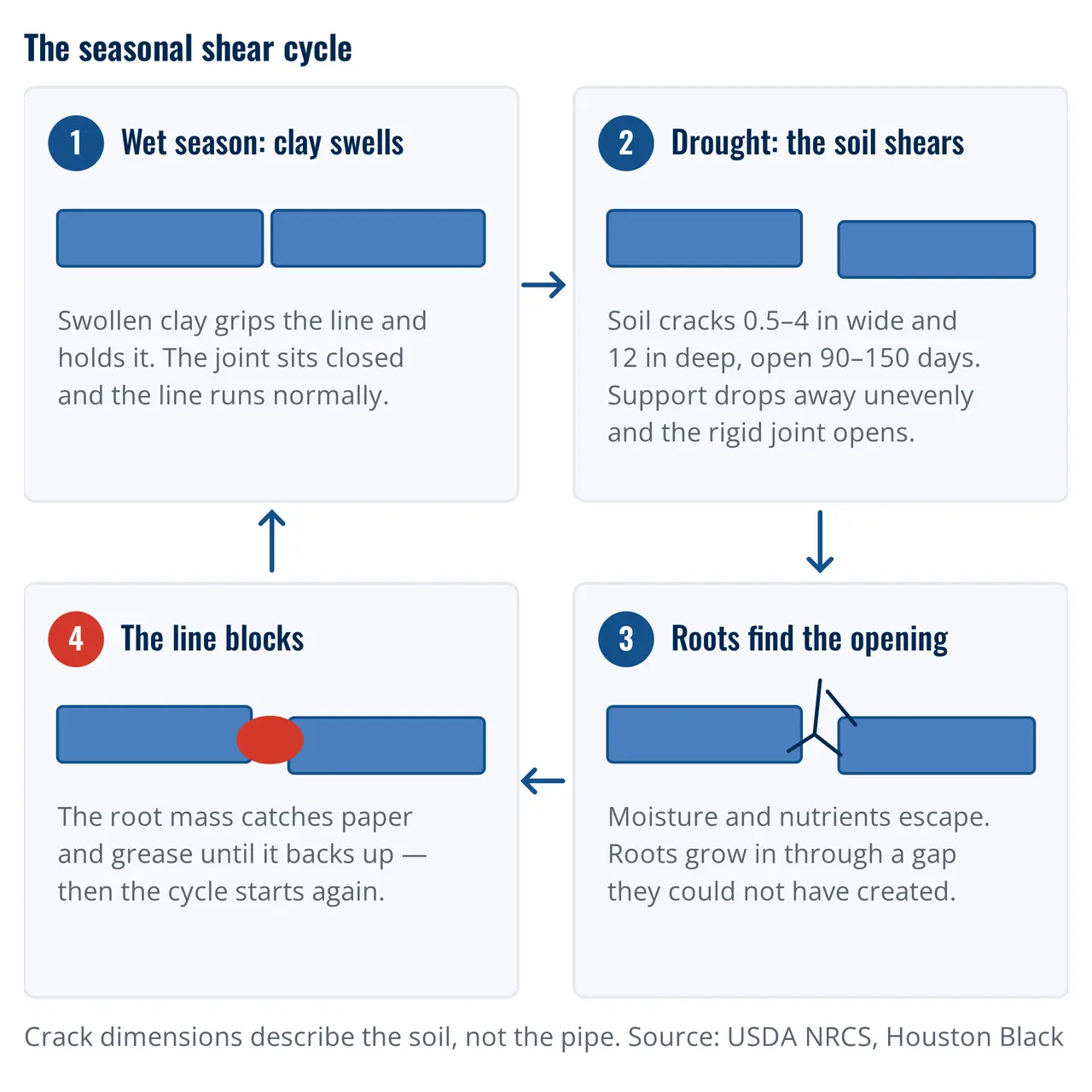
The loop is stubborn because stage four gets treated as the whole problem. The line backs up, somebody clears it, and the homeowner concludes the matter is closed. Nothing about that clearing touched stages one through three, which is why clay soil sewer lines back up on a shortening interval.
Roots Do Not Break Clay Soil Sewer Lines
Here is the part that surprises nearly everyone. NC State Extension puts it this way: tree roots cannot create cracks in your sewer pipe, they can only exploit existing cracks or gaps. The corollary is worth remembering: if you have tree roots in your sewer pipe, you had a leaking sewer pipe before the roots got there.
Roots found in clay soil sewer lines are opportunists, not excavators. A root has no mechanism for breaching sound pipe wall. What it has is an ability to detect moisture and nutrients and grow toward them, and a joint pulled open by soil movement broadcasts both. The root follows a signal the pipe is already leaking, then thickens until that mass catches solids and blocks the line.
The same source kills a popular piece of landscaping advice. Roots can grow two to three times as wide as the tree is tall, so a safe planting distance from clay soil sewer lines is mostly imaginary at residential scale. Moving a tree five feet changes nothing. A mature live oak’s roots are already everywhere in your front yard, and have been for decades without harming an intact pipe.
If roots were the cause, prevention would mean removing trees. Because roots are the symptom, prevention means closing the openings they exploit in clay soil sewer lines — a plumbing problem with plumbing solutions, including jointless methods that leave nothing for a root to enter. You are allowed to keep the tree.
So Do I Have to Lose the Live Oak?
Almost always, no. It comes up on nearly every root-intrusion call, usually from someone already braced for the answer.
Removing the tree does not repair the opened joint. It stays open, the soil keeps cycling, and clay soil sewer lines keep admitting water, silt and eventually roots from something else nearby. Repairing the joint properly ends the intrusion whether the tree stays or goes. Cutting roots out has the same limitation as clearing a blockage: it addresses the occupant, not the door.
One exception is worth naming. When a trunk or structural root sits directly over the line and the repair route passes through it, the tree becomes an obstacle to the work itself. That is an access problem, not a causation problem, usually solved by rerouting or by a trenchless method that never opens a trench along the root plate. We compare those in trenchless versus digging.
The call that repeats most is the homeowner who has had the same line cleared every autumn for four or five years and treats it as a seasonal chore. That timing is the clue, not a coincidence. A line that reliably backs up at the end of a dry stretch is telling you the ground is moving it, and the yearly clearing is the fee you pay to avoid finding out why.
Repair Strategy for Clay Soil Sewer Lines
Understanding the mechanism changes which repair is rational, and this is where the soil science starts saving money.
A spot repair assumes the defect is local, and sometimes it genuinely is: a section crushed by a vehicle load, a bad connection, a joint disturbed by construction. But when a line fails from seasonal shear, the load is applied along the whole run, and the joint that gave way first was the weakest, not the only stressed one.
Replacing two feet of pipe in a lateral whose every joint has worked for sixty years resets the clock rather than solving the problem. The line often presents again within a few seasons, close to where you just paid to fix it.
That is the honest case for full replacement on clay soil sewer lines that are shearing seasonally. If the camera shows a single isolated defect in a sound run, a spot repair is the right and cheaper answer, and we will say so. If it shows separation, offsets or intrusion at several joints, the line is failing as a system, and buying it joint by joint is the costliest route to the same place.
Jointless methods matter for one reason: lining and pipe bursting both produce a continuous pipe with no joints, removing the very feature the soil exploits.
Age matters as context. Monte Vista, the one neighborhood whose timeline is well documented, began development in 1889 and was largely built out by the 1930s. A lateral of that vintage that has never been replaced has absorbed seasonal soil movement for the better part of a century, and cast iron and vitrified clay are the materials in play in older San Antonio.
Those are the oldest clay soil sewer lines in the city, and they have had the most chances to come apart. If your house predates the war and the line has never been camera-inspected, that inspection is the cheapest useful thing you can buy. See what it costs alongside the repair options on our pricing page, and the full symptom-to-cost walkthrough lives in sewer line problems and what to do.
The same soil acts on the public mains. SAWS has operated under a federal consent decree entered in 2013 covering sanitary sewer overflows, and reports a seventy percent reduction in spills from their peak alongside its sewer system investment program. If your backup turns out to originate past your property line, responsibility and reimbursement work differently than most homeowners expect — the boundary and the claim process are covered in who pays for a SAWS sewer backup.
If your line is backing up right now, deal with that first and the strategy afterward. Sewage entering the house is an emergency plumbing call at any hour. Once flow is restored, the camera turns a recurring mystery into a decision, and our sewer line repair team would rather show you the footage than hand you a conclusion.
Frequently Asked Questions
Does San Antonio clay soil really break sewer lines?
It is the dominant driver across mid-county. Houston Black clay runs 40 to 60 percent clay with high shrink-swell potential, and the USDA records cracks half an inch to four inches wide opening 12 inches or deeper and staying open 90 to 150 cumulative days most years. Rigid cast iron and vitrified clay laterals cannot flex with that, so movement concentrates at the joints.
If roots cannot break a pipe, why did the plumber find roots?
Because the opening was already there. Roots detect moisture and nutrients escaping from a joint that soil movement or age pulled apart, then grow in through that gap. Finding roots is useful information: it tells you the line is open to the soil at that point. Cutting them out clears the blockage without closing the opening.
Will cutting down my tree stop the sewer problem?
Generally no, and it is an expensive way to not fix it. Removal leaves the opened joint as it was, so the line keeps leaking and stays open to roots from other vegetation. Repairing the defective section ends the intrusion whether the tree stays or goes. Keep the tree and fix the pipe.
Why does my sewer back up at the same time every year?
Seasonal timing points at soil movement rather than what you put down the drain. As the clay dries and contracts through a long hot stretch, support under the line shifts and joints open further, and root growth tracks the same moisture. A backup that reliably arrives at the end of a dry season argues for a camera inspection instead of another clearing.
Is a spot repair enough, or do I need the whole line replaced?
It depends on whether the camera shows one defect or a pattern. A single isolated break in a sound run is a legitimate spot repair. Separation, offsets or intrusion at several joints means the line is failing as a system, and fixing it a joint at a time costs more over a few years than replacing it once.
Does soil movement affect every part of San Antonio equally?
No, and this is worth knowing before accepting a general rule. Bexar County spans three soil regions: limestone-derived soils on the far north side, the Houston Black clay belt through mid-county along the Balcones Fault, and sandy soils over clay on the far south side. The mid-county belt is where seasonal shear does the most damage.
Want San Antonio plumbing answers from a local licensed plumber at the top of your results? Add Silverback as a preferred source.
Find Out Whether It Is One Joint or the Whole Run
A camera inspection answers the only question that matters with clay soil sewer lines: is this a local defect or a line failing along its whole length. We will show you the footage and tell you which you have, including when a spot repair will do.
Serving San Antonio, Helotes, Boerne, Bulverde, Schertz, Somerset and Stone Oak. Open 24/7 when a line backs up after hours.Sources
- USDA NRCS — Houston Black Official Series Description — the ground clay soil sewer lines sit in: 40 to 60 percent clay, cracks 0.5 to 4 inches wide and 12 inches or more deep, open 90 to 150 cumulative days, high shrink-swell potential.
- Texas Master Naturalist, Alamo Chapter — Bexar County Soils — the three soil zones and the vertisol belt along the Balcones Fault.
- NC State Extension — Tree Roots and Sewers — roots exploit rather than create openings; root spread of two to three times tree height.
- SAWS — EPA Consent Decree Program — the 2013 consent decree and reported reduction in sewer overflows.
- Texas State Board of Plumbing Examiners — license verification for anyone quoting the work.